Kungsleden Trip Notes and Planning Guide
Planning
I learned of the Kungsleden trek when paging through hiking books. The Kungsleden has a chapter in all of these books:
Walking Distance by Robert & Martha Manning ISBN: 978-0870716836; Classic Hikes of the World by Peter Potterfield ISBN: 978-0393057966; The Great Walks of Europe by Richard Sale ISBN: 978-0711228559; Classic Treks by Bill Birkett ISBN: 978-0821226551.
Of course, the trip description and photos in those books make the Kungsleden look fantastic. I was intrigued, and at our company holiday party, I told Anthony and Anneka of my plan to do the trek. They both professed enthusiasm and stated that they wanted to join Melanie and I.
A trip was born.
If you wish to plan a Kungsleden trek of your own, I recommend reading the useful information on Cody Duncan's website. It is worth the $15 to download his .pdf file,
it has a day by day hike description, and details of each mountain hut, plus information about what to bring, how to get there, etc.
This book just came out in 2017. Much of the information overlaps with the Cody Duncan website, but it also has lots of useful information, plus a complete trip report (the authors hiked the entire length of Kungsleden, not just the northern section that we hiked).
The book has an accompanying website full of fantastic photographs that are sure to motivate you to do a Kungsleden hike of your own.
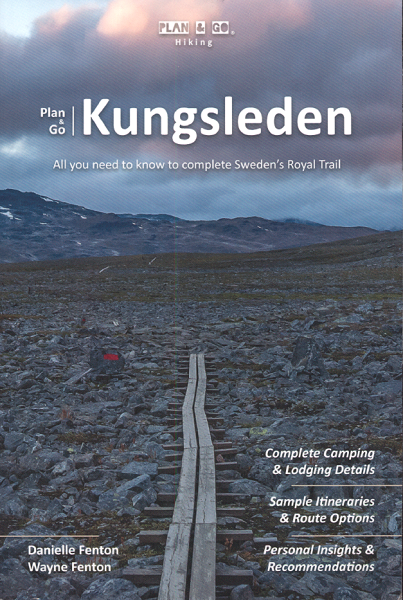
Although the Cody Duncan website and the Trek Snappy books are useful, they left out some details about the huts that I would have liked to have known before we took our Kungsleden trek, so I am adding some supplemental notes of my own.
The most crucial bit of information you should know is the fact that if you prepay STF and get a hut reservation, it does not guarantee you a bunk bed! Beds are given away on first-come basis, if you arrive late to a hut, you may find yourself
without a bed to sleep on, even if you have prepaid! When too many people arrive at a hut, spare mattresses will be put out on the floors. Overflow people sleep on
these mattresses in the kitchens, and if the kitchens are full, then additional hikers sleep in the "drying room", and if even the drying room is full, people have been known to sleep
in the woodshed! The hut warden may come by asking for people to sleep two-in-a-bunk in order to free up more beds. The huts run out of spare mattresses, so you may find yourself
on the hard wooden floor. It is a good idea to carry a "sleep sack" with you, the blankets and pillows that come with the hut have no facility for being washed after each use.
Obviously, getting to a hut early is a good idea if you wish to procur a bed, especially if you are hiking in the prime season. However, occasionally a large group will travel down the
Kungsleden - if you are unfortunate enough to share a hut with one of these large parties, you are pretty much screwed. Guided hikes of large parties have been rumored to send a runner ahead to the next hut to reserve all the beds.
Be aware that every August there is an event called the Fjallraven Classic, in which 2000 hikers travel from Nikkaluokta to Abisko. Do NOT plan your hike to coincide with this huge event.
Abisko Mountain Station: 365 beds, restaurant, food store, showers, electricity
Abiskojaure Mountain Cabin: 40 beds, food store, sauna
Alesjaure Mountain Cabin: 80 beds, food store, sauna
Tjatka Mountain Cabin: 20 beds, no food, no sauna
Salka Mountain Cabin: 50 beds, food store, sauna
Singi Mountain Cabin: We skipped Singi, no food, no sauna.
Kebnekaise Mountain Station: 220 beds, restaurant, food store, showers, electricity
We skipped Singi hut because it has no shop to sell you food, and it has no sauna. Singi is at the lowest elevation on the Abisko to Nikkaloutka route, and therefore it is
the warmest. Warm isn't necessarily good - we talked to hikers who did spend a night at Singi and they said it was miserable because the mosquitos were so ferocious that you couldn't step outside.
There is a marked route that allows you to skip Singi while traveling from Salka to Kebnekaise. This bypass reduces the Salka to Kebnekaise distance from 16 miles to 14.5 miles, saving almost an
hour of time. The bypass requires you to climb about 600 feet, but it is not an arduous climb. Besides, if you stick to the main Kungsleden route and go to Singi before traveling to Kebnekaise, you
will find yourself climbing (not steeply) as you head east. The Singi bypass is clearly marked on the map and it is clearly signposted. The bypass is easy to follow, with cairns. Many people go this
way to Kebnekaise.
The rooms in the huts are of various sizes. Sometimes we slept in a 4 person room. Sometimes we slept in a room with 20 people (Abiskojaure).
The huts all have a Torkrum - a drying room. It is warm place with hooks and clothes-lines where you can hang all your wet gear. It is a good idea to recover your gear as soon as it has dried,
because there is a lot demand for space to hang wet stuff.
There are saunas at Abiskojaure, Alesjaure, Salka, and Kebnekaise. There is no sauna at Tjatka and Singi. The saunas are nude saunas, but sometimes people wear bathing suits.
From 5:00 to 6:30 PM, the saunas are reserved for the women. From 6:30 to 8:00 PM the saunas are exclusively used by the men. From 8:00 to 9:30 PM, the saunas are open to anyone
of any gender.
The saunas have 3 rooms. The front room is the changing room. This is where everyone takes off their clothes and hangs them on hooks. The second room is a washing room. In the
washing room there is a big barrel of hot (boiling!) water and another of cold water. Pour a mix of hot and cold water into your metal basin using the plastic ladle (caution - if
you dump boiling water into the metal basin while you are holding it, you might burn yourself. It is hot!!) You can then soap up and pour the water over yourself to rinse off. There
is a drain in the floor. There is room for 4 people to wash at the same time. I found that this setup was an effective way to get clean, this was much better than what I was expecting
to find along the trail. The third room is the sauna itself. Everyone sits on a row of wooden bleacher benches. The sauna was always very crowded when I tried to go in, so I ended up just
washing up and skipping the hot room. It is traditional to run outside (stark naked) and plunge into the nearby cold mountain stream, and then rush back inside the sauna to heat up
again. Lots of people try this, and say it feels great! I didn't try it.
The kitchens come with pots and pans, utensils, plates, glasses, mugs, etc. There are 4 or 6 gas burners in each hut (we ate early so that we didn't have to compete with other hikers
for access to the burners). You are expected to wash your own dishes, fetch fresh water from the rivers, and dump waste water into special spots.
To my surprise, a couple of the huts had generators, which were used to run the stores. There were refrigerators selling cold beer and cokes. I saw some people using their credit card to
pay for shop items - but don't count on the generators running! We brought lots of cash with us.
If you arrive early at some of the huts, there are side jaunts that you can do. At Tjatka, there is a big mountain just west of the hut. It looked pretty steep, but the hut warden told me
that on the previous day there were "lots" of people who had climbed it. From the top, you can see into Norway. We only climbed up partway because it had snow on the mountainside, and it was
too dangerous to go higher. But even climbing just partway up the mountain gave fantastic views up and down the valley.
At Salka, you can follow a cairn-marked trail 10 km to the Nallo hut, into a valley of peaks and lakes. We only had time to travel about 5 KM - far enough to see the lake, but not close enough
to reach the Nallo hut. The valley is called Stuor Reaiddavaggi, the trail is marked on the map.
At Kebnekaise, you can hike the 9 KM western route to the summit of Kebnekaise, the highest peak in Sweden. Because the western route does not go over snow, you do not need a guide to hike
this path. I believe there is at least 5000' of elevation gain. We had two nights in Kebnekaise, because originally we intended to try climbing the mountain, but instead we opted to take a
18 km (round trip distance) to the Darfaljavri Lake. This hike has some elevation gain, but it takes you to an excellent spot where you can see a big glacier melting into the lake. It wasn't
a difficult hike, our total time was 5.5 hours for the entire excursion.
When planning your trip, book the reservation at Kebnekaise first. It is difficult to get a reserved room here because it is a popular destination for Swedes who like to come in for a couple of
nights and hike to the top of Kebnekaise. Because Kebnekaise and Abisko do have internet connectivity, these Mountain Stations will hold reservations for you (unlike the Mountain huts). The rooms
at Kebnekaise have bathrooms and showers at the end of the hall. The showers are popular - they ran out of hot water, so we waited until after dinner for the hot water tanks to refill before showering.
Kebnekaise only has wifi in the main building. Everyone crowds into the Kebnekaise main building to use the wifi, but the system is hopelessly overloaded, and it is impossible to get bandwidth during the peak hours.
The dinner at Kebnekaise is quite expensive. If you want, you can utilize a kitchen and cook your own meals. We opted for the dinner, which turned out to be tasty. There is a vegetarian option
if you ask for it. The dinner is a bit mysterious. At the beginning of the meal, the staff give a LONG speech in Swedish, presumably about the meal. There is no English translation, so I have no
idea what takes so long to explain. The first course is an appetizer bar - full of meats and breads and soup and fish and potatoes. At first, I thought that was the main meal. Both nights of our
visit, our table was always the last one permitted to visit the appetizer bar, so some of the best stuff was gone.
You have to remove your boots when entering any hut. I saw a guy at Kebnekaise looking for his boots - and when I left 15 minutes later, he was still looking for them. Someone had made off with the
wrong pair of boots! That would be a disaster. I am not sure how to protect yourself from boot theft.
When we landed in Kiruna, we already had reserved a taxi to shuttle us directly to Abisko. We paid SK1825 to shuttle 4 persons directly from Kiruna airport to Abisko Mountain Station.
To make taxi reservations in Kiruna, do a search on "flygtaxi kiruna" or "bokning taxi kiruna".
There is a bus from the Kiruna airport to the Kiruna bus station that runs about every half hour for 110 SK each. From the bus station, you catch the #91 bus to Abisko.
To get from Nikkaluokta to the Kiruna bus station, you will ride the #92 bus. The #92 bus cost us SK139 per person. You don't buy a ticket, but instead give your credit card to the
bus driver. You cannot pay with cash.
This is the only map that you need if you are just hiking the northern section. You can buy it at the Abisko Mountain Station. It names many of the mountains and lakes, which is useful. It also show side trails, which was how we found out about the nice day hike from Kebnekaise up to Darfala.

The organization that controls all the reservations is the Swedish Tourist Federation STF You can book all your rooms through that site. It is worthwhile to get the membership, because it gives you a discount on each hut stay.
The current money conversion rate is: US dollars to Swedish Krona
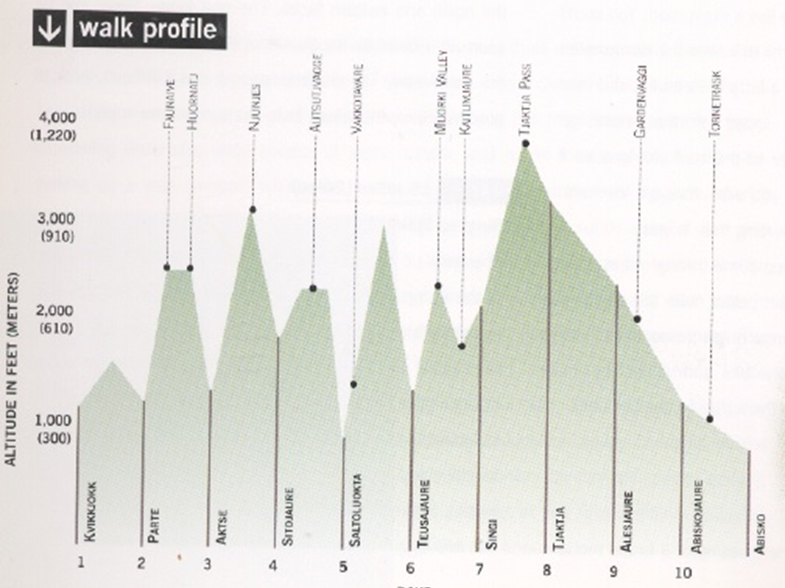
The elevation gain along the Kungsleden is minimal
Itinerary
Sunday August 20
|
Monday August 21
|
Tuesday August 22
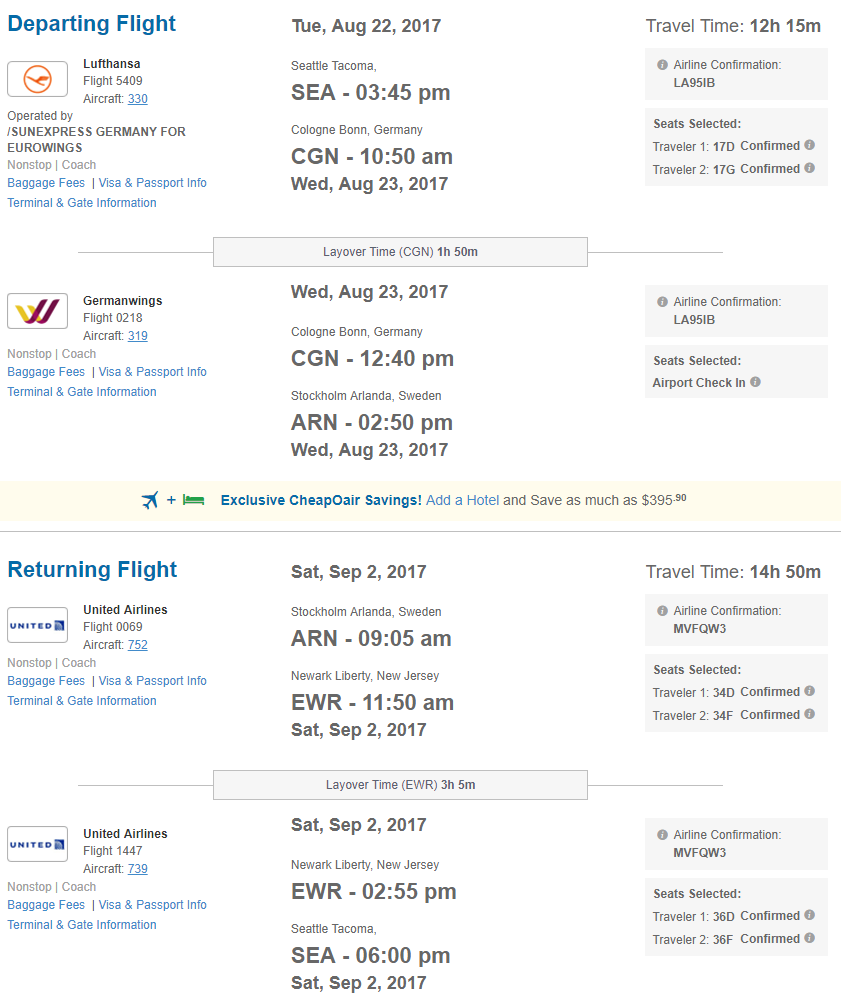
Fly Lufthansa 5409 from Seattle to Cologne (Take off 3:45 PM, land 10:50 AM)
|
Wednesday August 23
Fly Germanwings 0218 from Cologne to Stockholm/Arlanda (Take off 12:40 PM, land 2:50 PM). Total travel time 12 1/4 hours
Stay in Arlanda at Connect Hotel Arlanda
|
Thursday August 24
Fly from Stockholm Arlanda airport to Kiruna, take off 8:25 AM, land at 9:55 AM
Take 4 person shuttle from to Kiruna to Abisko
Abisko: restaurants, showers, wifi, electricity
Stay at STF Abisko Mountain Station
Check for Northern Lights each clear night? Yes!
|
Friday August 25
Hike 9.3 miles to Abiskojaure
Abiskojaure: sauna, shop
Stay at STF Abiskojaure Mountain hut
|
Saturday August 26
Hike 12.4 miles to Alesjaure
Alesjaure: sauna, shop, cafe
Stay at STF Alesjaure Mountain hut
|
Sunday August 27
Hike 8.4 miles to Tjakja
Tjakja: no food, no sauna, no showers
Stay at STF Tjäktja Mountain hut
|
Monday August 28
Hike 7.4 miles to Salka
Afternoon hike up Reaiddajavri Valley
Salka: food, sauna, no showers
Stay at STF Salka Mountain Cabin
|
Tuesday August 29
Hike 5.5 miles to trail junction.
Take the Bypass Singi Trail
Hike 9 miles Kebnekaise
(Total of 14 miles for the day!)
Kebnekaise: electricity, sauna, shop, cafe, wifi, showers
Stay at STF Kebnekaise Mountain Station
|
Wednesday August 30
Day hike 5 miles to Darfaljavri
Hike 5 miles back to Kebnekaise
Second night at Kebnekaise: electricity, sauna, shop, cafe, wifi, showers
Stay at STF Kebnekaise Mountain Station
|
Thursday August 31
Hike 11.8 miles to Nikkaluokta
Afternoon Bus 92 to Kiruna
Stay in Kiruna at Hotel Bishop Arms
|
Friday September 1
Fly Kiruna to Stockholm. Take off 6:05 AM, land at 7:40 AM
Sightseeing in Stockholm
Vasa Ship Museum
Stay in Arlanda at Connect Hotel Arlanda
|
Saturday September 2
Fly United 0069 Stockholm/Arlanda to Newark Take off 9:05 AM, land 11:50 AM
Fly United 1447 Newark to Seattle. Take off 2:55 PM, land 6:00 PM. Total travel time 14h 50min
|
Transportation
I think we did astonishingly well with these flight reservations, just $722 each. Only one stop in each direction - a 1 hr 50 min layover in Colgne on the outbound flight, and a 3 hr layover in Newark on the return. These are good layover times - not so short that we have to worry about lines at customs causing us to miss the connection, but so slow that we spend half a day at one of these airports. Just over 14 hours total travel time to get to Sweden (that's really good), and 18 1/2 hours flying back, against the prevailing winds.
Note that we flew through Arlanda, the International Stockholm airport, that is good distance outside of town. We booked our hotel in Arlanda rather than in Stockholm because the next morning we returned to the airport and flew to Kiruna.
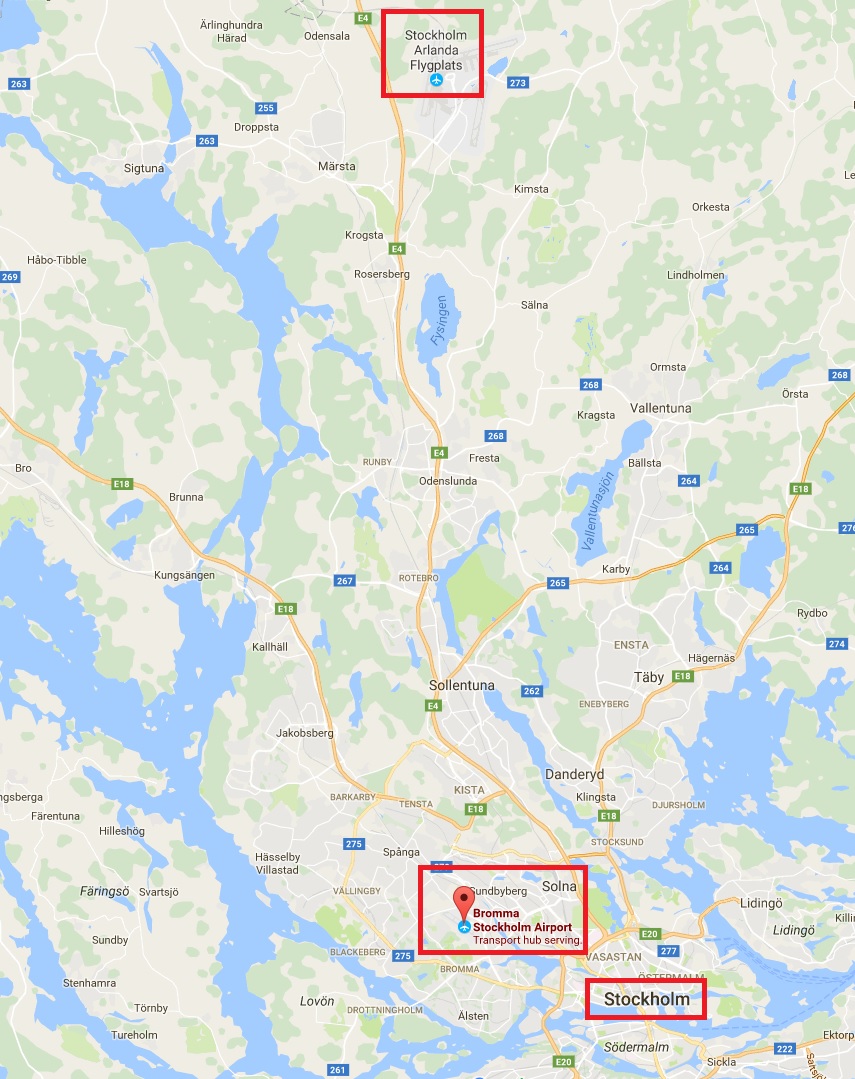
Stockholm-Arlanda Airport is the largest airport in Sweden, serving the Stockholm area. The airport is 42 km north of Stockholm, which can be reached by commuter rail, bus, and high-speed rail, the Arlanda Express
.
Getting from Kiruna to the trailheads is accomplished using buses or hiring a taxi.

Expenses
The following is a list of cost that we paid prior to departure.
| Prepaid Expense | Per Person | Per Couple | Comment |
| Round trip plane tickets Seattle/Stockholm | $707.06 | $1414.12 | Lufthansa, Germanwing & United |
| Round trip Flight to Kiruna | $191.17 | US$382.34 | Norwegian Air shuttle outbound, SAS on return |
| STF Membership Family membership | $38.18 | $76.36 | Gives discounts at STF huts. |
| Total | $936.41 | $1872.82 | |
The huts are all managed by STF, Swedish Tourist Federation
| Expense | Total Krona | Total US$ | $ Per Couple | Comment |
| Connect Hotel Arlanda | | $271.98 | US$135.99 | Aug 23 Connect Hotel ArlandaTwo standard twin rooms. Continental breakfast. Airport shuttle. |
| STF Abisko Mountain station | SEK$3450 | $414.94 | US$207.47 | Aug 24 Confirmation Two twin rooms. Showers, wifi, food, restaurant |
| STF Abiskojaure Mountain hut | SEK$1480 | $178 | US$89 | Aug 25 Confirmation One four person room.Sauna and shop |
| STF Alesjaure Mountain hut | SEK$1480 | $178 | US$89 | Aug 26 Confirmation One four person room.Sauna and shop and cafe |
| STF Tjäktja Mountain hut | SEK$1480 | $178 | US$89 | Aug 27 Confirmation One four person room. No sauna, no food |
| STF Salka Mountain hut | SEK$1480 | $178 | US$89 | Aug 28 Confirmation One four person room. Sauna, food store |
| 2 nights at STF Kebnekaise Mountain Station | SEK$14904 | $1792.54 | US$896.27 | Aug 29 & Aug 30 Confirmation Sauna, showers, restaurant, electricity. Price includes all meals |
| 1 night at hotel in Kiruna | | $334.60 | $167.30 | Aug 31 Hotel Bishop ArmsTwo double rooms. Breakfast buffet. |
| Connect Hotel Arlanda | | $195.82 | US$97.91 | Sept 1 Connect Hotel ArlandaTwo standard twin rooms. Continental breakfast. Airport shuttle. |
| Total | | $3721.81 | US$1860.94 | |
These are my guesses about additional expenese while in Sweden. Most of these we should expect to pay cash. I am showing prices per person
| Per person Expected Cash Expenses | Swedish Krona | USD | Comment |
| Round trip on Arlanda Express, airport to downtown | SEK$540 | US$65 | Roundtrip on day we arrive |
| Vasa Ship Museum | SEK$130 | US$15.64 | 1 adult Admission |
| #91 Bus Kiruna to Abisko | SEK$170 | US$21 | I believe there is also a train btwn Kiruna and Abisko |
<| #92 bus Nikkaluokta to Kiruna | SEK$160 | US$19 | I believe there is a morning and afternoon bus |
| Food - 9 days of Meals | SEK$2500 | US$300?? | Breakfast, lunch, dinner |
Food in the huts is obviously expensive. The selection of items for sale is mostly the same between all the huts. The prices were the same in all of the huts. I wrote down some of the items avail at Salka, prices were recorded in August 2017:
Granola bar: SK30
Potato chips: SK30
Can of Guld Beer: SK40
Can of Coke: SK25
Can of Fanta Orange: SK25
Bag of chocolate covered nuts: SK35
Marabua Chocolate bar: SK35
Bag of peanuts: SK25
HelaggsPulver: SK90 (I think this is powdered eggs)
Helmjolkspulver: SK120 (Powdered Milk)
package of slice salami: SK30
Wasa bread: SK15
Saltine Crackers: SK30
Package of Cookies: SK30
0.5kg of pasta: SK40
Package of olives: SK25
Can of Fruit Cocktail: SK55
Tin of sardines: SK20
Can of chili con carne: SK60
Can of Kottbullar (Meatballs): SK65
Can of Goulash: SK65
Can of lobster: SK30
Package Pasta sauce: SK30
Jar of Pizza sauce: SK35
Box of Svarta Vinbar (black wine): SK20
Box instant cheese & broccoli soup: SK30
Box of raisins: SK20
Weather
We planned our trip as late in the year as we could, we would rather risk cold than fight mosquitos. The Kungsleden huts close in late September, so we actually could have pushed our trip back a week or two. I checked the weather for the
week after our hike, and they had some nice days in early September.
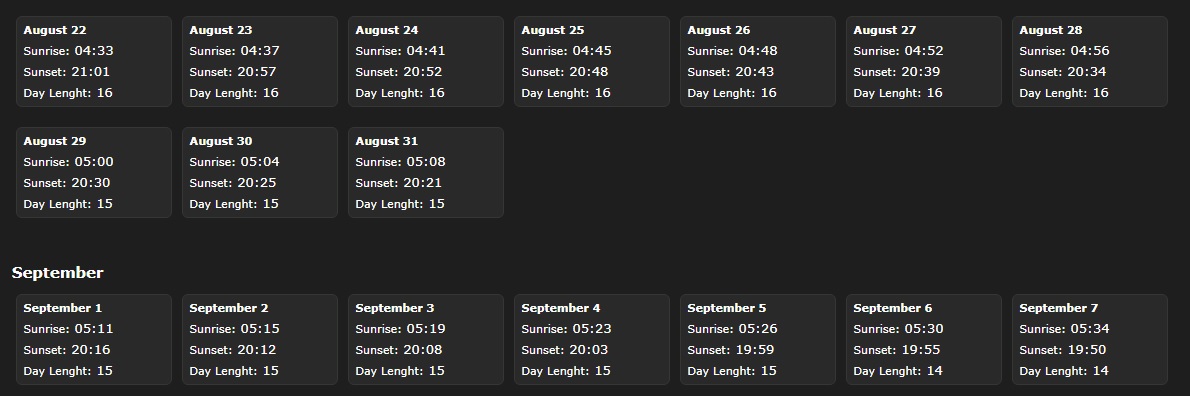
I found a sunrise/sunset timetable for Abisko. Looks like the sun will rise before 5 AM and set after 8 PM.
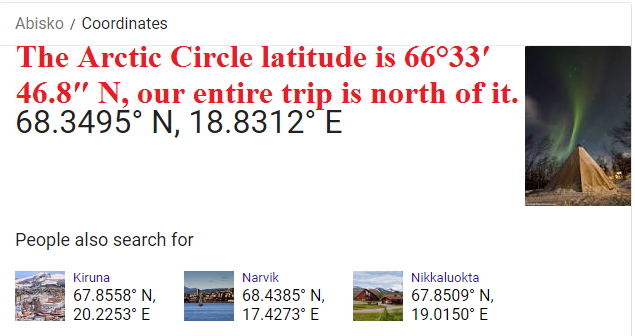
Our entire trip was inside the Arctic Circle!
Check the latest weather report for Abisko here: Weather Underground 10 Day forecast
The Mosquito Report
I decided to research the mosquito peril on the Kungsleden. The conclusion seemed to be that if you travel in the high season (July and early August), you get the best weather but the most ferocious mosquitos. Nevertheless, the high season seems to be the most popular time to travel.
We scheduled our trip at the end of August and 1st week of September, hoping to avoid the worst of the bugs and the worst of the weather. It seems that a few days of bad weather is a universal experience for anyone who hikes the Kungsleden, but the scenery is beautiful. Almost every blog describes at least a day or two of bad weather. No one seems to have regretted making the trip.
If you read only one of these links, read the second table entry, Hiking the Kungsleden South to North. It gives an astonishing detailed description of the hike in August. Beautiful photos. They take the side trip to Skierfe. It has me fired up to go! The link takes you to Day 12 of their report, when they are already halfway thru their trek.
I am surprised at how many people camp out, and how many people carry their food rather than paying the "high prices" at the cabins. To me, saving the weight is well worth paying for indoor lodging and their expensive food.
The last blog talks about something called Fjällräven Classic 2017, in which a couple thousand people all hike the Kungsleden in mid August. That sounds crazy to me.
| When | Mosquitos | Weather | Trip Report | Comment |
| Autumn 2014 | Mosquitos not mentioned | Rains about 1/2 the days | Hiking Kungsleden in Autumn | A detailed day by day blog, with some excellent photographs |
| Mid July 2015 | Millions of mosquitos | Heavy wind and rain | Kungsleden (The King’s Trail) Northern Section | Some nice photos. |
| September 2015 | Mosquitos not mentioned | "Be prepared for rain" | THE BIG TRIP: HIKING KUNGSLEDEN | They hiked the entire length of Kungsleden, camping out. |
| Late July | Many mosquitos | Lots of Rain, strong winds | Trekking the Planet | "... an awe-inspiring experience and one we will not soon forget." |
| Best time: after Aug 20 | Few in late season | Prepare for anything! | Kungsleden: Useful Information | Advice from a guy who has hiked Kungsleden multiple times. |
| Summer 2009 | Mentioned only once | Lots of rain. Mentioned 18x | Trekking the Kungsleden | Beautiful photos. In comments section, he says there a mosquitos south of Aktse (our first two days) |
| Not specific | "bring some mosquito-repellent spray" | Not mentioned?! | Swedish Nature – Hiking the Kungsleden | "I decided to go there and see for myself… And it was AMAZING!" |
| Fall 2005 | Lots of mosquitos | Lots of rain (he is camping) | Kungsleden - A Hiking Travelogue | |
| July 2012 | Not mentioned | Not mentioned | The Kungsleden in Sweden | This is just a brief report, not a full trip blog |
| September | Not mentioned | Sun, rain, snow and wind | Enchanted by the Kings Trail | Some beautiful photographs |
| August 2013? | Not mentioned | Driving rain is mentioned | Kungsleden – The KING of Trails | Information on how to hike Kungsleden |
| Mid August | Mosquitos not mentioned | "I loved it. Well, 90 per cent of it. The slippery rocks and rain were challenging, but then moments of stunning scenery and pancakes with jam lift your spirits" | Trekking the Kungsleden trail in remote Swedish Lapland | Mentions something called the Fjällräven Classic 2017, with thousands(?) of hikers on Kungsleden from Aug 11 to Aug 18 |