
I was doubtful about visiting Salem - I didn't want to see a bunch of tourist traps full of witch stories. I was pleasantly surprised at how interesting the city of Salem is, and I was glad we went.
Salem was a major seaport before and after the Revolutionary War. It was a more important harbor than Boston. After the Revolutionary war, when government income was based upon import duties (excise taxes), Salem at one point was contributed to 1/9th of federal budget, because it's trade was so lucrative (remember, they didn't have income tax back then, so the majority of federal income was derived from tariffs). One the major reasons why New Englanders were so angry with the British before the Revolutionary War was a restriction on colonial trade ships - only ships based in England were allowed to sail beyond the Atlantic ocean - this reserved all the lucrative trade with the Orient for the English merchants. After the Revolutionary War, ships from the US, especially from Salem, were soon sailing all around the globe. However, during the war of 1812, a trade embargo with England crippled the Salem merchants. After the war ended, Boston was the new hub of shipping because it had a deeper water port, and Salem began to recede in importance.
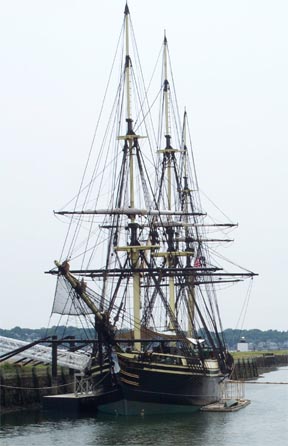
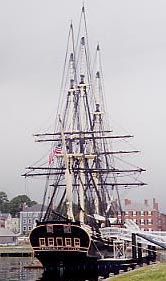
Below are some photos of the Friendship, a ship in the Salem harbor that shows the typical merchant ship. Unfortunately, it was being renovated, and we were unable to go on board. I don't think this is an original ship, rather, it is a copy of a ship from the 18th century.

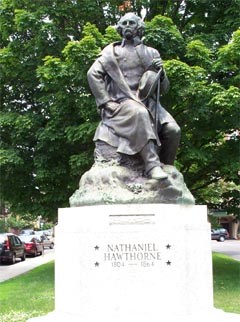
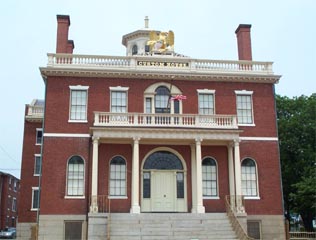
Nathanial Hawthorne (author of The Scarlet Letter) worked in the customs house in Salem. He wrote the House of Seven Gables while in Salem. They have a statue erected to him. The custom house is still standing. It looks out over the docks /wharves. The officials could sit in the building and watch the arrival of each ship. In the 18th century, there were many docks extending out into the harbor, but all of them are rotted away now. Only a couple of stone piers still stick out into the harbor.
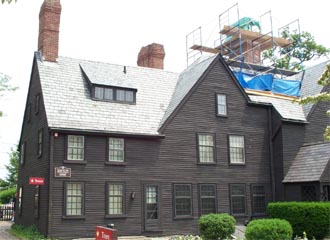
There really is a House of Seven Gables. I didn't read the book, nor did we take the tour, so I don't know the significance of the seven gables. You can see from the photos that the House is under going renovation. The red building is the home where Hawthorne lived - it is next door to the House of Seven Gables.


After lunch we did tour some of the Salem witch-related attractions. At one establishment, there were live actors that portrayed the accusation of one of the prominent women of Salem by her serving girl. The lines in the re-enactment are taking from the court transcript. It sounds rather absurd to the modern ear (if you can not recite the Lord's Prayer without error then you must be devil spawn!) but I guess the testimony of the servant girl was convincing to 17th century hysterical jurors, because the old woman was imprisoned and scheduled to be executed. The witch hunt spread beyond Salem to other nearby towns, many unscrupulous people accused rivals, or neighbors whose land they coveted. People were thrown into horrific prisons (you could escape imprisonment by admitting guilt and then accusing someone else, but if you claimed innocence and refused to point the finger of blame at another innocent, then you were unrepentant and must be imprisoned.) There is an basement tour you can take (see the wonders of animatronics!) that describes some of the hysteria and gruesome punishments.

One of the most intriguing ideas I learned from the Salem visit was the possibility that ergot may have caused the hallucinations and hysteria. Ergot is a fungus that grows on rye, and its spores can carry dust that cause people to act bizarrely. The first women to make accusations worked in a kitchen on the western edge of Salem, near wet swampy ground which is ideal for the fungus. (Rye was a staple in Salem). Perhaps this was the cause for the actions of the accusers? Check out this link, I guess PBS has done an investigation of that idea. http://www.pbs.org/wnet/secrets/case_salem/clues.html


