
We spent this day checking out the portion of the British route between Lexington and Concord that has preserved in the Historic Park. There is a five mile stretch of the Battle Road that once was a road with automobile traffic, but now is a walking trail. We walked up and back, from the Visitor Center to the Meriam House. The Meriam House, shown below, is the point at which the retreat British came under fire when they marched out of Concord. At first the rebel fire was ineffectual - the shots were fired from too far away, and there were not enough guns in action. But as the day wore on, more and more militias joined the fight, until there were over 4000 colonials firing on a dwindling column of 800 redcoats.

The next photo shows the home of Captain Smith. The Hartwell Tavern, which we had toured the day before, was also located along the Battle Road. Although these photos show a heavily wooded countryside, we were informed that during colonial times there were almost no trees left standing. All the land had been converted to farming, the trees cut down and used for construction and firewood. The rebels had to hide behind rock walls and hills (and what few trees still stood) to launch their ambush attacks. The British employed "outriders" - men who marched on either side of the column and attacked any militia men who attempted to fire on the main column. The rebels would fire and retreat. Often they fired too soon, and did no damage. If they waited too long to retreat, they risked bayoneting from the outriders. It seems to me that they should have concentrated their fire upon these outriders, but perhaps the inaccuracy of the guns made firing upon the main column a better choice.

The next picture shows the plaque that commemorates the point where Paul Revere was captured on his midnight ride. I did not know that he didn't make it all the way to Concord. The story is that there were two riders - Revere and William Dawes - who started out from Boston on different routes. As they sounded the alarm along the route, they joined up and rode together. They met a young man who had been out courting - his name was Dr Sam Prescott. Prescott volunteered to ride with them, and the three of them alerted Lexington. As they rode to Concord, they were halted by a British patrol. But Prescott wheeled his horse and galloped away, and Dawes rode in the other direction. The British grabbed the reins of Revere's horse, and he was captured. But after several hours, the patrol realized that all attempts at secrecy were blown (they could hear the colonials sounding the alarm throughout the countryside, ringing bells and lighting torches.) So the patrol let Revere go, but they kept his horse, and he ended up walking back to Lexington. Prescott, however, rode on ahead to Concord, and successfully sounded the alarm there.
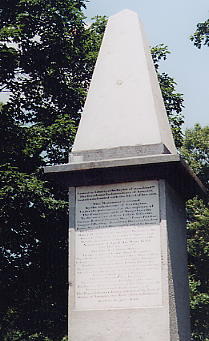
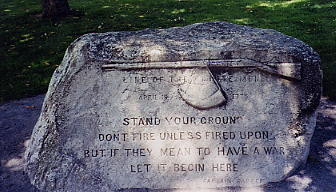
After we walked up and back on the Battle Road, we drove into Lexington. There is a statue to the minuteman in the village green. There is also a plaque with the words of Captain Parker to his militia as they stood on the green of Lexington, opposing the marching British column (this occurred while the British were marching too Concord). The words of Parker: "Stand your ground. Don't fire unless fired upon, but if they mean to have a war, let it begin here." Parker's men were ordered to dispersed by the British, but refused. No one knows who fired first, but shots rang out and two colonials were killed. The British charged in wild, undisciplined manner (horrifying their commander) and the rebels ran. The British regrouped, and resumed their march to Concord.


We got ice cream in Lexington, and then return to the campsite. That evening, Melanie and I met Mark, a friend of mine from when I used to work with him in San Diego. We had dinner together, and then we walked around his neighborhood, saw all the big houses that were being built down the street. $600K in Boston buys a heck of a lot more house & land than it does in Sonoma County!


