Black Sand Basin
Black Sand Basin is just across the street from the main Upper Geyser Basin. You can walk to it if you continue along the path that leads to Daisy Geyser and Punch Bowl Spring. We drove there, it is to reach from a pulloff of the main park road.
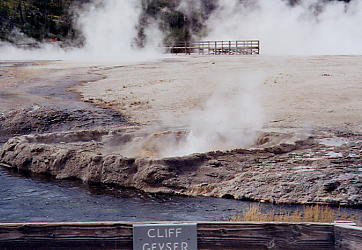
There are few geothermal features at Black Sand. The first you will see is Cliff Geyser, which is perched right on the bank of Iron Spring Creek. Cliff was only steaming when we saw, I presume it erupts sporadically. The wooden platform you see in the photo behind Cliff is the walkway that takes visitors out over Sunset Lake, which is the largest attraction here.
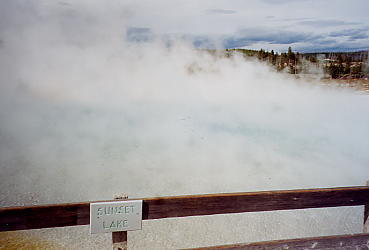
Sunset Lake was beautifully colored, but I could not capture this on film. There was large amount of steam rising off the lake. The wind would blow through, and momentarily disperse the steam, but immediately more would rise up off of the surface of the lake.
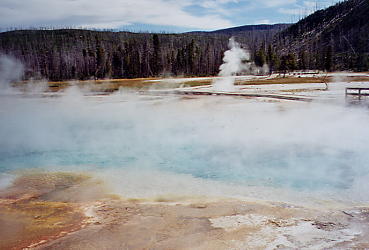
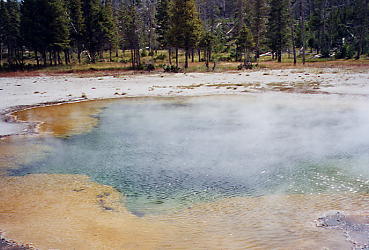
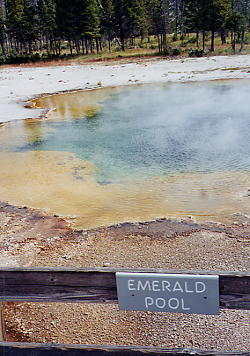
Emerald Lake is also at Black Sand Basin. I think on a sunnier day, the color of the lake would appear greener. But this was how it looked to us.
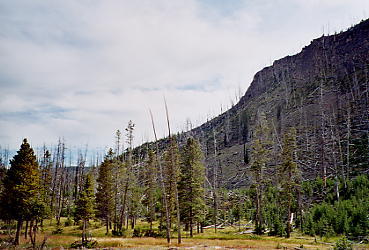
I like this last picture because it shows two things. The first thing you can see is the burnt dead trees that are all still standing. This is from the devastating wildfire of 1988. Although it is nearly 20 years later, the dead trees are still there, you can see trees like this all over the park. They look white because all the bark was burned off. There are small saplings growing up densely around these standing dead trees, in another few decades, the burnt trees will be obscured from view. I am surprised they kept standing this long.
The other feature visible in this last picture is the steep wall of rock that is behind the trees. This is part of the rim of the gigantic volcano that erupted 600,000 years ago. Yellowstone is the remains of a huge explosion, which left a crater (or caldera) about 30 miles across. The reason the park is so active geothermally is that it sits on a hot spot of the earth's mantel, there is hot magma relatively close to the surface. There are pictures in the exhibits of the size of the eruption - it threw ash and debris over an area that stretched from the state of Washington down to Texas. Obviously, if such an eruption occurred again it would devastate the United States. Lake Yellowstone is the center of the caldera.