Wednesday, October 27 After the Matterhorn Some people decided to join Joe to climb up a path to where there were
said to be some old barns that could be photographed with the Matterhorn in
the background. Since I don't care much for old barns, I decided to
photograph around Zermatt. I went to the beautiful church, and while photographing its exterior,
saw the grumpy nun who threw Marilyn out yesterday. She was cleaning again
and came out to shake her mop. I waited a while, then went around, and
entered by the front door, just in time to see the grumpy nun leave by another
side door. I set up my camera and tripod as fast as I could, and began
photographing to get as much as possible before she would return to
throw me out too. Later, I inquired on-line and received the following information about
the church: ZERMATT CHURCH She has been sketched by the architect Adolph Gaudy. She was built in
1913 under Minister Johann Bittel. Altars: 1 The baroque high altar was constructed approx. 1750 by an
altar farmer from the Goms. Are shown: of hl. Maurizius, the bishops Niklaus
(on the right) and Theodul (on the left), hl. Josef and hl. Ignatius.
The founder's coat of arms reminds of the bishop Johann-Josef Blatter (1684-1752). 2 The heart Jesus' altar on the right side was built in 1736
by Johann Ritz from Selkingen. With the renovation of 1980 he was
complemented with a copy of Christ Statue from the church Glis. Are
shown: the evangelists Matthew (on the right) and Johannes (on the left),
Antonius von Padua (on the right), Jakobus (on the left) and hl. Family on the
run to Egypt. 3 The mother's of God altar on the left side of the church was
initiated in 1736; he comes from an unknown Walliser master. Are shown:
hl. Mrs. Agatha (on the right) and Apollonia (on the left); in the upper
floor Katharina (on the right) and Barbara (on the left). 4 The representation of the baptism of man with the apostle's
princes earns special mention. Equipment: The Zelebrationsaltar and the lights created Theo Imboden from Täsch in
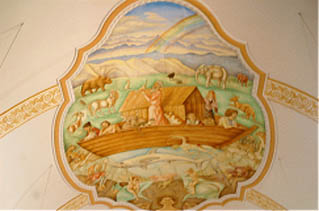
1980. Painting: With the renovation of 1980 the cover painting was created by the young
Florentine painter Paolo Parente. It moves the Noah's ark into our
time. In the choir four evangelists are illustrated in the liturgical colors.
The Verkündigunsszene and biblical figures decorate the choral curve. Organ: She is from Hans J. Füglister in 1981 been built. She is mechanically
and counts 25 registers, distributes to two manuals and the pedal. The denomination: Roman-Catholic Church Someone in the Zermatt Chamber of Commerce (or its Swiss equivalent)
did her best to translate from the German information. Most of the information
can be figured out, except that the answer to my first question is missing:
What is the name of the church? In search of the name of the church, I inspected the cornerstone and
guessed that the writing said "Saint Maurice". After walking a couple
hundred feet away, I suddenly realized that I had left my tripod set up in the
church! Hurrying back, I was relieved to find it still set up exactly
where I had left it! Only a few other nuns were still praying in the church. Not far away were the very old huts, mazots, originally used as
storehouses for grain. They are kept in their original condition to add atmosphere
to the town. They are unique because they are built on a base called
"mushroom piles." The "mushroom piles" are wood with a stone slab upon which the
small barn is supported, and are designed to keep mice out of the barn.
In summer, window boxes filled with flowers decorate these storehouses.
The flowers were gone now, as it was almost winter. Back at the chalet, I photographed the Matterhorn again with a chalet
in the foreground. Its window boxes of flowers were gone, however. Lunch was scheduled for noon, and people arrived back in small groups,
comparing what they had seen and photographed. Our bags were once again loaded into electric taxis, and again I was
fortunate to get a ride down as part of the baggage, and glad to do so.
I was sorry to leave. It was such a nice sunny, bright day! The train ride to Tasch was short, and our luggage was loaded onto our
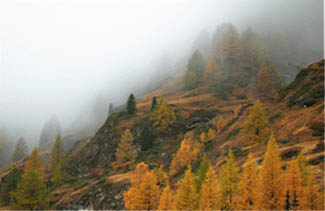
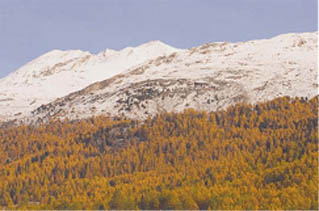
bus, where ever-patient Walter was waiting for us. We drove south to the town of Visp where we turned east. The larches
had turned to gold by now and there were golden mountainsides along our
way. I tried again to catch the beauty of the scenery through the bus window,
but found it better to try to photograph through the front window. The
scenery flies past quickly at 82 kilometers/hour. Along the way we saw Army bunkers which hid warplanes during World War
II. Now they look like ordinary hills. We also passed the Rhonda Landslide, which happened twice, during the
50's and the 70's. It blocked the valley entirely, and is still very evident. Our original plans called for a photo shoot at the Castle of Chillon on
Lake Geneva, but the clouds had moved in, and the light was so poor, our
pictures could not have come out. We continued along the shore of Lake Geneva to Geneva itself. After
checking in again at the Holiday Inn Airport Express, we walked over to
the restaurant connected to the Casino. Once again we had a good dinner,
but it seemed that we had just finished our get-acquainted dinner a short time
ago. We all sang "For He's A Jolly Good Fellow" as we presented José with
the money we had collected for him. He really did an excellent job for us,
and saved many a crisis with his ability to communicate with everyone in
different languages. We were all leaving for homes the next day on different flights. I
found it surprising that no one else was flying Continental to Newark with us.