
The first day we went to see the Mayflower 2. The ship is a replica of the actual Mayflower. It is as close a duplicate as they could build. They sailed it over from England, and now it is docked. It seems pretty small. How did they cram 120 passengers and their livestock, plus the crew, along with all their provisions and tools, and survive for the 60 day crossing? A little ship like that would be lost on the open Atlantic Ocean. I would never have been brave enough to risk the North Atlantic in such a tiny vessel. The doors visible at the waterline on the stern shot of the Mayflower are gun ports. Even a merchant ship like the Mayflower had to be ready to battle pirates. They didn't seem watertight to me, I assume a lot of water washed in and had to be pumped out.


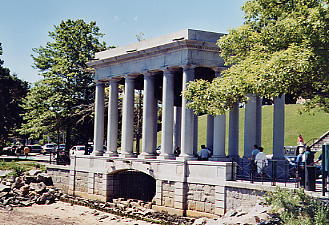
Plymouth Rock is inside a masoleum structure. There is a written description about how it has been moved around, how it broke in half, and now how it is protected in this special structure. The significance of the rock is that it was the first piece of North America that the first married woman disembarking the Mayflower put her foot upon. The rock isn't that big, nor impressive in appearance, and it probably isn't the right rock any way. It wasn't until long after the event that anyone went back to the landing site and designated that "this was the place!"
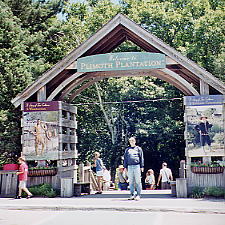
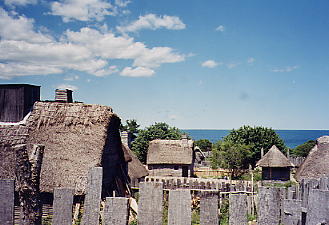
We drove to Plimouth Plantation. It is a reconstructed village, about 1/3 the size of the original village. It demonstrates how the early pilgrims lived - which was in crude houses with dirt floors and thatched roofs. Basically, they were one room houses with a fireplace, a bed(s) and a table. They must have been filled with smoke all the time. The furniture was surprisingly nice - did they really bring such hand carved pieces of furniture with them? How did all this stuff fit on the Mayflower? Maybe they should have brought more blankets, because in the first winter half the population died. I believe they expected to land in Virgina, which does have a milder climate.

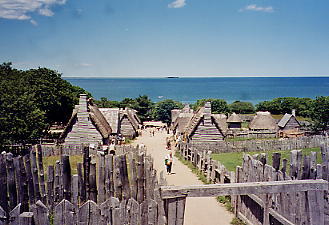
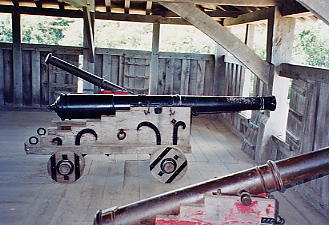
There was a stockade around the village, but it didn't look like much of a deterrent. Anyone could have climbed the wall in a jiffy. There was a two story church/fortress structure at the top of the hill, which is where all the villagers would gather in times of trouble. There were cannon on the top floor, which must have been offloaded from the infinite cargo holds of the Mayflower. It didn't seem to me that the defenses were solid, if the Native Americans had been determined, the settlers would have been slaughtered. Of course, the locals were busy dying from exotic new diseases like smallpox, so they weren't able to muster much resistance.
One of the interesting aspects of Plymouth Plantation is the actors hired to dress upon like the pilgrims. They go about the village, performing chores in the manner that the early settlers presumably did. You are encourage to talk to these actors about 17th century life. They hold interesting opinions on bathing (bad), singing (bad), dancing (bad), seafood (bad), and women's rights (huh?). Red meat was prized, but mostly unavailable. The ocean was overflowing with 45 lb lobsters and endless fish, but lobster was as appealing as eating insects, and the best use of fish was to fertilize the fields (for the first couple weeks after planting season, with fish buried beneath the corn seed, the settlers had to stand guard in the field to prevent wolves from digging up the fish.) It seemed like miserable conditions, and the puritantical views of the settlers did nothing to enliven their existence in their harsh environment. The colony was funded by investors who hoped that the colonists would develop a profitable export economy - the famous Mayflower Compact was a document describing how the profits would be divided, and what schedule payments would be made. Of course, the document was drawn up on the Mayflower before land fall, before they started dying left and right in the cold winter. The investors never recouped their initial investment.
Near the village they were constructing another house, using 17th century techniques (no nails). Someone had a sense of humor with the sign

There were some structures nearby to show how the Native Americans lived. The bark structure was quite large - it had three fire pits in the center. We crawled in there to listen to a young girl describe the Native American lifestyle (skunk was a delicacy, if you grab a skunk by its hind legs and lift them off of the ground, apparently it is unable to spray). You can see an actor in traditional dress walking by the grass hut - oh wait, that is Melanie!


We went over to the Miles Standish State Forest, but must have gone to the wrong part of the park, because we didn't find any hiking trails - just a mountain bike path. We did get a photo in front of the park sign, which is a family tradition, especially for National Parks. We headed back to the campground in Middleboro where everyone was staying. The cabin we stayed in is shown below. No running water, bring your own bedding, but it did have an electric light! And we didn't have to worry about rain or mosquitos.


