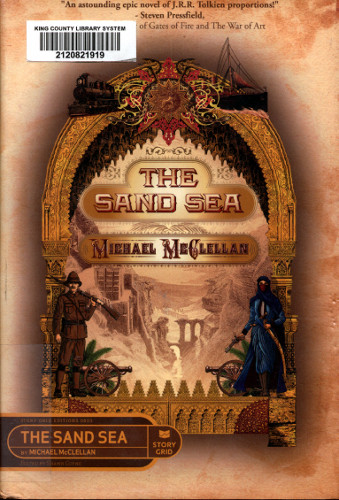
was excited to read The Sand Sea, despite its intimidating length (733 pages in the hefty hardback edition - it is truly a doorstopper).
The reviews compared it to the works of Tolkien and George R.R. Martin, with a dash of Raiders of the Lost Ark thrown in. That sounded great to me! How did I miss the fact
that, despite its enormous length, that The Sand Sea is not a complete tale? Maybe that's what the comparision to A Game of Thrones meant - the story doesn't end, and
even though The Sand Sea has a copyright date of 2019, there is no sign of a subsequent volume, even though I am writing this review seven years after the publication of volume 1.
Not that I would read the next book, this
first novel in the series was a huge disappointment.
If McClellan does anything right in The Sand Sea, it is world building. In the vein of Guy Gavriel Kay, McClellan imagines an alternate universe
that is similar to our own, but with some key differences, plus a touch magic. In McClellan's world, it is roughly the nineteenth century, at the dawn of the Industrial Revolution. Railroads and
steamboats exist. The Anglians (the British) live on islands just off the coast of the Old World and are the major colonial power in the world. The New Anglians (Americans) have just completed a transcontinental railroad across
their western continent. The Gressians (Russians) are a despotic empire ruled by a corrupt king (tsar).
There are four protagonists in this sprawling novel: Peter Harmon, an Anglian bookish university student; Hannah, a New Anglian beautiful blond tomboy who rides her
horse, is a crack shot with a rifle, and somehow is still unmarried even though she is already in her early twenties; Jack Campbell, also a New Anglian - the son of a wealthy railroad baron, he is a drunk and a womanizer, Jack
is devoid of redeeming characteristics; and Selena Savanar - a young orphan growing up on the streets of the city, trying to eke out a living by selling baskets. Selena has no idea that she is
actually a princess and a key figure in an 800 year old prophecy. A major problem is that none of these characters actual DO much of anything in the novel - at least, not until page 700 or so when Peter
and Selena finally display some agency of their own. There are dozens of other characters in the novel, and I got confused by them all. Another warrior tribesman would make an appearance, and
I would wonder - have I read about this fellow before? I don't remember him?
There are many, many characters in this book, not just the four primary protagonists of Jack, Hannah, Peter and Selena. I could not keep straight all the different
actors. Chapters will describe the deeds of one group of characters, and then the story jumps to the actions of a different group, and then another shift to still other set of persons. There is a long,
climatic battle near the end of the book, where the fate of many characters is spelled out - each chapter detailed a fighter's engagement, I kept wondering - "Do I know this guy? Or is this
someone introduced here, only to fall tragically - but heroically - in battle?"
Unfortunately, the villains are all cartoonishly evil. The diabolical Grand Vizier, Jemojeen, goes out of his way to be cruel, greedy, wicked. The evil Gesserian count
tortures his own troops. There is no nuance, the bad guys are devoid of any good qualities.
I have major problems with the plot. Some of those plot faults are detailed in the spoiler section below. I think McClellan would have been better served to have
an editor explain to him that his novel needed some major trimming and plot revisions. There is simply too much unnecessary characters and story arcs. This apparently McClellan's first novel, and it shows. I do not recommend this book.
*** Warning - Spoilers below ***
Peter Harmon does not join the Stanwich expedition willingly, he wants to serve overseas in a governor's office. But his father and Stanwich insist that Peter must go
along into the Sand Sea. But why? There are knowing glances exchanged between Stanwich and Hersen Expey, as if there is some conspiracy is afoot. But was never explained why it was so important
to the expedition that Peter Harmon be brought along? He is a bookish student with no experience in the desert or anywhere else.
Nor could I understand why the Stanwich expedition included two New Anglians (Americans) who would presumably be rivals for the secret beserite material. The Anglians are determined
that the Gressians (Russians) not get any share of the beserite, but clearly the New Anglians are a much bigger threat. Halfway through the novel, Peter suddenly starts referring to Jack Campbell as his cousin.
Hannah, the blonde tomboy, should have been edited out of The Sand Sea entirely. She does nothing in this novel. Her mother wants to marry Hannah off to a suitably wealthy cad, but Hannah
opts instead to go off on this mysterious, dangerous mission to find beserite (whatever that might be, Hannah has no idea what it is). Hannah's sole purpose in this book is to be a victim of
terrible violence. Presumably, McClellan plans for Hannah to become a formidable female protagonist in later volumes, but in The Sand Sea, Hannah is simply there to be assaulted by the dastardly natives.
Jack Campbell is a wealthy young man. He is also a drunkard and womanizer. And stupid. Many scenes are used to establish what an amoral individual he is. Despite Jack's unsuitability,
he is sent to join the Stanwich expedition to hunt for beserite. The natives of the Sand Sea decide that Jack is the "Amahdi", the mystical one in their prophecy because 1) he comes from the west, and 2) he is
23 years old. Those qualifications are sufficient to convince Aurelio Demassi that Jack is the one prophesized to restore the staff of the Ram, Serpent and Lion. Aurelio kidnaps Jack and takes him
to the gathered tribes, informing them that he has brought the "Amahdi". Now installed as the holy leader of the united tribes, Jack does nothing. The tribe leaders continue to make all the decisions while Jack dutifully follows along.
Halfway through the novel, we finally learn what the purpose of the Stanwich expedition is - the Anglians intend to ride into the Sand Sea and win exclusive rights to mine valuable beserite.
From page 239:
"It is a remarkable thing, really," said Stanwich, "Some professors at your university came to realize that Beserite, if mixed with coal, even in minimal quantities, can have a -- well,
a very dramatic impact on the performance of engines. In fact, it could make every railway, every steamship, and every factory that uses the steam engine far more efficient -- far, far
more efficient."
The reader is supposed cheer for these colonial powers, hoping that they gain a mineral that makes their steam engines run more efficiently, and thus increase corporate
profits?? If beserite is only found in the heart of the Sand Sea, how did the Anglians get enough samples so that they could experiment and discover it's wonderous effect on burning coal? If Beserite is
only found at one spot on the planet, how long could its supply possibly last? If the beserite properties have just been determined and kept secret, how is it that the rival Gressians also know of it catalytic properties?
There is a scene where Peter's father is shown to be a high ranking Anglian politician. During a session of Parliament, the reader is led to believe that Peter's father and the Prime
Minister are trying to start a war, looking for an excuse to send their army into the desert. But why? The Stanwich expedition is going to negotiate for the beserite. Nevertheless, an Anglian army marches forth.
The Stanwich expedition is attacked by raiders led by Jabil the Jackal. The Westerners fire their repeater rifles and gun down many camels and assailants, but the raiders steal all their camels.
Why is this considered a successful raid by Jabil? He lost men and camels in exchange for stealing other camels - that does not sound like a winning strategy to me. Jabil sounds like a nitwit to me.
After the raid, the survivors march on foot to
a distant oasis. The valuable crates of rifles, with which Stanwich was presumably going to exchange in order to win exclusive rights to the beserite mines, are forgotten on the sands and
never mentioned again.
At one point, Peter and a dozen natives are riding camels across the Sand Sea when they are fired upon by sentries hiding in a thorn hedge. After the sentries
are dispatched, Peter looks down into a valley and sees a huge group of Gressians digging up the valuable beserite mineral. So why doesn't Peter and company simply ride around the valley
and continue on their way? Instead they ride down to confront the evil Gressian Count. Surprisingly, the bad guys don't shoot, despite the fact their sentry-pals now lie dead in their thornbush.
Peter talks to the evil count, and ends up handing over 400 gold ducats, his rifle, and the information that Anglian spies know exactly what the Gressians are up to. Then Peter and company ride off.
This whole episode left me bewildered - I think McClellan is trying to show us what a tough and savvy veteran Peter has become, but instead I felt he acted like a fool.
Selena grows up as an orphan in the streets, eking out a pitiful existence by weaving baskets. Now Selena is a young woman, but thieves have wrecked her
meager basket-making enterprise, and so she decides that she has no choice but to sell herself to a brothel. Suddenly, two agents of the Order of the Lion try to rescue her. They plan to lead Selena to safety amongst allies out in the desert. At the
same time, the evil Vizier's minions also decide that Selena must be captured and subsequently killed. What follows are many chapters of hairs-breadth escapes. Both the good
guys and the bad guys have been watching Selena (who naturally turns out to be a princess) all along - for years they have monitored her. I thought - if everyone but Selena knows she is a princess, why is she living in the street at
all? Why wasn't Selena living out in the desert with her tribesmen? All these narrow escapes and chases were totally unnecessary - she could have left the city years ago with no peril at all.
If the staff of the Ram allows the possessor to read people's thoughts, why would the Qhaliffa, Sumetan the Magnificent, ever hand it to evil Jemojeen?
The Qhaliffa should see inside his Grand Vizier's mind and know that Jemojeen plots to usurp his throne and rule instead. He would have had Jemojeen executed instead.
When Selena and her party arrive at the Hahst, they are confronted by giant serpents who live under the sand. But because she holds the Staff of the Serpent, she is
permitted to cross the magic sands. Why wasn't Peter's party confronted by the these same magical serpents?
At the end of the book, when Selena holds the Staff of the Serpent, Hersen Expey and Diego ask her to heal Stanwich, who is dying from infection. Selena uses the staff's magic
to sense Stanwich, even though he is at an incredible distance: And then she soared south and west, crossing vast tracks of the desert, flying across sands in seconds that would have taken men days. In
half of a minute, she covered distances that would take even the swiftest Beserian camels weeks to conquer. (I wondered, how did Hersen and Diego cover that fast distance in so little
time?) Selena heals Stanwich of the gangrene. I wondered - if Selena has this healing power, why isn't she helping the thousands of tribesmen who must be wounded from that epic battle that was
just fought? Surely not every old man, woman or child who was attacked by the legion died from their injuries - why didn't Selena heal any of them?
This is not an exhaustive list of plot points that I disagreed with. But it ought to be enough to convince you that The Sand Sea is not comparable to the works of Tolkien or George R.R. Martin.