Title: |
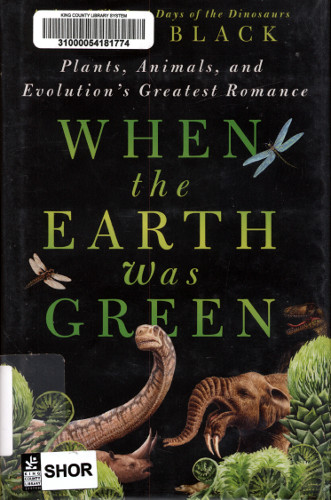
When the Earth was Green |
 |
Author: |
Riley Black |
|
Category: |
Non-fiction |
|
Rating: |
||
Date Reviewed: |
January 31, 2026 |

Chapter one is titled Sex in the Shallows - 1.2 billion years ago. It describes the dawn of plants - tiny organisms growing at the water's edge. The proto-plants have
differentiated cells - ie: cells that perform a specific function, such as root-like structures that anchor the tiny plant to the ground. Previously, for a billion years on Earth, single-celled organisms
reproduced by splitting; cloning themselves. But now evolution has produced a new technique: sex. Two tiny plants can contribute DNA to a create a new offspring. Sex allows much faster variability; new
shuffling of genes means that plant and animal life is about to take off. Multicellular organisms are going to quickly dominate the planet with a wide diversity of plants and animals.
The last chapter, chapter fifteen, is titled After the Ice - 15,000 years ago. This chapter talks about vast forests and the huge mastodons that feed on tree branches.
The reader learns that mastodons have evolved giant, powerful molars which are optimally designed to crush branches and leaves before the mastodon swallows them. Mastodons have big guts that break down the
crushed plant matter and ferment the green mash to extract as much nutrients as possible. The size of the mastodons means it must consume large quantities of tree branches every day. And there are many mastodons
roaming the planet. Plus, there are also giant ground sloths, horses, bison, camels and more - all grazing on plants. These hungry herbivores keep the forests thinned out, without the megafauna, the forests
would soon blanket the northern steppes. (Black doesn't mention it, but humans show up and slaughter all the large animals, and after the extinction of the large beasts, the steppes soon are converted into dense forest).
Each of the fifteen chapters describes how environments have changed, and the resulting adaptations by the plants and animals. The reader meets sabretooth tigers, the first horses,
the first primates, the first flowing plants, the first grasses and forty foot long serpents (Titanoboa). But the book doesn't just focus on the large animals, because what happens down at the small scale is just as important.
When the Earth cools down and ice ages come, some plants adapt by shedding their leaves in the winter. The discarded leaves create a blanket in the winter, protecting insects and small creatures from the harshest
winter conditions. Prior to that, the Earth only experience wet seasons and dry seasons.
I thought all of this material was interesting. It amazes me that we apparently know so much about ancient landscapes. The fossil records are not extensive, and the further back in time
scientists look, the rarer the fossils are.
When the Earth was Green almost seems to be a companion book to Becoming Earth, by Ferris Jabr. I happened to read both of them within a few weeks of each other.
Both non-fiction books discuss how life on the Earth has changed over the eons, yet the material they cover has little overlap. I recommend both volumes.
|