Title: |
We Have No Idea |
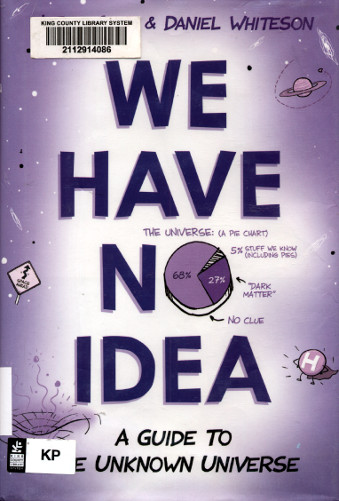 |
Author: |
Jorge Cham and Daniel Whiteson |
|
Category: |
Non-fiction |
|
Rating: |
||
Date Reviewed: |
February 19, 2026 |

I liked Chapter 7 on the discussion on the weirdness of space itself - it is not just a vast and empty void. Space itself bends and has ripples, therefore
it must be something, even if that something is not matter (at least, not matter than we can detect. The book repeatedly stresses that the mass we can see - galaxies, gas clouds, planets -
make up only 5% of the estimated mass in the universe.)
I also liked learning how the constant speed of light can make it appear to different observes that one event can have different outcomes depending on your
relative speed to what you are observing.
The chapter on cosmic particles was enlightening. I had no idea that the Earth was hit with such high energy particles, nor did I know that we have
no explanation for how such particles might be generated. (Seems like a cool idea that cell phones around the world could somehow all be linked to form an Earth-wide muon detector).
The chapter on the size of the universe explained the puzzle that we can see objects that are farther away than the estimated age of the universe. (ie:
the Big Bang was 13.8 billion years ago, but we see galaxies more than 40 billion light years away.) Since the universe is transparent and empty out to such distances, I wonder where it is
that we observe the Cosmic Microwave Background Radiation left over from the Big Bang.
The most interesting topic is discussed in the last chapter - examining the possibility of life elsewhere in the universe. Since there was only one chapter
devoted to this subject, the authors mostly just covered the Drake Equation (no mention of the ominous Great Filter theory). So nothing enlightening there - other books focused solely on the
topic of extraterrestrial life are a lot better for this subject.
Mostly, the issues were clearly defined. However, I unsuccessfully hunted for a way to send an email to the authors because some of their
explanations left me confused. I wish I could ask them a couple questions for more clarity. For example, at the end of the chapter on Dark Energy, they
imply that the night sky will be mostly starless because Dark Energy will have driven all the stars apart, so far apart that only the very nearest stars would still be
visible. This is surprising to me - I thought that the gravity of galaxies would hold our Local Group together (after all, the Andromeda Galaxy is rushing towards
the Milky Way, not away).
In the chapter on Dark Matter, they state that Dark Matter doesn't even react with other Dark Matter. When galaxies collide "the two dark
matter clusters seemed to be moving along the line of collision as if nothing happened... The clusters of dark matter kept going and passed through each other - almost as
if they were invisible to each other. The stars also mostly passed through, because they were so sparse." But I thought elliptical galaxies were formed by colliding
spiral galaxies - on first pass, the majority of the material passed through, but then it was drawn back in for successive passes until both galaxies had settled into a uniform
big blob of stars.
Page 265 says: "If you have a bigger mass, say enough to form a planet the size of Earth, the gravitational forces are strong enough to compress
the rock and metals at the center into molten lava. The reason the center of the Earth is hot and liquid is due entirely due to gravity." But I had read that center of the
Earth was kept hot by the decay of radioactive elements. If not for radioactive elements, the iron core of the 4 billion year-old Earth would have cooled by now and we would have a solid
cold core like Mars. (Victorian scientists did not know about radiation and so miscalculated the age of the Earth and thought it was much younger than it actually is.) The book mostly succeeds with its goal of outlining the Big Mysteries of our universe. It was a worthwhile read.
|