Title: |
The View from the Center of the Universe |
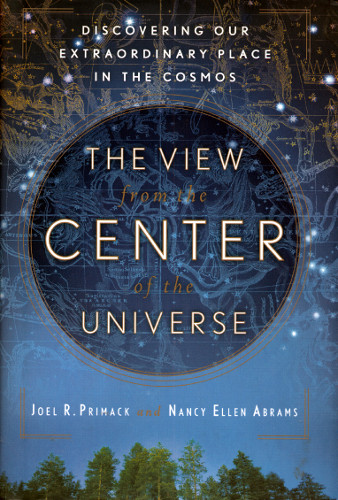 |
Authors: |
Joel R. Primack, Nancy Ellen Abrams |
|
Category: |
Non-fiction |
|
Rating: |
||
Date Reviewed: |
October 6, 2025 |

In the first several chapters, the authors describe cultures where humans were certain that everything revolved around Earth. The world was flat, the planets, sun and stars revolved around us, and thus each civilization felt that it was important. It was connected to all creation. But the discoveries of Copernicus and Galileo (the Earth goes around the sun, not the other way around) knocked our perception of place off kilter. Later inventions of powerful telescopes revealed our actual insignificant place in the universe teeming with unimaginable numbers of solar systems and galaxies. This has left humans with an existential feeling of hopelessness. The middle section of the book is the best. It provides summaries of topics like the Big Bang, Dark Matter, Dark Energy and the possibility of multiple universes (which we can only theorize about, never observe.) The chapter on the possibility of intelligent life else where in the universe seemed to think that only Earth-like conditions could lead to a civilization as advanced as. But Europa, with its ice-capped ocean, heated by tidal stresses from Jupiter, and possibly fueled by chemical reactions from deep ocean vents, appears to be the likeliest place in our solar system for life to also evolve, and Europa certainly is not an Earth-like environment. In the final chapters, the authors argue that because intelligent life is (presumably) so rare in this gigantic universe, we should adopt a Cosmic Consciousness and do our best to create
a sustainable civilization. They show the famous chart of exponential human population growth. Everyone who has ever taken a biology class knows what happens to the population of bacteria in a petri dish when all the resources are
consumed. Our population curve matches that of the bacteria in the petri dish. If only humans would alter their consciousness to consider the long term consequences of their actions, then we could bequeath a civilization
for generations of descendants.
From the final pages of the book: "We are at a turning point in history as the rising curve of human inflationary growth on Earth reaches its maximum. What direction it will take from here
we do not know. The next decades - the active lifetimes of people reading this book and their children - will create the blueprint of the future Earth. We represent an age on Earth comparable to the age of cosmic inflation
at the beginning of the universe: brief, but about to set the pattern for our long-term future. We have the chance to be heroes if we have the courage to do what the knowledge implies, or to be reviled as ignorant, selfish
and hugely destructive if we do not. This is a once-in-all-life's-times opportunity, but only if we take advantage of it if we understand what a unique moment this is and how crucial it is to get things right, and to do it now.
For our entire species, today matters."
This book was published in 2006, twenty years ago. Since that time, we have seemingly done everything possible to accelerate climate change, increasing emissions and rolling back regulations while ignoring the increasingly obvious consequences of the changing climate. We
are on track for an incredible 3C warming by the end of this century, with even more catastrophic temperatures beyond - once the permafrost thaws and the gigatons of trapped methane are released into the atmosphere, huge
swaths of our hothouse planet will literally be uninhabitable for human beings. So I guess we will have to settle for being reviled as ignorant, selfish and hugely destructive. On the plus side, there were probably be few humans
remaining, and they will be struggling so hard simply to survive, that they won't have breath to waste cursing our names. |