


Title: |
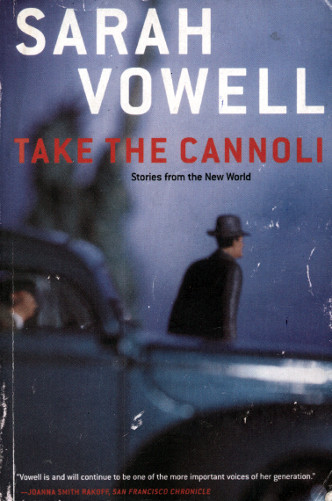
Take the Cannoli |
 |
Author: |
Sarah Vowell |
|
Category: |
Non-fiction |
|
Rating: |
||
Date Reviewed: |
June 17, 2026 |

I thought the best essay was titled "What I See When I Look at the Face on the $20 Bill". Andrew Jackson, of course, is the person depicted on the twenty. It was Andrew Jackson's administration that implemented the forced relocation of the Cherokee, Choctaw and Chickasee tribes to Oklahoma, and the infamous Trail of Tears that resulted. Vowell is part Cherokee; she and her twin sister decide to drive the length of the Trail of Tears on a fact finding mission. Did you know that at the Battle of Horseshoe Bend in 1814, a Cherokee warrior saved Andrew Jackson's life? Yet it was Jackson who signed off on the stealing of all of Cherokee lands. The Cherokee were not primitives - they emulated the American system. The Cherokee had their own Constitution, they ran plantations (and some had slaves), they printed a bilingual newspaper. Nevertheless, the white settlers lusted for their land, and so Jackson's Federal government forced the Native Americans off to Oklahoma in one of the dark chapters of American History. Vowell can write some witty stories that made me laugh. Here is a paragraph from "The End is Near, Nearer, Nearest":
"However much I doubted the logic of Genesis, I never once doubted the inevitability of Revelation, never once doubted that the
world would end. Because living in eastern Oklahoma and believing in the Apocalypse made a lot of sense. When I read the part in Revelation about the Four Horsemen of
the Apocalypse, how the end times would be set in motion by horses breathing fire and brimstone, it reminded me of the near-death trips I'd taken with my own pet, Stockings.
My dad had given me a Tennessee walking horse - but not a saddle. And so I rode bareback, clutching Stocking's mane, praying that she wouldn't get spooked, though she always
did, tearing off into the woods, breathing fire. By the time she stopped, after thirty-nine thousand repetitions of the command "Whoa!", the hickory branches would have etched
my skin into a bloody gingham. If one of the four horses of the Apocalypse had to be put down, Stockings was ready to ride." The title of the book comes from an essay of the same name: "Take the Cannoli". Vowell reveals that she is a huge fan of The Godfather
movie. She watches it so many times that it might be an addiction. She imagines that if her obsession is discovered: "Then my parents would ship me off to some treatment
center where I would be put into group therapy with a bunch of Trekkies. In The Godfather, there is a scene where one thug assassinates another. The criminal in
charge instructs the shooter "Leave the gun. Take the cannoli." In the world of The Godfather, there is no ambiguity. There is a strict code of what (immoral) action
to take in every situation, and college-aged Vowell finds this certainty reassuring. As with any collection, some material is better than the other. The chapter on the Chelsea Hotel didn't do much for me (I had never heard of this
famous rat-trap in NYC). But when Vowell decides she finally needs to learn how to drive, the results are amusing. I also liked the story about her dad the gun-nut, and the one about
trying to be an American Goth. This is light reading, it is easy to put the book down and then resume reading at a later time. I read the whole thing while watching my cats go outside
on their daily walk. |
