


Title: |
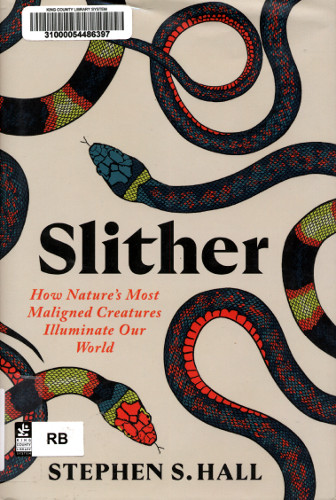
Slither |
 |
Author: |
Stephen S. Hall |
|
Category: |
Non-fiction |
|
Rating: |
||
Date Reviewed: |
February 4, 2026 |

Snakes are ancient creatures; they have been around for millions of years. While having no limbs seems like an enormous disadvantage, it actually helps in
certain environments, such as places with dense vegetation where the serpent can push off of the close-standing stems while gliding quickly through the flora. Snakes have adapted to
many environments - deserts, jungles, forests, salt water, prairies - pretty much everywhere but the coldest regions. They possess a number of unique features, which Hall details in
each chapter.
All snakes are venomous, even garter snakes. It just that some snakes don't bite, and other snakes lack the fangs and muscles to drive venom into their prey. But of the
snakes that use poison, some are extremely dangerous. Although only six Americans on average die each year from snake bite (you are more likely to perish from a lightning strike or bee stings), in
Africa and South Asia the toll is much worse. It is thought that India suffers 60,000 fatalities a year from snake bites. Anti-venom is expensive, requires refrigeration, and each type of snake has
a different set of proteins, enzymes and toxins in its venom. Even the same species of snake can have different cocktail of poisons in its venom depending on its geographic location and the adaptations
of the prey it hunts. Once sentence in the book stood out : "In the not a matter of if but when world of people who handle venomous snakes on a routine basis..." Yeah, you're going get bit. Too
many people the Hall interviews in this book have disfigurations due to past bites.
The chapter on digestion was quite interesting. Snakes can go months without a meal, and then they swallow one enormous lump of prey. This sudden switch from almost no metabolism
to a gigantic surge in digestion has led to a lot of research into how do they do it. During the fallow times, the stomach doesn't produce acid, the intestines wither to just a thin thread. But when prey
is swallowed, insulin levels skyrocket, the digestive organs are seemingly rebuilt on the fly.
Snake reproduction chapter wasn't as interesting. Many animals have what humans consider weird shaped penises. However, the description of the giant ball of mating garter snakes in
Manitoba piqued my curiosity so I looked it up on Youtube. It must be amazing to see in real life.
Limbless snakes propel themselves across the landscape with four different forms of locomotion: lateral undulation, rectilinear belly rippling (heaviest snakes), concertina (accordion-like
contractions), and sidewinding. So far, researchers have not been able to replicate how sidewinding snakes crawl up dunes of loose sand. The topic is important because humans would like to build snake robots
that can search collapsed mines or unstable buildings.
Snakes are thought to have poor eyesight, and no eardrums but have exquisite sense of smell (their forked tongues pick up molecules from the environment and then the tip of the tongue
places those molecules into sensitive receptors.) Pit vipers and constrictors also have cells that are highly tuned to heat. Intriguely, the nerves from the pit sensor and the nerves from their eyes both map to the
same part of the brain; perhaps these snakes see in thermal wavelengths.
The chapter on Burmese pythons invading Florida is disturbing. This invasive species is decimating all the native mammals, birds, amphibians and reptiles. While studying these pythons,
researchers put ten of them (each was 8 to 10 feet long) in a 8'x10' room filled with natural habitat grass, weeds, branches, etc. As an experiment, they ask 19 volunteers to spend half an hour each in the room
counting how many pythons could they detect. Half of the 19 searchers were expert snake hunters, yet only two of the 19 searchers found even one snake. That's how incredibly good the pythons are at camouflage.
There have been multiple instances where biologists with radio tracking devices on snakes have been literally standing on the radio-tagged python without realizing it. If we cannot see the snakes, we cannot count them, so all
we know is that the problem is bad and that the snakes are migrating northward.
At the end, Hall tells us that places where snakes once were common are now devoid of snakes. Habitat loss is destroying the numbers of snakes (and all other wild creatures) around the
world. It seems every non-fiction book I read lately describes the dire trajectory we are on as our biosphere collapses. Our descendants will be facing unimaginable environmental and climate challenges.
This is a worthwhile read, even if you (like me) prefer to never encounter a snake in the wild.
|
