


Title: |
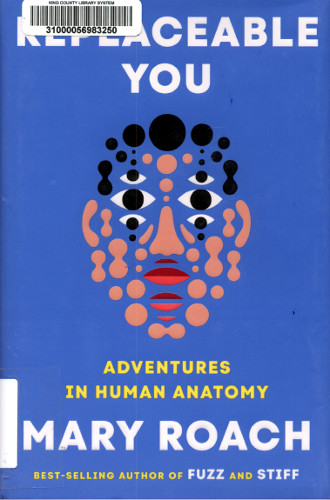
Replaceable You |
 |
Author: |
Mary Roach |
|
Category: |
Non-fiction |
|
Rating: |
||
Date Reviewed: |
August 16, 2026 |

Some of the topics covered are attempts to create artificial skin (to help burn victims), or to grow organs in pigs that could be transplanted into
humans. This cross-species procedure is called xenotransplantation. The hope is that hearts, pancreas, kidneys, liver, etc, could be grown in a pig and then moved into a human.
Gene-editing techniques would allow the pig's organ to closely match the human recipient so that the immune system would not reject it. (China has a huge shortage of organ donors,
but an abundance of pigs. Roach describes a 26 story pig farm in China, and I don't think she was joking.)
There are chapters on constructing replacement vaginas, penises, hips, prosthetic limbs, corneas. I was fascinated by the promise of the
stem cell research. In 2006, Dr Shinya Yamanaka discovered a procedure to take ordinary red blood cells and reverse them back into stem cells. Once you have a patient's stem cells, the
hope is to induce them to grow into replacement cells, such as new neurons to cure Parkinsons, or new pancreas cells to cure diabetes. In the far future, perhaps the stem cells could be
induced to grow a new replacement organ, but that is well beyond present capabilities. Replaceable You has plenty of astonishing information, but reading the following paragraphs amazed me the most of all (the scientists are trying to discover ways to lengthen the amount
of time a heart can be detached from the body; this will allow for more time to do heart transplants) :
"For reasons that remain a mystery, a heart needs a brain. When person is declared brain-dead, their heart - along with their other organs - begins
to fail after around twelve hours, even if the body is being oxygenated on a ventilator. The blood vessels lose tone, the capillaries start to leak, and within forty-eight hours its
all over.
If a head-injury or illness were to leave a pregnant person brain-dead, on a ventilator, their organs would keep functioning for the duration of the
pregnancy. But once the baby is delivered, the familiar cascade of organ failure would begin. The baby's brain appears to be producing something that sustains the organs of the mother. The reverse scenario also holds. "Very rarely," Bartlett continues, "a fetus develops without a brain." The "acephalic" baby's organs will continue to
function as long as it is inside the mother's womb. "As soon as the fetus is delivered, it dies." Bartlett says. "You need one brain or the other." He reasons that there's a necessary hormone,
or possibly several, produced inside the hypothalamus, inside the midbrain. "The hypothalamus consists of hundreds of clusters of hormone-producing cells. We know what four or five of them do,
but not the rest." At the end of Replaceable You, Roach inserts a note that said that the book went to press in 2025, just as the Trump administration was gutting the NIH. Much of the
research described in the book was funded by NIH grants, so it is possible that many of the amazing things that scientists and doctors were working on all got tossed out the window.
It is hard to imagine a better example of "penny-wise but pound foolish". |
