


Title: |
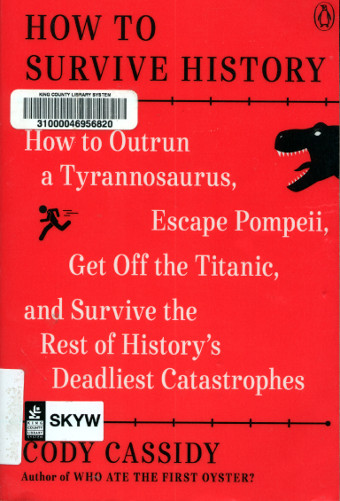
How to Survive History |
 |
Author: |
Cody Cassidy |
|
Category: |
Non-Fiction |
|
Rating: |
||
Date Reviewed: |
March 6, 2026 |

The Dinosaur Age - what is the best escape for the time traveler if pursued by a Tyrannosaurus Rex? Cassidy argues that you do have a chance, as long as you are pretty fit and fleet of foot. The bulk of T. Rex makes it hard for it to accelerate or change direction. Unfortunately, juvenile Tyrannosaurs are not so bulky and thus quicker than any human, so the time traveler is doomed (even if the juveniles don't hunt in packs, which they might have). The Chicxulub Asteroid - the impact of this asteroid had a devastating effect on Earth's biosphere that lasted thousands of years. Clearly the time traveler isn't going to hang out all that time to watch the Rise of the Mammals. Survival means living through the days that follow the immediate impact. Your best bet is to be on the opposite side of the earth in a cave far above sea level. The Ice Age - Cassidy says that early man focused their hunting on woolly mammoths. Given that their only weapons were stone-tipped spears, hunting was
an amazingly dangerous occupation. The rules of time traveler apparently forbid you from inventing the bow and arrow. Or focusing on less daunting prey, such as waterfowl or rabbits.
Ancient Egypt - Care to volunteer to help build the pyramids? There are a few things you ought to consider. Did you know that at least 1,600 tourists
fell to their deaths climbing up the steep-sided pyramids before the Egyptians banned the practice? But the time traveler must be alert for less dramatic threats like heat stroke, parasites,
or work place accidents - like getting crushed by a giant stone. Cassidy offers an interesting idea of how temporary ramps beside the pyramids were used, and then later dismantled, to allow the stone blocks to be
dragged into place.
Pompeii - One would imagine that time travelers would have enough sense to not be in Pompeii when Mount Vesuvius erupts. But it is possible to survive
the destruction if quick action is taken when the eruption first begins. The secret is to run (or walk fast - there is a time lag from the first explosive burst until Pompeii is buried
beneath the pyroclastic flow) to Naples. This seems counterintuitive, since Naples is not the direction that leads directly away from the volcano. But the time traveler knows beforehand
which way the ash and lava will flow, so heading immediately off to Naples should save your life.
The Sack of Rome - Rome actually has been sacked multiple times during its existence; Cassidy is discussing the attack by the Goths in 410 C.E. He has
researched how the assault went down and provides a map on which way to run through Rome to reach the Metronia Gate (and presumably keep going until the time machine arrives to take you home.)
The Darkest Year of the Dark Ages - I have heard of the Little Ice Age, but I did not know that in 536 C.E. the eruption of a gigantic still-unidentified volcano (possibly in Iceland)
threw so much soot and ash into the atmosphere that the sun's rays were greatly diminished, leading to crop failures and freezing temperatures. Then, in 540 C.E., a second volcano - perhaps
in Guatemala, added more debris into the air. Finally, in 547 C.E., a third volcano - suspected to be near Indonesia - also erupted. To make things even worse, the first bubonic plague follows
these years of freezing temperatures and famines. Time travelers ought to be smart enough to just stay away.
The Black Death - Time travelers should also avoid the year 1348 C.E. Surviving bubonic plague mostly comes down to avoiding infection from flea bites, or
exhalations of sick people.
The Fall of Constantinople - The armies of Sultan Mehmed II laid siege to the famed capital of the Byzantium Empire. Despite being greatly outnumbered, the
Byzantines withstood the assault because they were protected by the unbreachable walls of Theodosius. Again and again the sultan's troops were beaten back, until the third wave of the final assault
discovered an unsecured door in the Kerkoporta wall (it was used for Byzantium troops to mount sallies and counterattacks) and the invaders are able to pour in and commence the slaughter. I
assume the rules of time traveling prevent you from changing history, otherwise the best bet would simply be to seal that door and Constantinople would remain intact. Instead, Cassidy outlines
the best chance for escaping the sack of the city. He suggests carrying lost classic books to Western Europe to help spark the Renaissance.
The First Circumnavigation - Magellan set forth in 1519 with five ships and 260 men. Only eighteen men and one battered ship survived the three year voyage to limp back into Spanish port.
Cassidy lists the which ship to sail upon, and which landing parties to avoid. The biggest threat is scurvy - Cassidy advises that the time traveler bring as many jars of quince jam that will
fit into the sailor's trunk. (Or perhaps stock up on pickles?) Magellan himself didn't complete the voyage - don't go on that landing party in the Philippines!
Do all these things and you might just be one of the eighteen survivors. One of the 18 survivors happened to be a scribe who recorded events of the entire voyage. He kept meticulous records.
They couldn't understand why his journal said that it was a Saturday on the day that the voyage returned, while the citizens of Spain said it was a Sunday.
A Voyage with Blackbeard - Piracy was a lucrative business for a few years. Sailing with Blackbeard led to some rich prizes, which were split amongst the
surprisingly democratic pirate crews (the captain only got a double share). But it is important to be off of the Queen Anne's Revenge in 1718 C.E. when the Royal Navy decides it has had enough
of Blackbeard deprivations and sends lieutenant Maynard and two sloops to bring him to justice.
The Donner Party - a wise time traveler would simply skip the "shortcut" and take the well establish route to Sacramento. Unless cannibalism is secretly your thing.
The 1906 Earthquake - wow, the earthquake was much more powerful and destructive than I realized, and the subsequent fire storm might have been even worse.
Cassidy maps out a survival strategy, but it doesn't sound fun.
The Sinking of the Titanic - again, it would seem best to avoid boarding the doomed ship in the first place. But perhaps time travelers wish to play a high-stakes
game of Can You Survive? Cassidy assumes you have a third class ticket and are below decks in steerage. There is a potential way out, but it requires some luck, clear and decisive movements, and the
ability to swim 500 yards in icy cold water.
The Worst Tornado in American History - I never even heard of this disaster before. In 1925, an incredibly powerful tornado (later dubbed "The Tristate Tornado") swept from Missouri across the southern
tip of Illinois and into Indiana, leaving a wide swath of destruction. The Illinois town of Gorham is obliterated. Cassidy identifies which structures remained standing and recommends that the time
traveler scurry into one of those buildings and place a large metal pot over his or her head while curling up in a bathtub or closet and hoping for the best.
I enjoyed this book. The explanations are clear and concise and interesting. I am inclined to look for Cassidy's other book, Who Ate the First Oyster.
|
