


Title: |
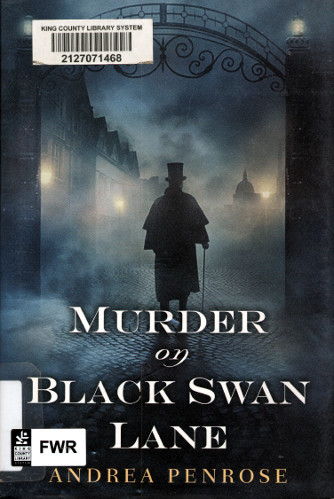
Murder on Black Swan Lane |
 |
Author: |
Andrea Penrose |
|
Category: |
Mystery / Thriller |
|
Rating: |
||
Date Reviewed: |
November 13, 2025 |

I dithered on my ranking of Murder on Black Swan Lane; I couldn't decide between 3 or 4 stars. But the pace of the story picked up in the end, so I ended generously awarding four review stars to the book.
I was annoyed by the character of Charlotte Sloane,
who uses the moniker A. J. Quill to produce satirical cartoons that skewer England's rich and famous. I very much doubt that a network of gossipy servants and sharp-eyed street urchins could provide enough
accurate detail (and so quickly as well) to allow Sloane to make her detailed drawings. Stories passed by word of mouth are inevitably incorrect, exaggerated, or deliberately slanted; by the time Sloane
got the story it would be greatly distorted from the actual event. Also, I doubted that Sloane's rare glimpse of the elite aristocrats would allow her to render their cartoon faces with such precision that
they would be readily recognizable.
At the beginning of this tale, Reverend Holworthy is murdered in a church on Black Swan Lane after he gives a rare text to a furtive masked figure known only as the Golden One. Prior to his violent demise, Holworthy
had been engaged in a public war of words with the Earl of Wrexford, so naturally Wrexford is considered the prime suspect. Wrexford is depicted as a devil-may-care figure, normally protected by his wealth and title
from consequences of his actions, but murder is such a serious charge that even he might be arrested. Wrexford and his ultra-competent valet, Tyler, set out to clear his name.
Although he is an elite member of the idle gentry, Wrexford is no fool. He served in the Napoleonic Wars in Portugal (though it was unclear to me in what capacity he was involved, if Wrexford held a rank and
commanded soldiers it was never stated) and he has a passionate interest in the new scientific discoveries of the era, especially chemistry. Penrose describes Wrexford experimenting with chemicals in a lab out of
scientific curiosity, and this background turns out to be fortuitous, because when Holworthy was murdered, his killer splashed his face with a highly corrosive acid. There is plenty of talk of alchemy, though
I thought that by the nineteenth century people had come to realize that you could not transmute lead into gold.
A Bow Street runner (an English policeman) named Griffin confronts Wrexford on a few occasions, and threatens him with arrest. This puts pressure on Wrexford to find the real culprit.
Sloane publishes a cartoon depicting Holworthy's death, and her drawing has some amazingly correct details. Wrexford decides his first step should be to identify who the mysterious A. J. Quill
is, and determine how he (Wrexford assumes the artist is a he) knows so much about the crime. Naturally the face to face confrontation results in an uneasy alliance between Sloane and Wrexford as together they work to solve the case.
I may look into reading book two of the series, though I already read at least one book in about thirty other mystery series, so not sure I should start another one. I don't think I have ever completely read an
entire book series longer than a trilogy. But there is still time...
|
