


Title: |
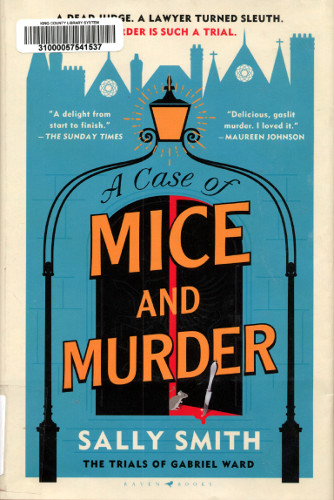
A Case of Mice and Murder |
 |
Author: |
Sally Smith |
|
Category: |
Mystery / Thriller |
|
Rating: |
||
Date Reviewed: |
May 18, 2026 |

Living in an apartment inside the Inner Temple is a brilliant, eccentric King's Counsel (a lawyer) named Gabriel Ward. Today, we would describe his personality
as Obsessive Compulsive - Ward always checks the lock on his apartment door three times when departing, he is careful not to step on cracks in the pavement, the papers on his desk must align
with the inkwell in a precise manner. Despite his peculiarities, Ward proves to be insightful and kind. He definitely is not class conscious but treats even the maids and porters with respect.
I think characterization (not just of Ward) by Smith was one of the best aspects of this novel.
Ward is dealing with a thorny upcoming case regarding the authorship of a wildly popular children's book called Millie the Temple Church Mouse. The
manuscript was dropped anonymously on the doorstep of the publisher Herbert Moore. Moore's daughter read the story and loved it, so Moore decided to publish it after unsuccessfully trying to
discover who wrote it. Moore anticipated a first edition of only a few hundred books, but Millie the Temple Church Mouse exploded into a wildly successful book. Children all across England
wanted to read the story about the humble, pious mouse. A lot of money came pouring into Moore's coffers. Susan Hastings has come forward, claiming that she is the true author. Moore has his doubts;
Hastings does not seem to be an entirely sane individual. Gabriel Ward has been hired by Moore to represent him in the upcoming, high-stakes court case against Susan Hastings. As he steps outside of his apartment one morning, Ward stumbles over a body lying across his threshold. It is the Lord Chief Justice of England, Norman Dunning and
there is knife buried in his chest. Someone inside the Inner Temple has murdered its most prominent citizen (access into the Inns of the Court is carefully controlled by a contingent of porters who
man the gates, preventing the ordinary riffraff from London's streets from entering the hallowed grounds.) Bizarrely, the Lord Chief Justice is barefoot. His shoes and socks are missing.
Although the London Police are called, they don't have jurisdiction in the Inner Temple. The Master Treasurer, Sir William Waring, decides that the matter should be investigated
internally. Waring assigns Ward to the investigation; giving him one week to solve the crime. Constable Wright of the London Police will assist, but it is up to Ward to find the murderer.
Thus, there are two cases running in parallel in Ward's life: he must solve the puzzle over who killed Dunning, and he must resolve the case over the authorship of
Millie the Temple Church Mouse. Like all detective stories, there are clues and misdirections. The mysteries are fun, but what I enjoyed most were Smith's characters. Everyone shines with personality, even
the unsavory characters. I see that there is already a sequel written, A Case of Life and Limb. I have added that book to my extensive To Be Read stack. Hopefully, I get to it soon.
|
