


Title: |
Dead of Night |
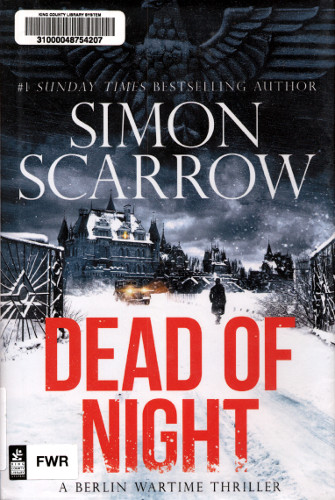 |
Author: |
Simon Scarrow |
|
Category: |
Mystery / Thriller |
|
Rating: |
||
Date Reviewed: |
August 7, 2026 |

Police detective Horst Schenke is asked to investigate the death of Dr. Schmesler. It has officially been ruled a suicide, but the widow knows that the good
doctor would never have killed himself. Schenke's conclusion is that she is probably right. But the highest authorities in Nazi Germany tell him to stop his investigation and leave well
enough alone.
Schenke's girlfriend finagles him into meeting William Shirer, an American reporter in Berlin (this is a real figure - he would later write The Rise and Fall of
the Third Reich.) Shirer asks Schenke's police team to investigate the death of a little girl. Although disabled, she was perfectly healthy when she was sent to the clinic. Yet two weeks later she
was dead of tuberculosis; her ashes returned to her stunned, grieving parents. Schenke actually has a conscience; he hasn't adopted the Nazi party line. With great reluctance, he offers to do a
preliminary inquiry. Naturally, his initial findings lead to more dark questions.
Scarrow does a great job depicting the terror of living in Nazi Germany. Who can you trust? Are you being watched? Followed? Your phone line tapped? What do
you do when someone you love argues passionately for opposing the regime, when such loose talk risks that loved one being collected by the SS for interrogation? The atmosphere is oppressive and dark.
Scarrow concocts a plot that looks impossible for Schenke to survive. If the deeds at the clinic are sanctioned by the highest branches of the government, then
exposing their crimes would put Schenke in the bullseye of their revenge. Schenke's fears for himself and the people he loves are always battling with his conscience and his desire for justice.
I know it is important that the atrocities of the Nazis are never forgotten and never excused. I am always bewildered by reports of far right groups gaining in
popularity in various parts of the world (what are those people thinking??) But reading a harrowing tale like this is just too much for me. I am never going to support the neo-Nazis. I don't
need any reminders how sinister and abjectly evil they were. Scarrow does a marvelous job of portraying what it is like to live in a lawless regime ruled by violent, evil men. The result is a taut
thriller that is a scary read.
|
