


Title: |
Blackout |
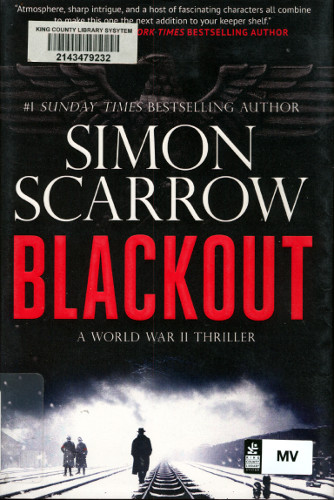 |
Author: |
Simon Scarrow |
|
Category: |
Mystery / Thriller |
|
Rating: |
||
Date Reviewed: |
November 9, 2025 |

It is a cold, snowy December of 1939 in Berlin. Germany has already conquered Poland and is officially at war with both Britain and France. Though the European powers are
not shooting at each other yet, Berlin has strict blackout requirements at night. No lights must shine in the city to give guidance to potential Allied bombers. During this blackout conditions, a killer
is stalking women. His preferred technique is to assault the woman, and then smash her skull and leave her lying in the snow beside the train tracks.
The head of the Gestapo, Heinrich Muller, calls in Horst Schenke, the head of Kripo (the police), to investigate the crimes. Schenke is one of the rare police officers who
has not joined the Nazi party. In Muller's eyes, this makes Schenke an unbiased operator. The Nazis are riven with factional in-fighting, and the first dead woman, Gerda Korzeny, was last seen at a swanky
Christmas party with many Nazi officials. Schenke will have to question Nazis from various branches, so his impartiality is a plus.
Unlike Detective Lefort in the series by Pryor, Schenke is the head of the Pankow police department. He has a team of underlings that he assigns tasks as he tries to direct the
investigation. Every day Muller calls up and demands a report, insisting the Schenke must solve the crime quickly. Schenke cannot help but wonder if there is something more going on with this crime than
murder, it seems that there might be political calculations behind the scenes of which he is unaware.
Schenke has a beautiful girlfriend, Karin Canaris. Karin his witty, intelligent and gorgeous. She is also outspoken with her opinions and is not a fan of the direction
that Hitler is leading the country. Schenke must always consider who might be tapping his phone, or listening in to conversations he might have. But Karin shows no discretion despite the danger. Schenke
meets with Karin's uncle, Admiral Canaris, who happens to be the head of Military Intelligence. Admiral Canaris warns Schenke to tread carefully in his murder investigation, and again Schenke wonders if there
is more to this case than he has been told.
An impatient Muller assigns a Gestapo officer, Liebwitz, to follow Schenke's investigation. Liebwitz lacks social skills and takes many things literally - in modern terms
Liebwitz might be classified as autistic, but in WWII Berlin, he is merely seen as a odd duck. Nevertheless, his presence is unnerving to Schenke and his team as they struggle to find clues to catch the
criminal.
Another woman is found murdered, and the pressure on Schenke ramps up. Muller does not want Berlin to panic if there is a serial killer preying on women.
I found Blackout to be a good detective story. Schenke struggles with his conscience - he is trying to catch criminals, but the entire government is run by lawless
criminals who care nothing for justice, only for power. Nazis are perfect villains and Schenke is in a tough spot. The characterization, the plot and the descriptions of 1939 Berlin are all spot on. The second
book in this series is certainly worth looking for.
|
