


Title: |
Poland |
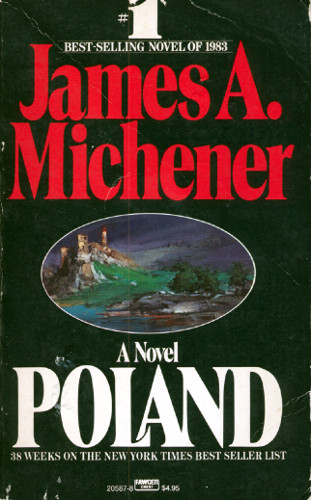 |
Author: |
James A Michener |
|
Category: |
Literature |
|
Rating: |
||
Date Reviewed: |
July 19, 2026 |

The best parts about Poland is the history. I had heard of the Battle of Tannenberg but knew nothing else about it. Turns out that there were two Battle of Tannenberg - Michener describes the first one, which was fought in 1410 between victorious Poland and the mighty Teutonic Knights (Germans). I did not know that Poland was involved in the fight to lift the siege of Vienna by the Turkish Army. But although Polish armies sometimes succeeded, more often they failed. Poland had no standing army, no powerful king to direct Polish forces, and no natural geographic to protect any of its borders. As a result, Poland gets invaded from the south (Turks, Austrians), from the east (Tartars, Russians), the north (Swedes, Lithuanians) and the west (Germans). For much of its history, Poland was an occupied kingdom. The least interesting part is a long section about a impoverished aristocratic cad named Bukowski looking for a wealthy woman to marry. Bukowski has a title
but no money. He ends up pursuing a wealthy American heiress. But the insufferable Bukowski is not a likeable character, all he cares about is horses.
There is a long section about the Nazi occupation of Poland. Many atrocities are described. If Michener could have focused on fewer characters,
he could have generated more tension, but then he would not have been able to relay as much historical information. Too much of the book flies at bird's eye height, rather than concentrating on
a few main characters in a specific period of time.
It is clear from the end of the book that Michener fears that the Soviets are prepared to crush any attempt by Poland to declare independence.
The early 1980s was when Lech Walesa and the Solidarity movement were making international headlines.
Michener lived until 1997, so he saw the fall of the Iron Curtain and the collapse of the Soviet Bloc. That had to be gratifying to him (and of course, to all Polish people!). |
