Title: |
Picture in the Sand |
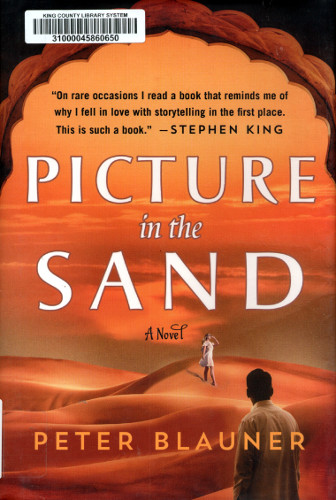 |
Author: |
Peter Blauner |
|
Category: |
Literature |
|
Rating: |
||
Date Reviewed: |
February 4, 2026 |

Picture in the Sand is set sometime shortly after the 9/11 attacks. Alex Hassan, a bright young Egyptian-American was on track to attend
a prestigious university. But Alex became enamored with on-line radical Islamic content and decided to abandon his Western lifestyle and travel to an unnamed location in
the Middle East and join the jihadists. Alex announces (via a final email) that his new name is Abu Suror, and that he is permanently cutting off all contact with his family
as he has joined the holy war.
Alex's grandfather (Ali Hassan) sends a reply, offering to tell Alex his own history, details of which he had never shared with anyone. Most of this
novel is told as a series of emails by Ali that recount his own youth in Cairo in the 1950s. Ali was enthralled by American movies; his passion was to go to the cinema and watch
films. In his dreams, Ali moves to Hollywood and becomes a director. In 1954, Cecil B. DeMille comes to Egypt to film the epic The Ten Commandments. Incredibly, Ali has procured the dream job as personal aide/chauffer to Mr. DeMille,
he will be on the set and watch and learn how movies are made. It seems like an incredible stroke of good fortune.
But at the same time, Egypt is wracked with political turmoil. The Suez Crisis has just ended (with control of the Suez Canal transferring from Britian
to Egypt). The Egyptian government led by King Farouk had been overthrown by a military coup and installed General Naguib as the new head of state. But another commander, Gamal
Nasser challenged Naguib, and when the power struggle ended, it was Nasser who was dictator of Egypt. Adding to the unrest is the Muslim Brotherhood, a large subset of the population
that longs to convert Egypt to a theocracy, throwing out all influences from the decadent West.
Despite this instability, DeMille arrives in Egypt anyway to shoot his movie.
Ali has a cousin, Sherif, who fought in the 1948 war against Israel. Sherif was shot in the leg and now walks with a limp. Sherif is a radical member of the
Muslim Brotherhood, and he wants to use Ali's position on the movie set as a way to create a powerful, devastating "statement" against both the rule of Nasser and the DeMille (symbol of the loathed
West). Ali is ensnared by his cousin's machinations, and unwilling drawn into a tense world of plots, intrigue and conspiracy.
I enjoyed reading this novel. Stephen King was correct; the storytelling was captivating. I found myself hoping Ali could navigate his increasingly perilously
circumstances. Everyone knows that The Ten Commandments was a wildly successful movie; it is what is going on behind the scenes that make the story compelling.
By coincidence, I had just finished reading The Lion Women of Tehran before starting Picture in the Sand. That novel describes the horrors of living
under the Iranian theocracy. Egypt's ruthless dictators crushed the Muslim Brotherhood and anyone suspected of sympathizing with them, which is told in Picture in the Sand. Which country had the better outcome? Both sound
pretty bad. Iranian is currently engulfed in massive protests, but Egypt's populace has also had large scale demonstrations that were brutally suppressed.
Living under an authoritarian ruler is an awful plight for ordinary citizens, whether that regime is religious or not. It is sobering to read about these countries.
|