


Title: |
The Light Between the Oceans |
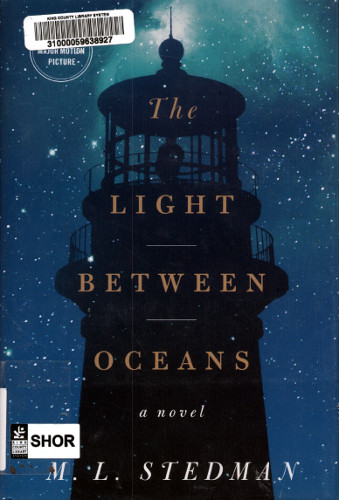 |
Author: |
M. L. Stedman |
|
Category: |
Literature |
|
Rating: |
||
Date Reviewed: |
August 9, 2026 |

Stedman tries really hard to make Isabel sympathetic. Isabel is young, vivacious, bold and beautiful. Except for the miscarriages, Isabel has thrived out on the isolated rock that is Janus; Isabel is the ideal wife of a lighthouse keeper. Plus, she just had a third traumatic miscarriage, so surely her decision to keep Lucy is understandable? No? No, not for me. I never agreed with Isabel. Tom should have immediately radioed the mainland, announce their discovery - and offering to adopt the child if it was an orphan. But Isabel emotionally blackmails Tom into raising Lucy; rationalizing that if Lucy did have a living mother, that woman would certainly have assumed that her baby had perished. The middle of book describes the happy years of the infant Lucy growing into a toddler under the loving care of Isabel and Tom. They only visit the mainland
every other year. Isabel's parents are delighted to be doting grandparents and are so proud of how Isabel has blossomed as a young mother. But visiting the mainland pricks Tom's conscience; he
discovers that Lucy's real mother is still alive and still grieving over her lost husband and baby.
The final third of the novel is about consequences. Grief, anger, betrayal and shattered trust - it is a time of supreme unhappiness for all the characters in the book.
I am not a parent, so perhaps that is why I cannot sympathize with Isabel. I liked the character Tom, but Tom should have simply reported the dead body and living baby found in that rowboat. But of course,
then there wouldn't have been this novel.
This bothered me when I read it: on page 253, Stedman writes : "Instead, he [Tom] sought comfort in perspective: in his mind's eye, he mapped out on the ceiling the exact position
the stars would be in that night, starting with Sirius, always the brightest; the Southern Cross, then the planets - Venus and Uranus - all easily visible in the sky over the island." Uranus
is not visible from Earth, except under the most optimal dark sky viewing conditions when it can be perceived as a tiny dot of magnitude of just 6.0 (at the absolute limit of human perception). Change
Uranus to Saturn or Jupiter and the sentence is plausible.
|
