


Title: |
Harriet the Spy |
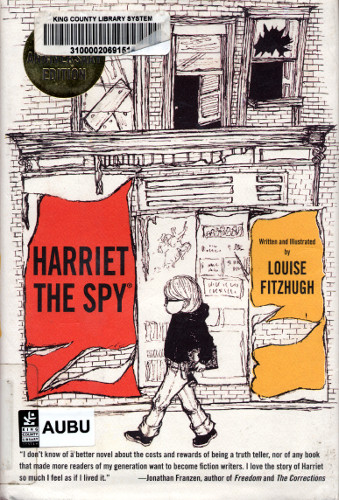 |
Author: |
Louise Fitzhugh |
|
Category: |
Literature |
|
Rating: |
||
Date Reviewed: |
July 6, 2026 |

From the title, and knowing that this was children's literature, I anticipated that Harriet and her friends would use detective skills to solve a mystery, maybe locate a treasure, or perhaps stop a crime. Nope. Harriet does indeed spy upon everyone in the neighborhood, but her snooping skills and discoveries result only in her writing nasty observations into her notebook, which she carries with her everywhere she goes. Harriet claims that she does these observations because she aspires to be a famous writer one day, but with her journal entries packed with cruel thoughts it is doubtful that any writing she eventually produced would be anything but hateful diatribes. Eleven year old Harriet M. Welsch is a spoiled rich child growing up in New York City. Her family employs a cook and a nurse who Harriet refers to as Ole Golly. Harriet is not sick, so it was never clear why she needed a nurse. Ole Golly is the only person who can keep Harriet's worst impulses under control. When Ole Golly gets fired because she takes Harriet to the cinema one night, Harriet's behavior gets noticeably worse later in the book. This is not to say that Ole Golly is an admirable character. Ole Golly tells Harriet "brutal realities" such as sometimes you need to tell lies, or, you should pretend to apologize for things even though you don't mean it. The only likeable characters in this book are Harriet's friend Sport and Harrison Withers, the man who keeps twenty-plus cats in his apartment. The tributes at the end of the book praise Harriet the Spy for its funniness and honesty. I didn't find any of the observations that Harriet wrote in her notebook
to be funny; I found her commentary to be uniformly nasty. Harriet looks for the worst in everyone, and is always able to find it. She calls people fat, stupid and zeroes in on any physical defect, however slight. Here is an entry about Sport, Harriet's best friend: "Sometimes I
cannot stand Sport, with his worrying all the time and fussing over his father, sometimes he's like a little old woman." Is that refreshing honesty? I don't recall having thoughts like that about my best friend.
The other school children get a hold of Harriet's notebook, and they read all the nasty things that Harriet has written about them. Harriet does not learn any lesson from
becoming ostracized from the class. She throws temper tantrums like a four year old. She escalates to physical attacks - she trips Pinky Whitehead so he falls flat on his face: "A terrific wail went
up from his prone body, and when he raised his face his nose was bleeding. Harriet looked extremely blank. Inside she felt a sense of very personal satisfaction." When the school kids run out the
door at lunch time, Harriet expertly pinches Carrie Andrews - this results in a big fight amongst the children while Harriet nonchalantly walks away. Harriet steathily clips off a section of hair of the
girl who sits in front of her, later, Harriet's mother says: "That Laura Peters is practically going to have to have her head shaved." This is funny? There is no redemption arc in this story - Harriet's behavior never improves; she remains nasty until the end.
I found Harriet the Spy to be disturbing - how can so many people read of her exploits and laugh? Harriet is a horrible child, devoid of any redeeming qualities, well
on her way to growing up to be a psychopath. This a terrible book. Not recommended for anyone at any age. |
