


Title: |
Fagin the Thief |
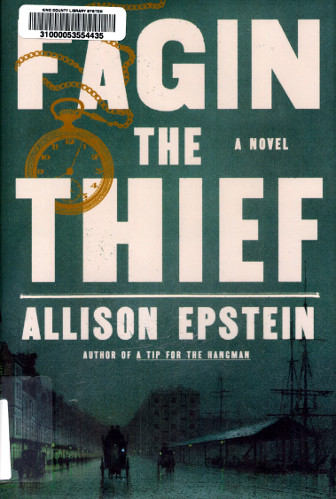 |
Author: |
Allison Epstein |
|
Category: |
Literature |
|
Rating: |
||
Date Reviewed: |
February 27, 2026 |

The story begins with Fagin as a young Jewish child in London. His father is dead; having been hung for the crime of theft. Fagin periodically sees
the ghost of his father, but the spirit never speaks. Fagin's mother tries to raise her only son to be a proper law-abiding citizen, sending him to classes conducted by the rabbi.
She drags young Fagin to a public execution, and forces him to watch a criminal hung - trying to instill in her son fear and respect for the law.
But Fagin's restless spirit wants more than a life of poverty. Skipping classes and wandering the streets of London, Fagin spies a smooth pickpocket, Anthony Leftwich working his
trade. Fagin boldly tells Leftwich "I want to do what you do". When Fagin demonstrates some nerve, Leftwich takes him under his wing and teaches him skills. Fagin soon proves to be
a better pickpocket than the master.
The story unfurls mostly in linear fashion, except that the chapter where Oliver Twist first appears (by which time Fagin is in his fifties, and still never
been caught pickpocketing). The violent housebreaker Bill Sikes needs a young lad to help sneak into a house and unlock a door. Sikes and Oliver Twist disappear and don't return when
expected. This open ended situation is then ignored until the end of the novel, when the Oliver Twist thread resumes. (Even then, what happens at the housebreaking is not covered in
Fagin the Thief, so I guess I would have to read Dickens book to find out what happened.) Oliver is hardly a presence at all in this novel. Nor does the Artful Dodger have more
than cameo appearances.
A large part of this novel deals with Fagin's relationship with Bill Sikes. Sikes is a 13 year old running wild in the streets of London. He is fleeing from
the police when Fagin makes a rash, snap decision and decides to hide Sikes and save him. This leads to Fagin training Sikes, just like Leftwich trained Fagin so many years earlier.
But when Sikes becomes a grown man, he is huge in strength and body, and violent of temper. Sikes changes his lawless behavior from pickpocketing to the more dangerous, but more lucrative,
crime of housebreaking. Fagin fears Sikes and his explosions. Yet he also remains Sikes best friend.
The other main character is Nancy ("Nan") a young female pickpocket who is a perfect partner in crime for Fagin. Working together, one to distract the targets, the
other to riffle their pockets, the two of them become far more successful that either was alone. But Nan becomes attached to Bill Sikes. She sees him as a tormented soul, still a lonely child
who was never loved.
Fagin routinely will take in street urchins and train them in the arts of pickpocketing. I did wonder how it was that everyone knew Fagin was a pickpocket when he
had never gotten caught.
Epstein does not totally sanitize Fagin. He frames Sam for theft, the child leader of the street gang that he ran with for a couple of years. He forces a beggar out into the
cold when he could easily have let the poor man stay unobtrusively in the basement of the ruined home. Much later in life he stumbles across the ruined Andrew Leftwich, his former
mentor, but shows him little compassion.
The story was interesting enough that I continued all the way to the end. Epstein's backstory of Fagin explains why he became a criminal mastermind, but he isn't
especially likeable. The best that can be said is that he abhors violence.
|
