A Weekend In Yosemite
We tried to leave the motel earlier today, but the proprietor had not yet set out the continental breakfast even half an hour after the posted time. We finally just scrounged around and found most of what we needed in the refrigerator.
We decided not to visit the overcrowded valley today at all and turned our attention first to the Mariposa Grove of Redwood Trees at the southern end of Yosemite Park. It was actually on our way into the main park itself.
When we arrived at the tour center, there were no parking spots to be had, so we left the car on a space with diagonal lines. I decided to ride the tram uphill to the best grove, and walk back down, while Art and Melanie chose to walk both ways. They had quite a head start while the tram operator gave the usual opening talk, collected all the tickets and set out.
After the usual talk about the history of the area, the tram driver/tour guide explained that we would stop several times for pictures.
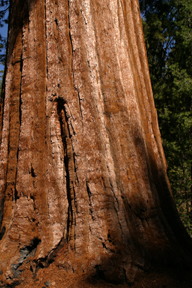
Redwood trees are the largest things that have ever lived on the fact of the earth, and can live for as long as three thousand years. One of the reasons for this longevity is that their thick bark is almost fireproof since it contains mostly water, rather than resin like so many other trees. Many trees have had the heartwood burned with lightning-started fires, but remain supported and alive by the cambrium layer which carries food down from their needles, and nourishment up from the roots.
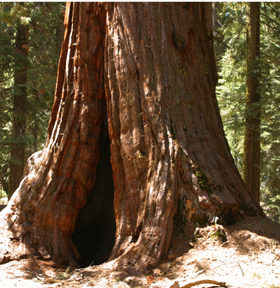
Many trees have had the heartwood burned with lightning-started fires, but remain supported and alive by the cambrium layer which carries food down from their needles, and nourishment up from the roots.
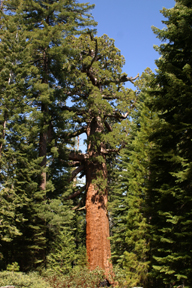
Many of the largest trees are named.
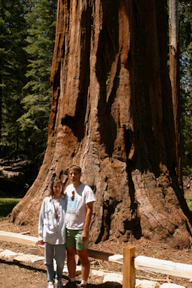
On our way down the trail, we stopped at The Faithful Couple, two trees that grew as one.
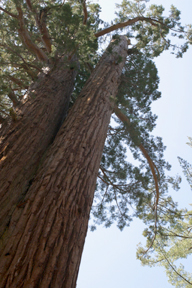
Redwood trees have a distinctive shape, and can be identified not only when they reach great heights, but by their shape.
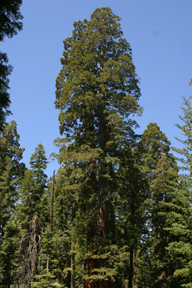
Although redwood trees are the largest living things on earth, their root system is shallow, but widely spread out. That is why it is important to limit traffic around them.
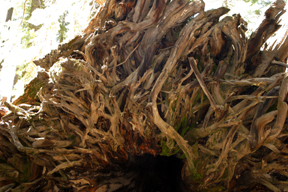
The dead redwood continues to benefit the forest as fungi grow upon it.
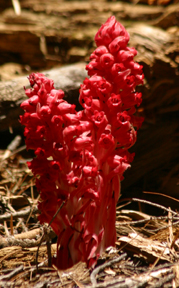
Redwood trees tend to grow in clumps or groves, because the cones must wait for fire to open the cones to let out the seeds. Therefore, they all germinate at the same time and in the same area, near to where the parent tree once stood.
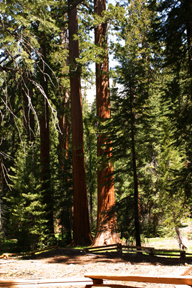
Much as we loved Sequoia National Park, we also wanted to return to Yosemite. The distance between them was considerably longer than we expected, so it was early afternoon when we arrived; along with a considerable portion of the population of California. As we approached Yosemite, we saw a double waterfall in the distance. Melanie and Art hiked closer for a better look, while I photographed them from the road.
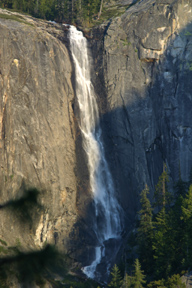
After a few hairpins turns, we stopped to admire Cascade Creek. Shortly after that, we came upon Cascade Falls, which like all the waterways in the park, had become a rushing torrent.
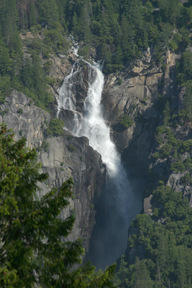
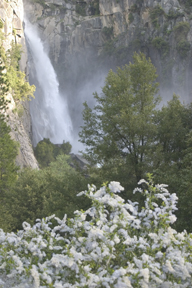
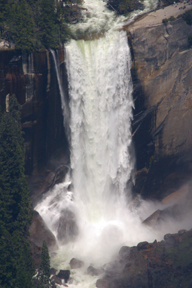
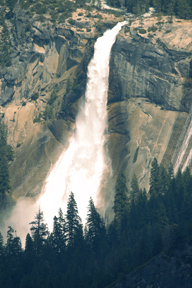
We decided to avoid Yosemite Valley entirely today, and go instead to Washburn Point. From there we could see Nevada Falls and Vernal Falls at the same time, forming "The Giant's Staircase."
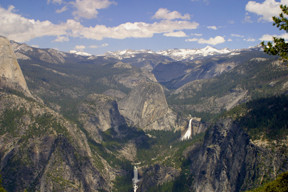
Glacier Point was not far away and we joined a crowd of people looking out over Yosemite Valley. We had a stright-on view of Half Dome, and The Giant's Staircase.

With my new 500 mm lens, I tried some closer shots of Nevada Falls and Vernal Falls.
click here to see "Saturday in Yosemite"
Click to return to Main Menu of Zoe Trips