
A Tale of Two Cities By Four People
My Visit to London & Paris
June 26th - July 15th 2010

Tuesday, July 6
 |
he Paris story actually began in London. We had to go through French customs before we could board the Chunnel train bound for France; by traveling underneath the English Channel. We arrived early, so as to have plenty of time in case of complications (we have found this to be very useful), and fortunately had no problems. Eventually it was announced (in both English and French) that our train was ready for boarding by going up a particular escalator. We found our car and reserved seats easily; but I was surprised that it was just open seating like on a bus; rather than compartments as in Italy. Baggage was no problem, since each of us had just one bag. The car was very comfortable. The clickity-clack of our trains was silent, conversation was easy, and the car was clean and new-looking, although these trains have been running for some years. |
London is a fair distance from the coast, so we passed through a lot of countryside. These new trains go very, very fast. I had seen speed limit signs of 80 to 90 KM/Hr! I wanted to show you what the countryside looked like, but this is what came out. Our route went underground several times, and then resurfaced and I wondered if the designers planned it to determine if anyone was likely to freak out underneath the English Channel. No one did; probably because most of London’s Tube system is underground.
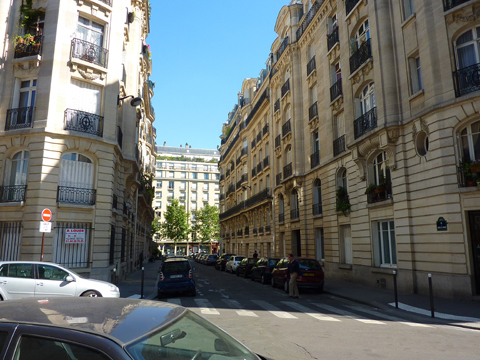
Our apartment is on the top floor of last building on the right
The Metro is the French term for their subway system, and we found that it worked much like the British Tube. We already knew the French name for the stop where we would live, so that was no problem. We easily found our street, and our 5th floor apartment; and when we walked in; this is what we saw:
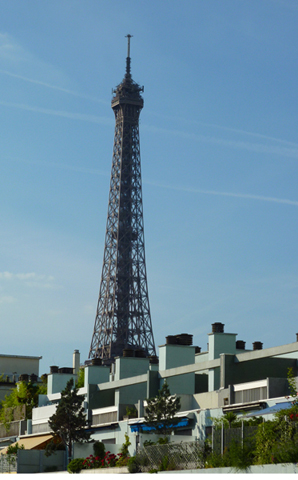
View from our apartment window: The Eiffel Tower!
What could say Paris more eloquently than the Eiffel Tower? This view from our living room/bedroom/dining room dominated our entire visit.
Of course, that evening we all wanted to walk over to the Eiffel Tower, which was farther away than it appeared.
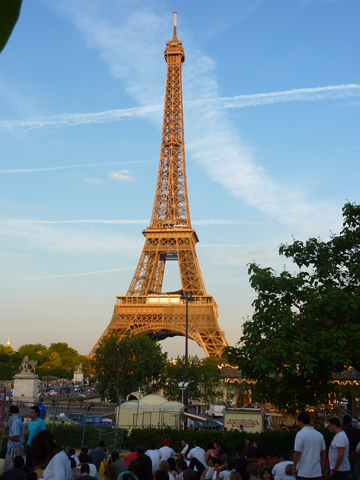
The Eiffel Tower is 1063 feet tall, and when it was built, it was the tallest building in the world.
Even though it is constructed of 7,300 tons of metal and 60 tons of paint, it is so well engineered that it weighs no more per square inch at its base than a linebacker on his tiptoes.
Gustave Eiffel, a bridge builder, won the contest to build the Tower as the centerpiece of the 1889 World’s Fair. Another rival proposal was a giant guillotine. After a year and a half of work, the tower had already surpassed the previous tallest building in the world – the Washington Monument which had required 36 years to reach 555 feet. It was not intended to be permanent, but was so popular, that no one got around to taking it down.
It was very crowded and we were tired from our trip from England, and decided to wait for a better situation before adventuring up into the tower.
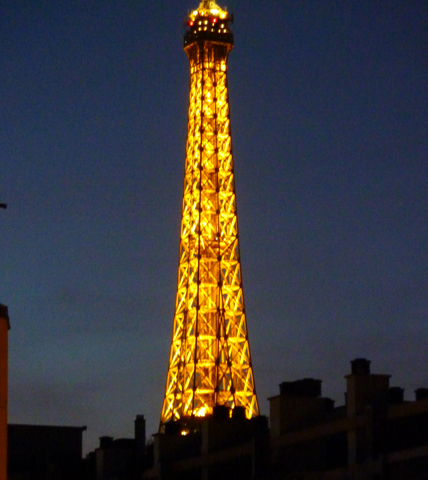
We discovered that the Eiffel Tower is lit at night, making a beautiful beacon for us to watch from our apartment windows.
Wednesday, July 7
My leg was bothering me so I decided to spend the day resting it. I gave my camera to my children, and asked them to take some pictures for me. They went first to the Rodin Museum.

The Thinker
The Cleveland Museum of Art has a copy of this very famous statue at it main entrance.

The Kiss
This was the first of Rodin’s statues that the public liked.
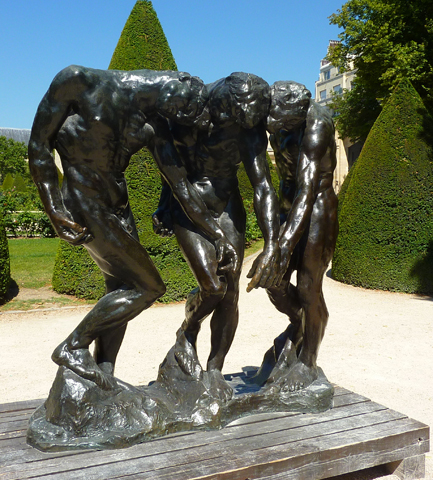
The Three Shades
Beseiged by the English in the Hundred Years War, the city of Calais was to be destroyed unless six men were willing to sacrifice themselves in its place. King Edward offered to spare the people of the city if its six leaders (the Burghers) would surrender to him. Edward demanded that they walk out from Calais, bringing to him the keys to the castle. Rodin sculpted these six men who have volunteered to die to save their city, and are trudging to their execution. So impressed was King Edward III by their courage, that he set them free and spared the city as well. This is said to be a true story.
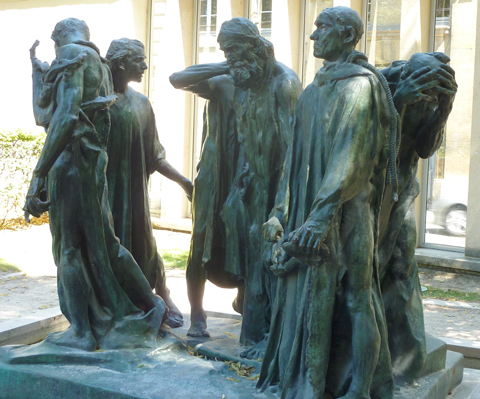
The Burghers of Calais
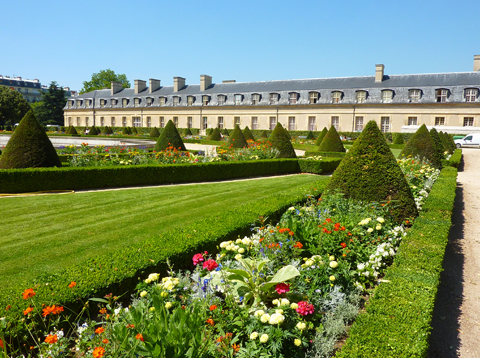
Gardens outside the War Museum
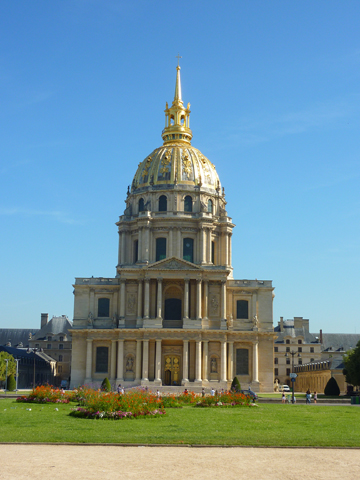
Les Invalides, which holds Napoleon's Tomb
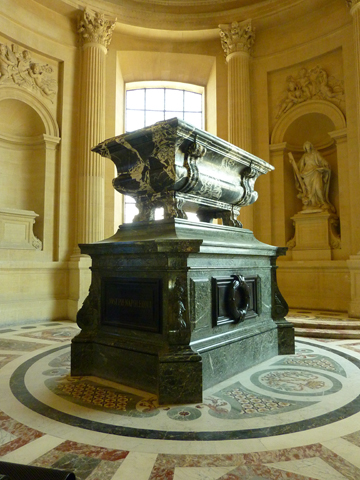
Tomb of Joseph Napoleon (Bonaparte's brother)
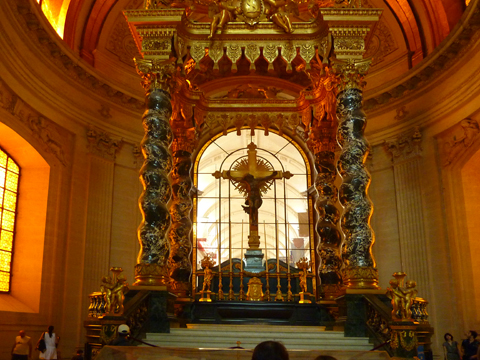
Altar of chapel inside Napoleon's Tomb

Interior of dome over Napoleon’s tomb
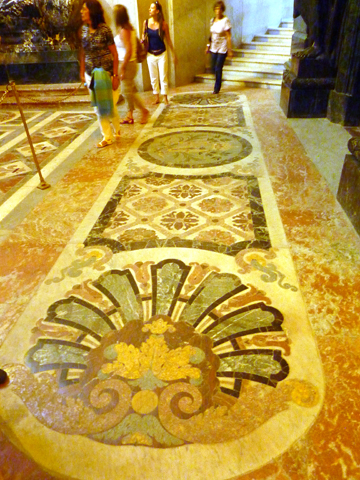
Mosaic floor inside Les Invalides
In the evening, we decided to go up in the Eiffel Tower. All of us had been looking forward to this as a very important activity.
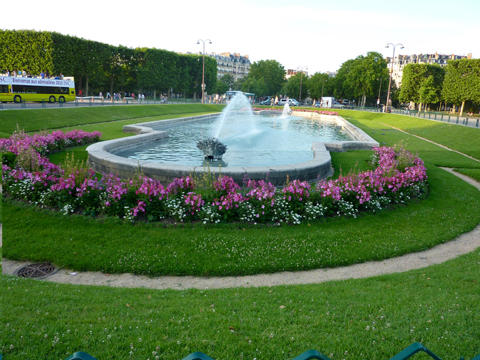
Fountains and flowers on the Fields of Mars (Champs de Mars)
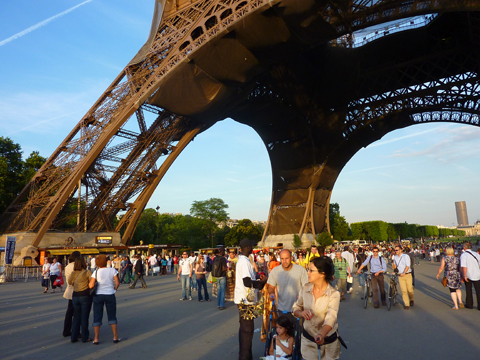
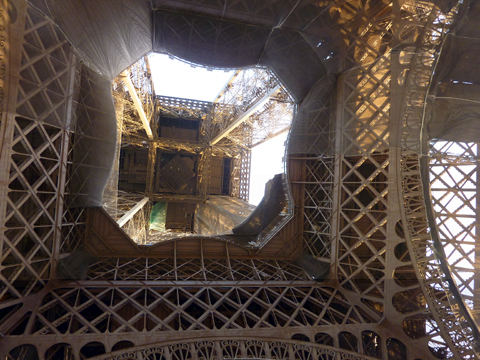
Looking up through the base of the Eiffel Tower
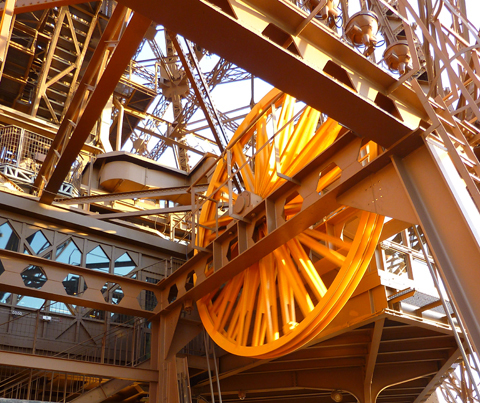
These huge wheels lift the elevators up and down.
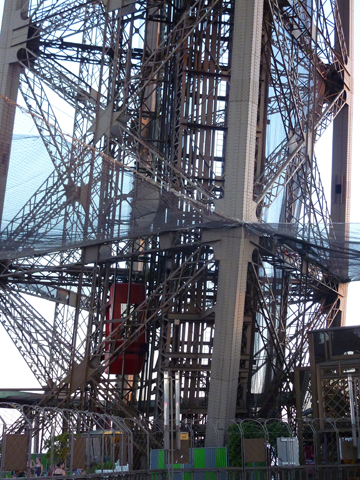
This photo shows the intricate structure of metal girders that form one leg of the Eiffel Tower.

Champs de Mars as seen from the top level of the Eiffel Tower
Napoleon had the Arc d’Triumph commissioned to commemorate his victory at the battle Austerlitz. It has been the setting for many triumphs: Napoleon’s funeral, the arrival of the Nazis, and the return of Charles de Gaulle after the Allies liberated Paris. It is possible to climb 284 steps to the top, and look out over the city. Around its base is a traffic circle with every imaginable form of transportation whizzing at dizzying speeds. It became so difficult to reach the Arc d’Triumph that a tunnel was built under the highway, to allow pedestrians to experience the Arc.
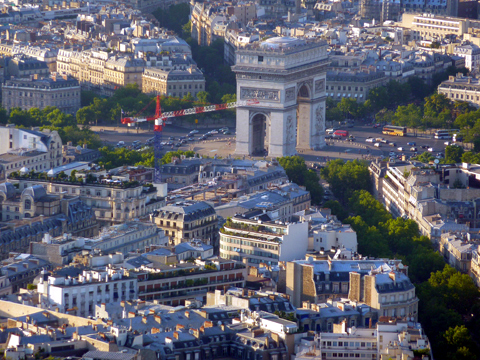
The Arc d’Triumph stands out in this view
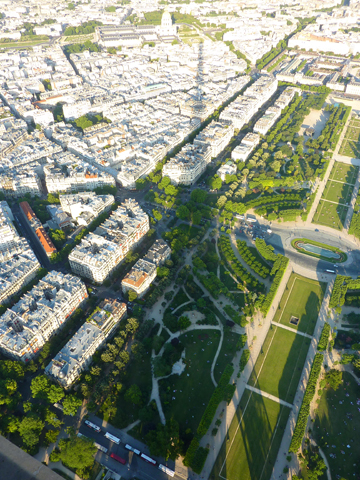
The Shadow of The Eiffel Tower covers a large portion of the city.
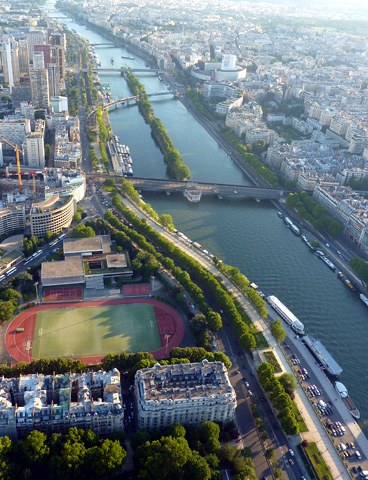
The River Seine is prominent in this picture.
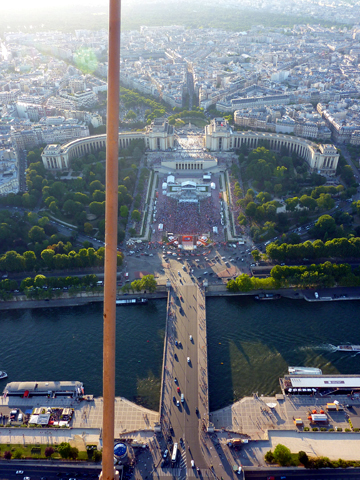
A Bridge of the River Seine leads to the Trocadero
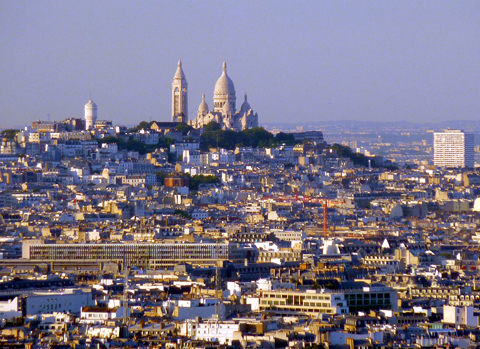
Sacré Coeur Basilica is easily seen on top of this hill.
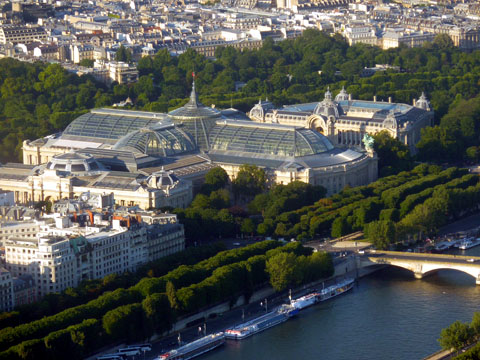
The Grand Palais (Grand Palace).
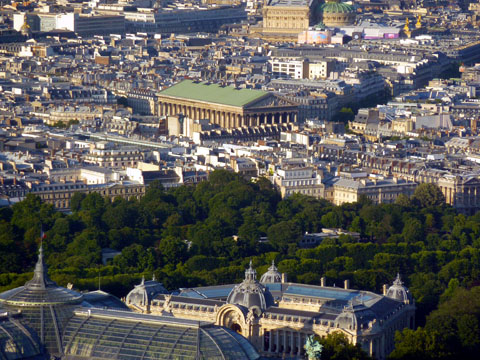
The L'église Sainte-Marie-Madeleine, a Roman Catholic Church dedicated to glory of Napoleon's army

These fountains appeared as drinking cups. They spurted a flash of water at unequal intervals from one cup to another.
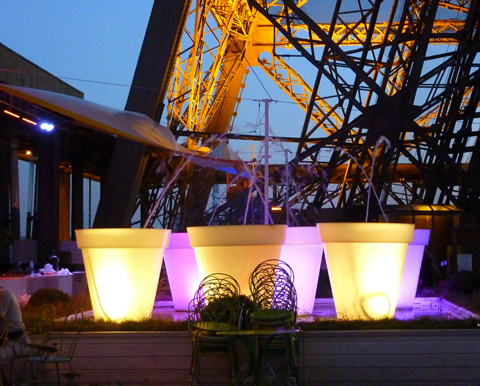
Look closely to notice I caught all four cups spouting at once!
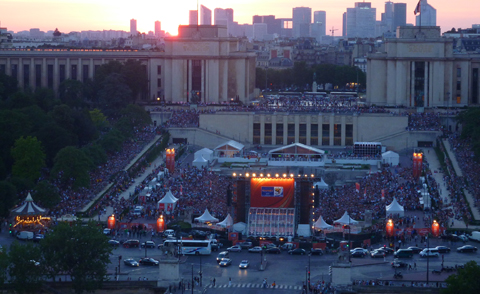

A large portion of the population of Paris was watching the World Cup soccer match on a gigantic screen.
The Louvre
|
he Louvre is the largest museum in the Western World, with 30,000 works of art covering the ancient world to 1850. You could spend days in there. |
This glass caused considerable controversy, when it was built as the museum’s new entrance.

Entrance to the Louvre
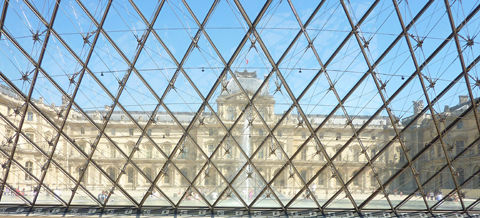
The Louvre viewed from inside the glass pyramid

Castle portion of the Louvre The Louvre is U-shaped of 3 palaces connected to each other.
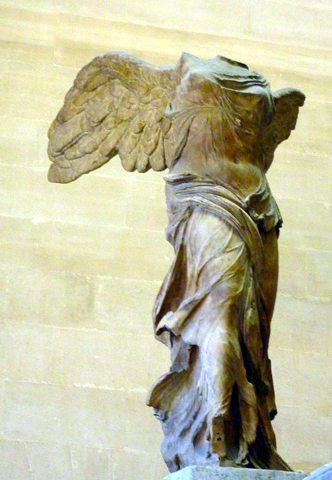
Winged Victory of Samothrace. Her arms (when she had them) were stretched up high; giving her the image of immense strength.
Of course, everyone who comes to France wants to see Leonardo daVinci’s Mona Lisa. The curators are well aware of this, of course, and have placed signs at every corner, directing the mobs toward the “Mona Lisa”. There is an immense room hung with paintings, but all attention is on the Mona Lisa. The audience mills around trying to get close enough for a photo of themselves with the famous lady. No flash pictures are permitted. What impressed me the most, was that I was looking at the same piece of canvas that Leonardo daVinci actually put his own paint onto so many years ago. This was REAL! I am so tired of reproductions, and look-alikes, and fakes; but this was the genuine article, and I was seeing it.

The Mona Lisa
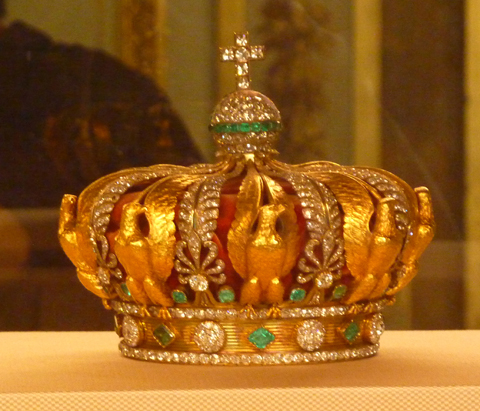
This shows the coronation crown of the Empress Eugenie, with the Balais Ruby, known as the Eagle of Poland.
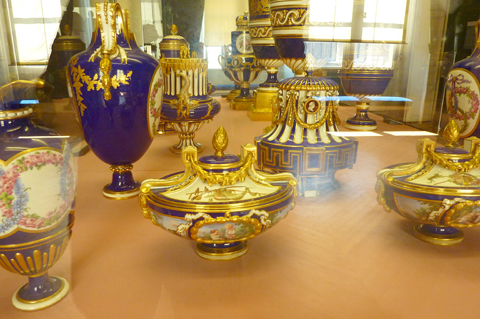
This display includes the Coronation crown of Napoleon 1st, and the smaller crown of the Empress Eugenie
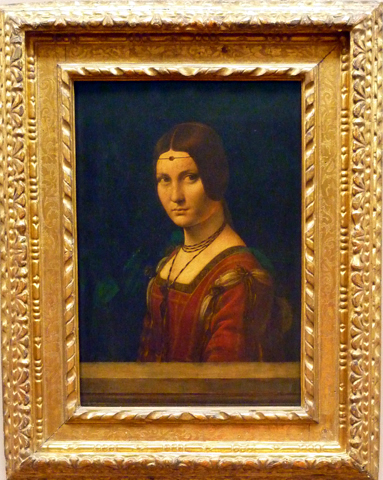
“La belle ferronnière” by Leonardo da Vinci, also called Portrait of an Unknown Lady
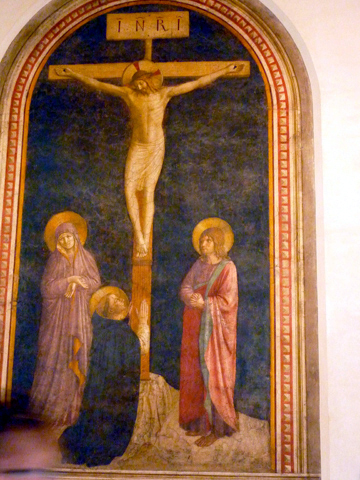
“Crucifixion with St. Dominic” by Fra Angelico (Guido di Pietro)
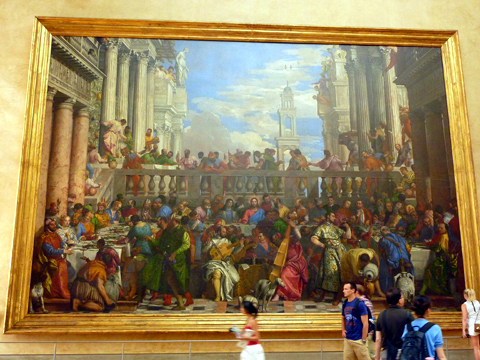
“Wedding Feast at Cana” by Paolo Veronese
There were so many more, but I mention these because they are by the best-known artists. I never found Michelangelo’s work.
All of museum touring required a lot of walking because the buildings were huge (remember they were originally palaces), and each had several floors). At last we went outside and sat down to rest by the fountains in the courtyard.
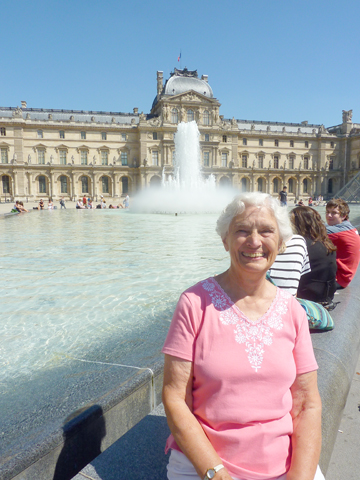
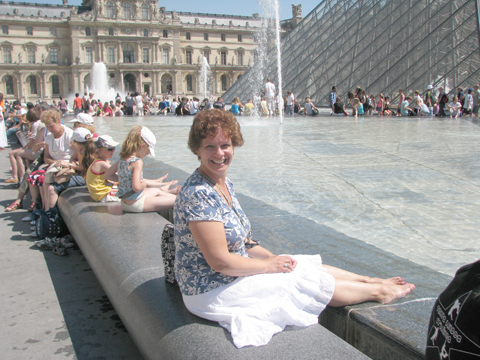
Lil cooled her tired feet in the pool.
Friday, July 9
Versailles
 |
ersailles is the dream palace of every king. The powerful court of Louis XIV at Vesailles set the standard of culture for all of Europe, right up to modern times. It has 3 main attractions: the Chateau the main palace itself, the Gardens with beautiful statues and fountains in addition to plants of every type, and Domaine de Marie-Antoinette, country-like area with several small palaces – a great place to avoid the mobs at the Chateau. |
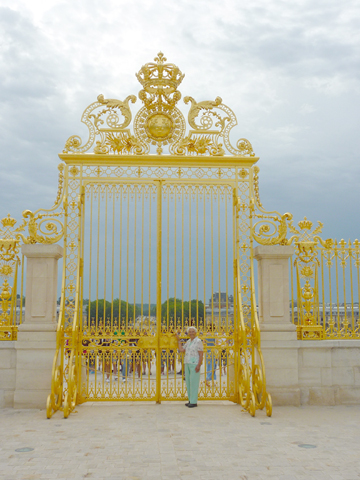
I'm standing at the front gates of Versailles

Detail of ornate front gates at Versailles
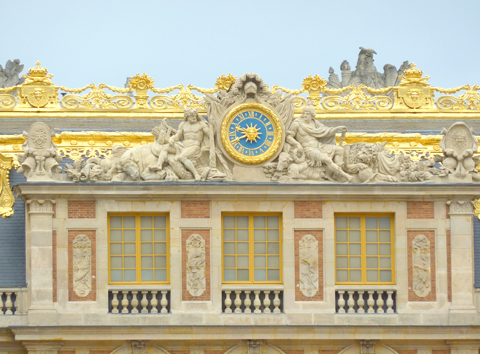
Clock mounted above front entrance of palace of Versailles
We took the tour with an audio guide.

Louis XIV by Philippe Vignon
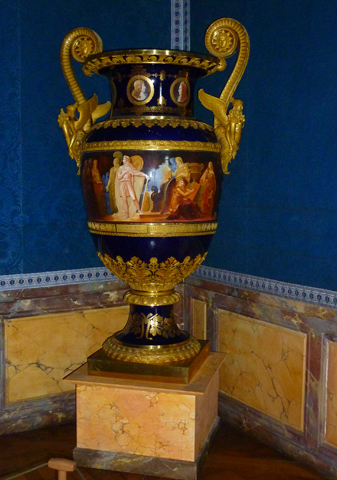
Beautiful Porcelaine Vase
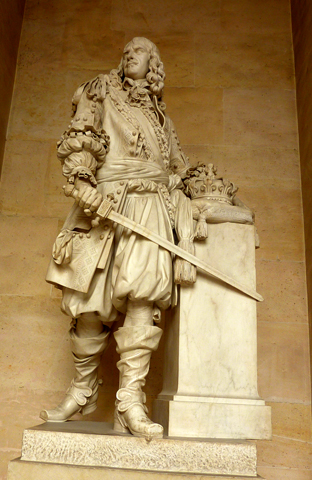
Turene, Henry de la Tour d’Auvergne vicomte de (1611-1675) Maréchal de France
This was called the “Chapel,” but it was more like a large church. When King Louis XVI got up in the morning to pray in this chapel, he was the only person who faced the altar. All the nobles present faced the king, who almost made himself a god. He was said to be one of history’s most polite and approachable kings, a good listener who could put even commoners at ease in his presence. Entry into the chapel was prohibited to tourists, so the best we could do was to look through the door opening, along with several hundred other people who were trying to do the same thing.
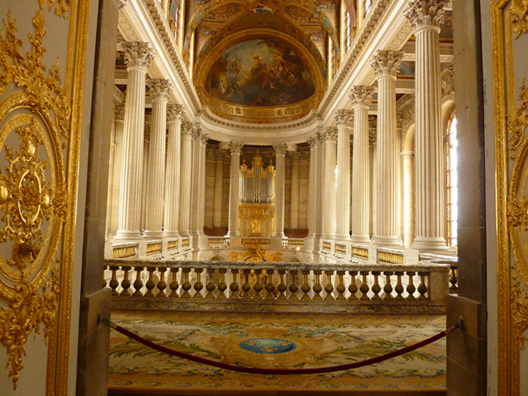
Chapel of Versailles

Closeup of the organ in the chapel
Europeans went to great lengths to paint masterpieces on their ceilings as well as walls and floors.
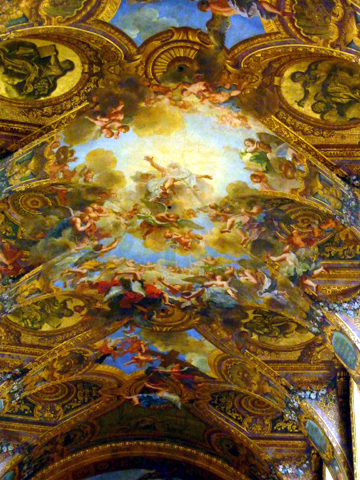
Painted ceiling
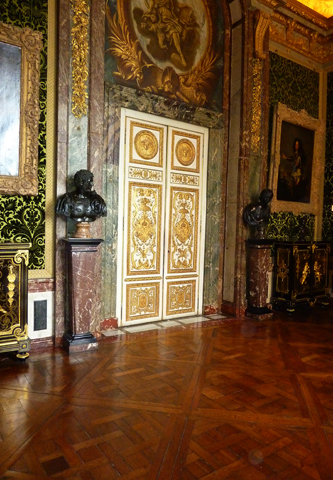
Everything in this room is decorated, even the door.
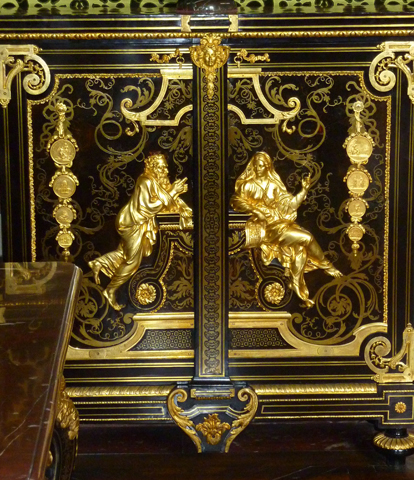
What a beautiful cabinet!
The palace was indeed fabulously beautiful, but it was somewhere around 90°F that day and humid. It was a pleasant change to be able to glance outside at Versaille’s famous gardens, which appeared at least, to be cool.
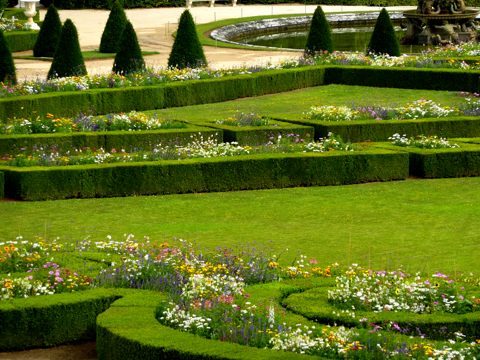
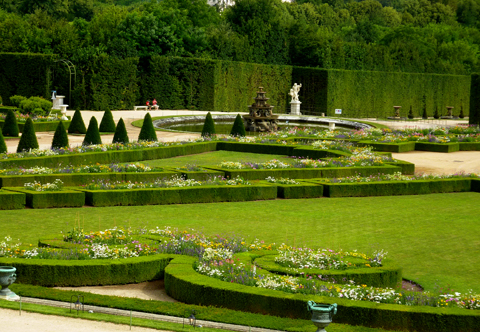
Gardens of Versailles as seen from the palace windows
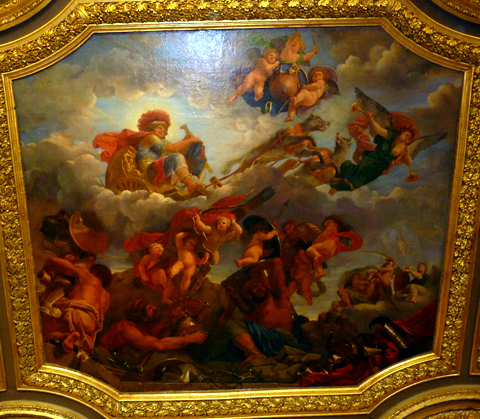
The ceiling in another room depicted a battle.
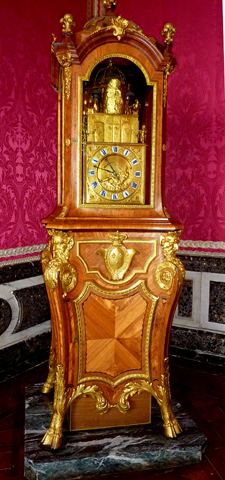
A beautiful clock! The time was accurate too.
The Hall of Mirrors
 |
hen it was opened, no one had ever seen anything like this hall. Mirrors were a great luxury at the time, and the size and number of them were amazing. The hall is nearly 250 feet long. There are 17 arched mirrors, matched by 17 windows letting in a breath-taking view of the Gardens. Lining the hall are 24 gilded candelabra, 8 busts of Roman emperors, and 8 classical-style statues (7 of them ancient). The ceiling decoration depicts Louis’ military accomplishments. |
In 1919, Germany and the Allies signed the Treaty of Versailles, ending World War I right here in the Hall of Mirrors.
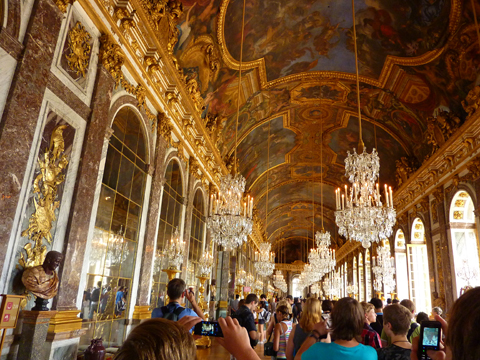
Overall view of the Hall of Mirrors

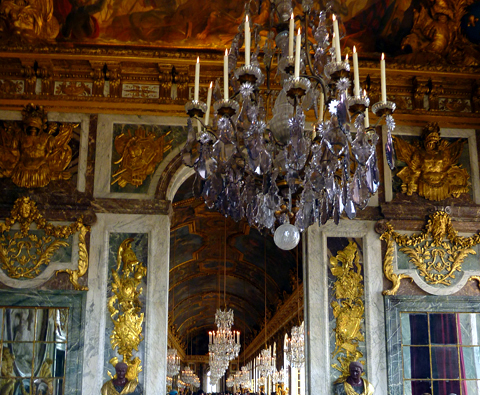
Chandeliers in the Hall of Mirrors

Horse & Rider plaster cast on the wall
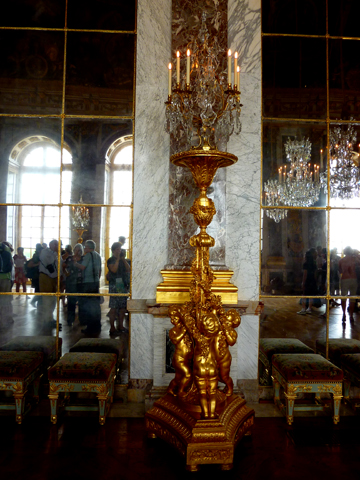
Golden candlestick & Mirrors
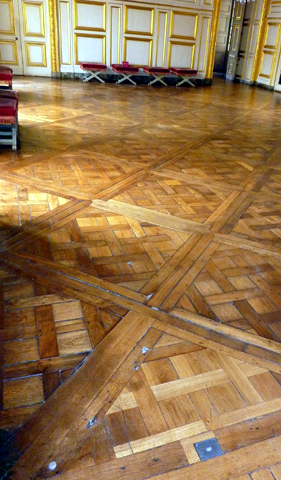
Inlaid wood floor

Chandelier close-up
The Queen's Rooms
|
he next point on our audio-guide conducted tour was the Queen’s area. The first object that stood out was this beautiful clock. |
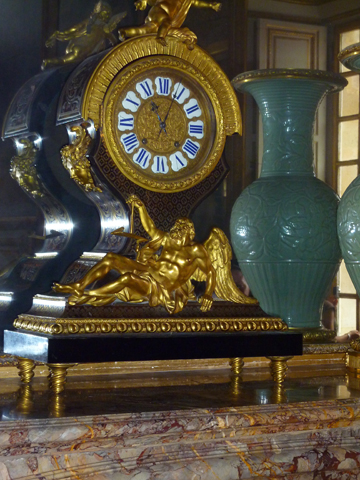
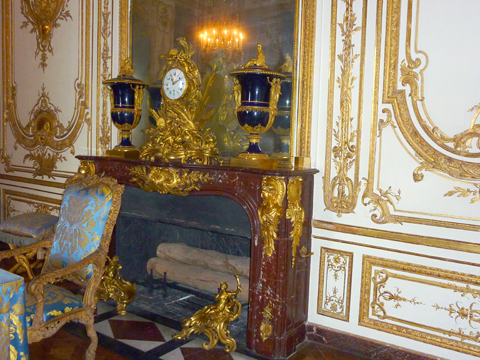
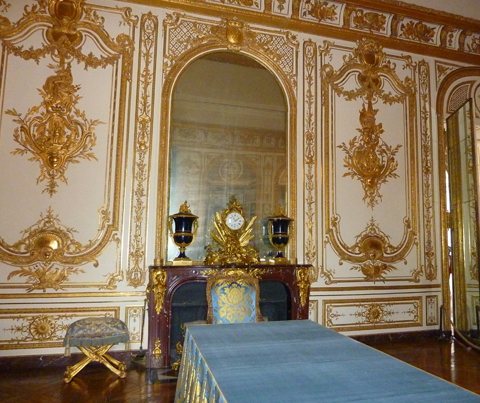
Next came her meeting room.
Notice all the gold around her fireplace. Despite the fact that these were the most important people in their world, they did not have central heating, and had to heat everything with logs on the fire. There were candles in the chandelier, to light the beautiful paintings on the ceiling.
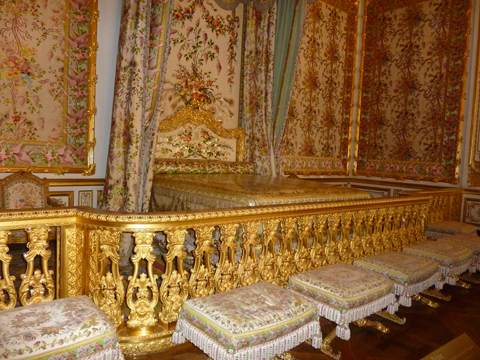
Even the railing around the queen’s bed was gold!
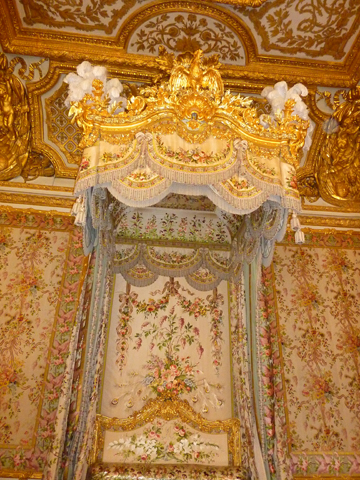
A canopy headboard fit for a queen.
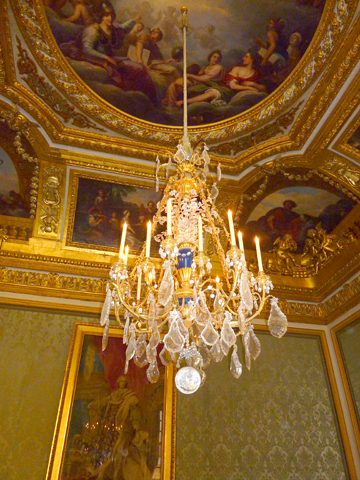
A bedroom ceiling light
Back On The Versailles Tour

The view through a window over the beautiful gardens of Versailles.
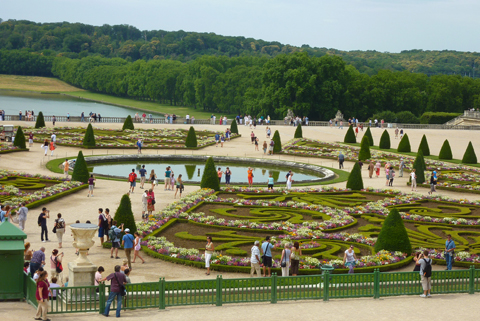
Looking out over the beautiful gardens.
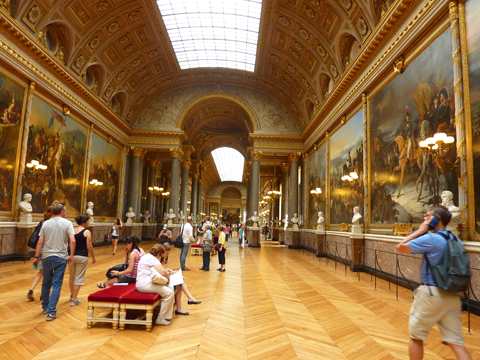
There was a very large Hall of Battles, even longer than the Hall of Mirrors, which celebrates the great French battles from the 6th century to 1830 with 33 grand paintings and many busts of military personnel.
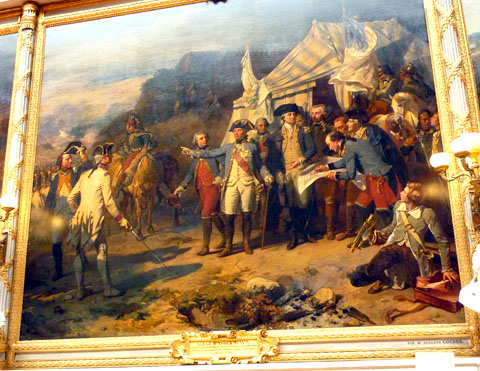
General Rochambeau and General Washington at Yorktown 1781. I was surprised that they would include this, since we were their allies rather than their enemies.
The Famous Formal Gardens of Versailles
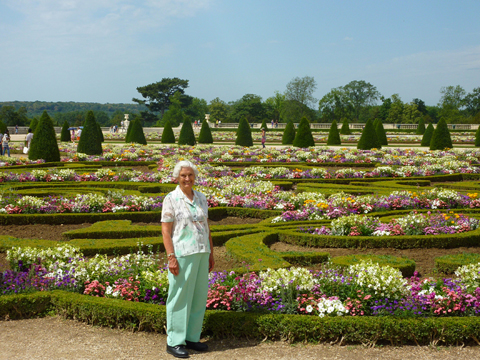
I loved admiring the beautiful gardens.
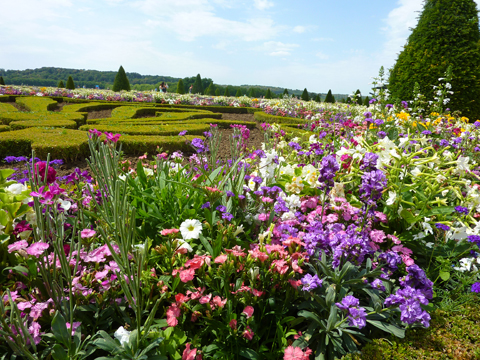
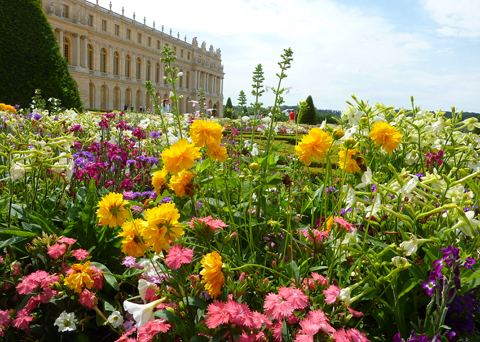
Small groups of bright flowers were beautifully arranged.

Statuary was everywhere.
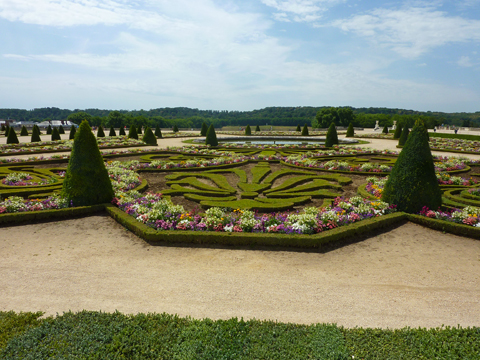
More formal gardens...
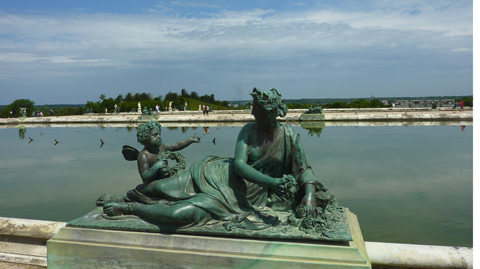
...and more statuary.
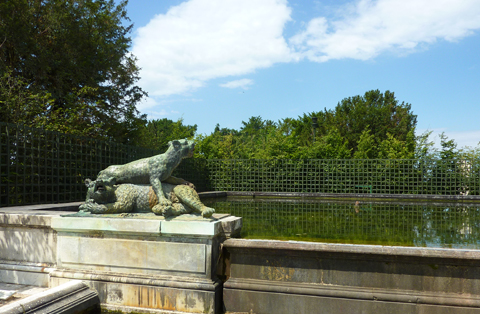
Cheetahs were popular at this time, and these were assigned to guard this pool.
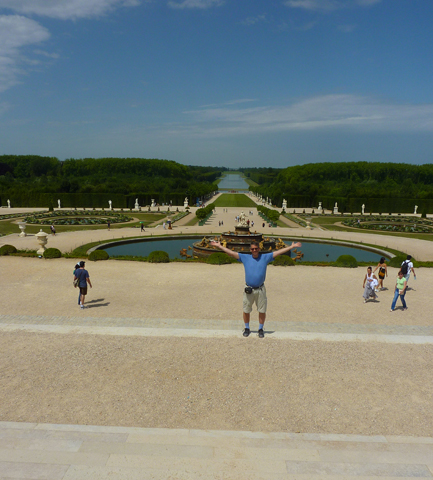
The Grand Canal. The Grand Canal is 1 mile long, man made for the sole purpose of pleasure. Barges would float around on it, playing music for the entertainment of guests in boats being poled by boatmen as in Venice.

The back of the palace - the Hall of Mirrors is on the second floor
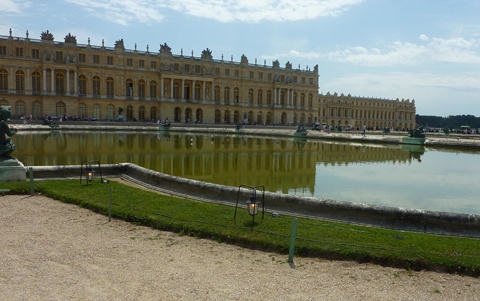
The back of the main palace, viewed from the side

Perfectly trimmed trees bordered this aisle.
Marie Antoinette’s Grand Trianon Area
|
hen Marie Antoinette became queen as Louis XVI became king, he gave her this building. It was called the Petit (small) Trianon, where she could get away to the simple home life of her childhood in her native Vienna. It is said she longed for the life of a peasant – not the hard work of one, but a fairytale world of the pleasures of being outdoors. She built her own complex of 12 buildings as her own private village. It became an actual working farm with food served at her table. |
Each room was furnished with a different color scheme.
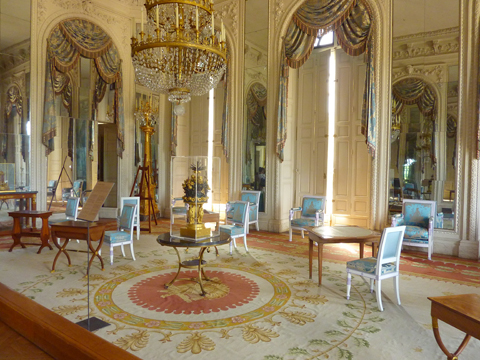
A Sitting Room where the Queen could receive guests
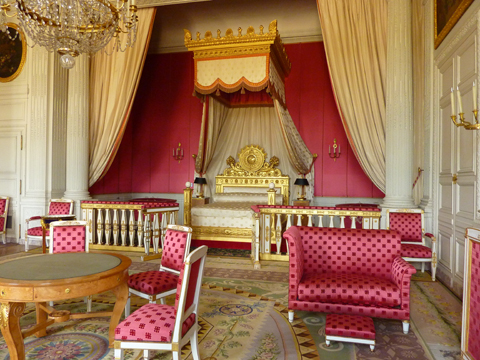
Marie Antoinette’s Bedroom
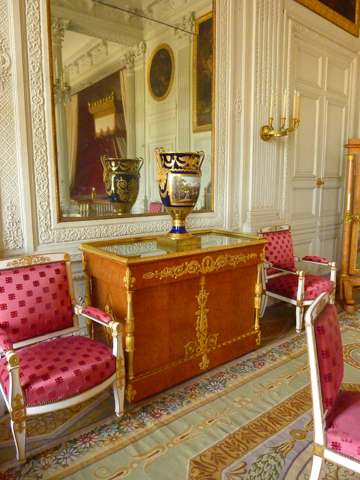
Lovely pink furnishings were scarcely country-like
Even the chairs showed needlework
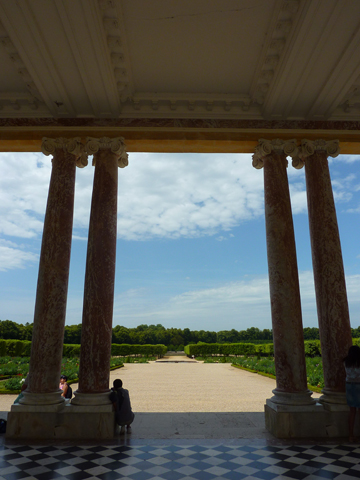
Looking into the gardens
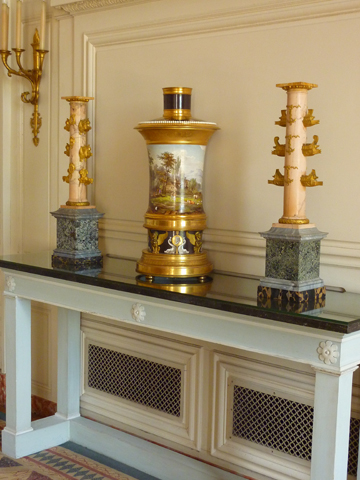
I wonder if these decorations were Marie Antoinette’s idea of simple country life

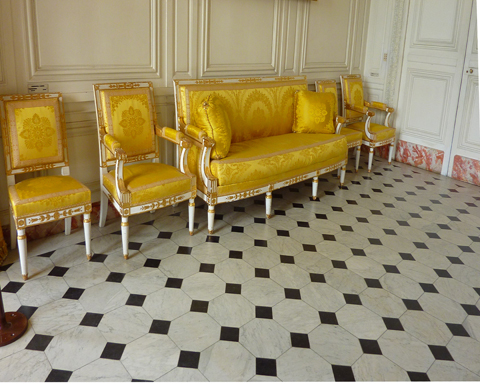
An all yellow room was pretty
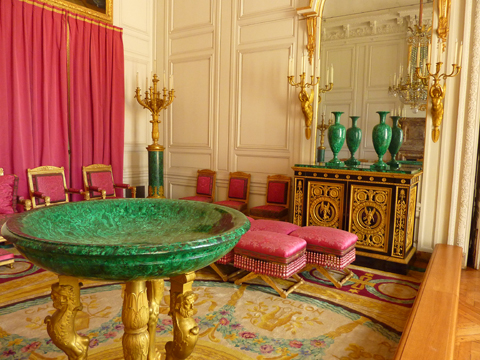
Green stone brought out the pink furnishings
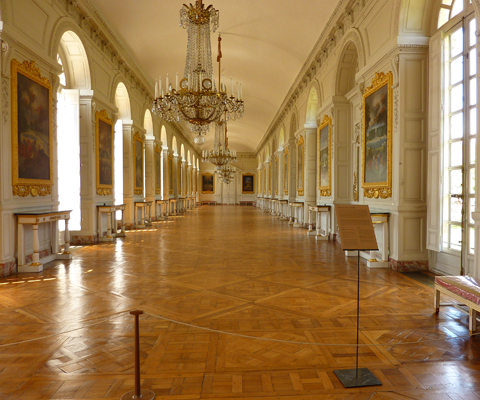
A gallery of paintings
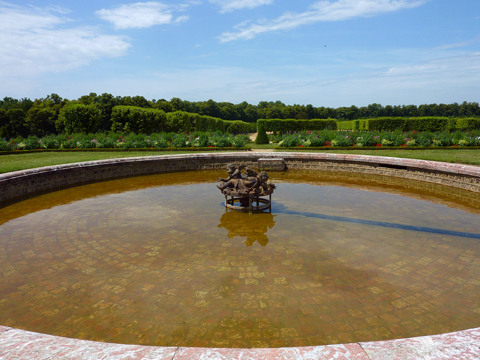
Row upon row of manicured trees surrounded beautiful pools
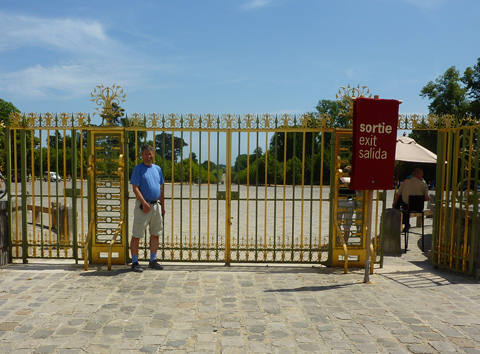
Art waited at a golden gate, which was our exit from the gardens
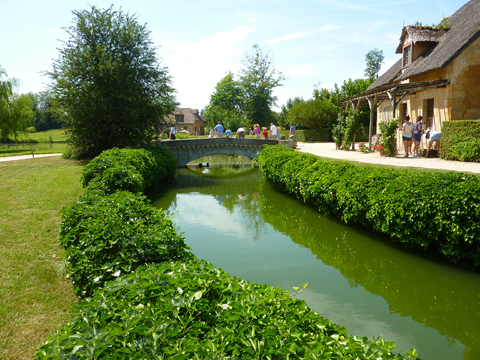
Scenes in Petit Trianon and the Queen's Hamlet
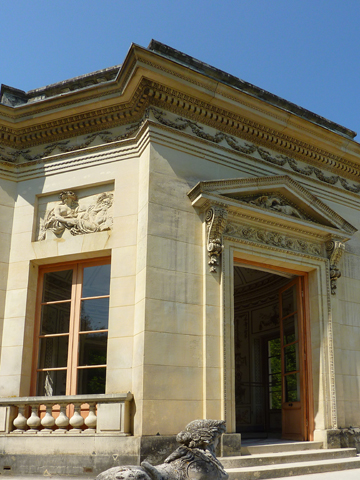
One of the entrances to the Petit Trianon
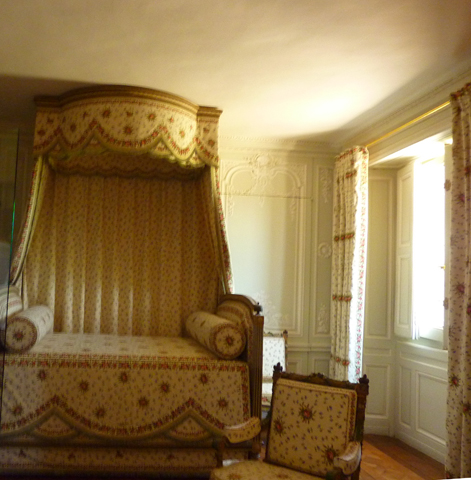
A smaller room, but nicely trimmed
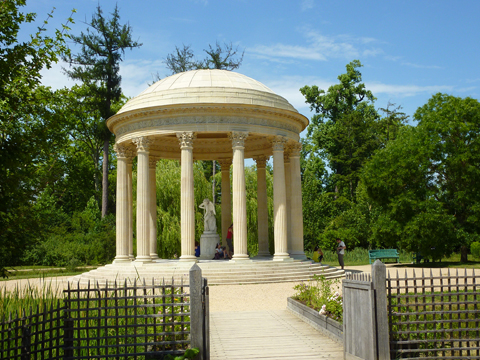
The Temple of Love
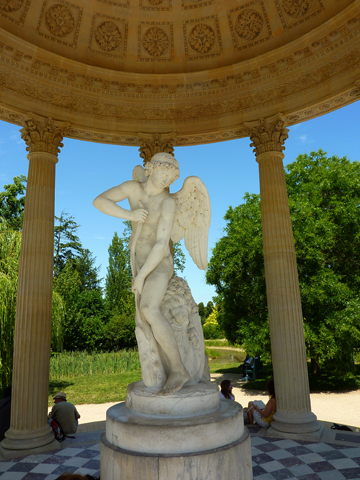
This is the statue inside the Temple of Love
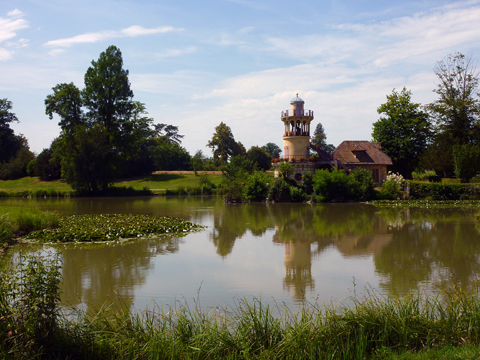

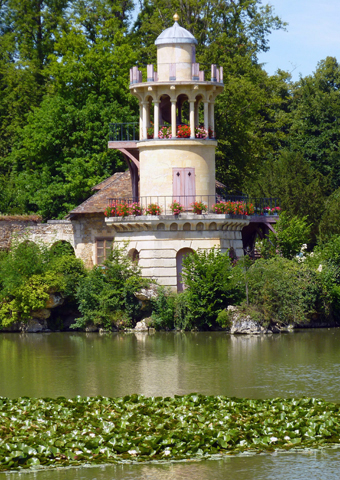
The Marlborough tower - also known as the Fishery Tower

Farmhouse
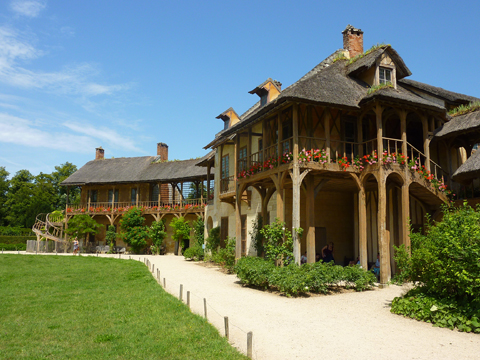
Hameau de la Reine (The Queen's Hamlet) (1783)

Another view of the Queen's House
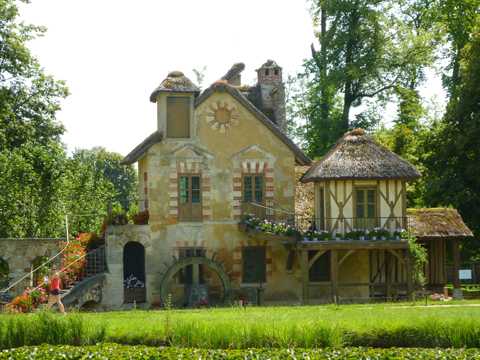
The Mill

Side view of the Mill
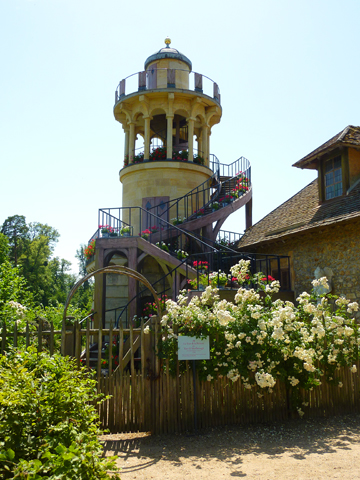
Another view of the Marlborough tower. Signals could be sent from the palace to watchers in the Marlborough tower.
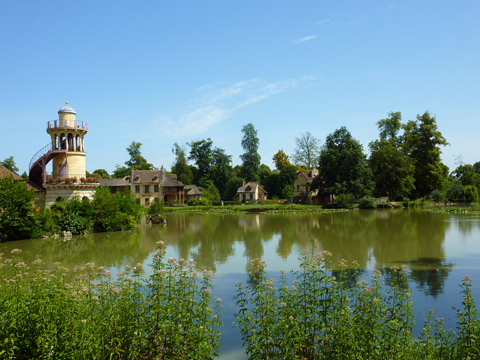
The buildings of the Queen's Hamlet sit around a small lake
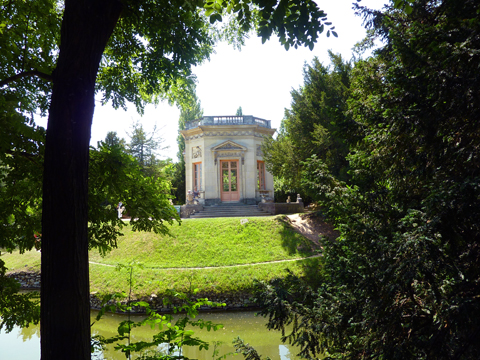
The Belvedere, a tea house beside a small lake
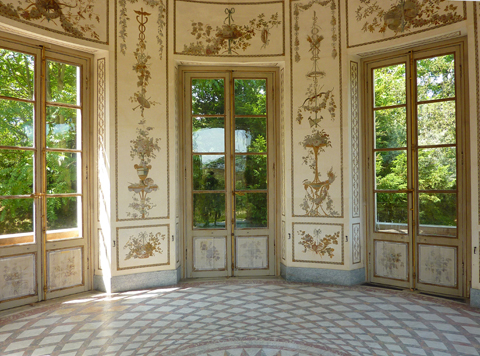
The interior of the Belvedere. The entire building was well planned.
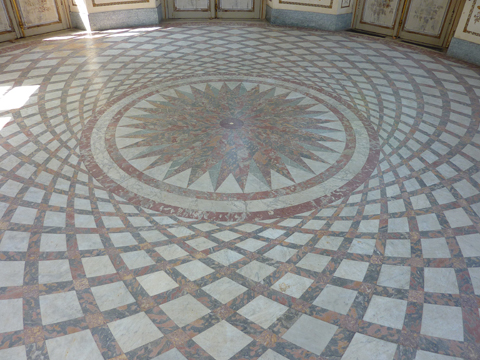
The tile floor of the Belvedere had a beautiful pattern
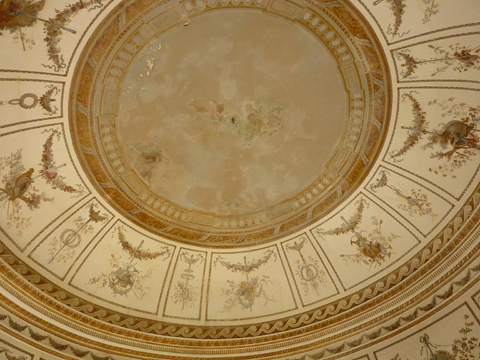
The Belvedere ceiling had even been carefully designed.
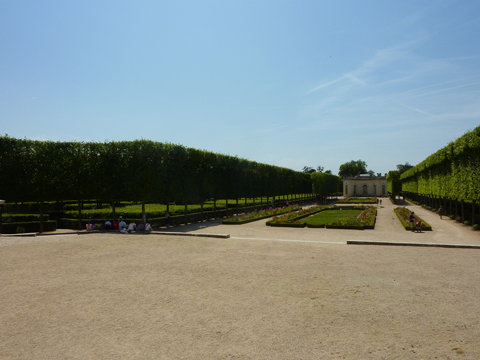
Perfectly manicured trees led to this delightful salon.
Notre Dame Cathedral
Saturday, July 10
|
his magnificent church took 182 years to build. It can hold 10, 000 people. The columns to the ceiling are 10 stories tall – the height of a 10 story building. |
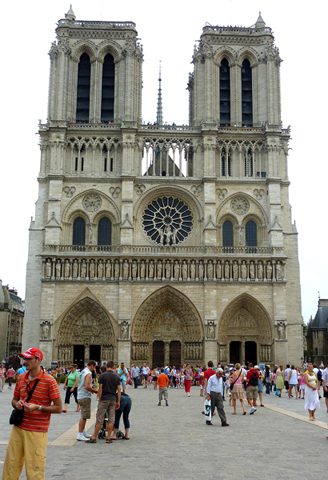
Our first look at Notre Dame was impressive. It makes you stop and search for all the detail in this beautiful and important church.

The twin bell towers of Notre Dame cathedral
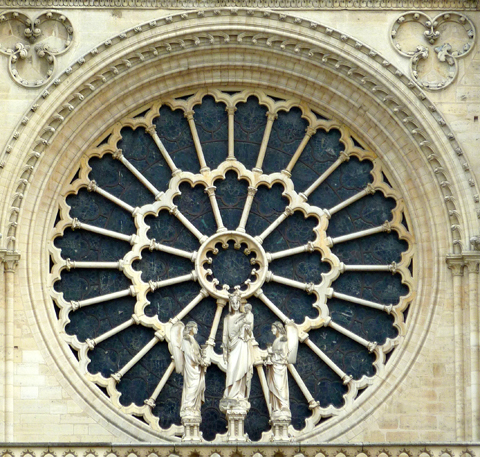
Notice the Rose Window. All round windows are called Rose Windows.
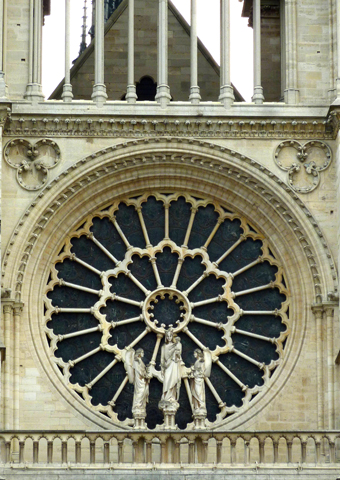
In this round window, called a “rose window” the Blessed Mother holds her precious baby, whom all the world has waited for.

These 28 statues represent the 28 kings of Judah. During the French revolution, the rioters mistook them for the hated Catholic hierarchy and chopped off all their heads. However, a schoolteacher who lived nearby, collected all the heads and buried them in his backyard for safekeeping. They remained there until 1977, when they were accidentally unearthed.
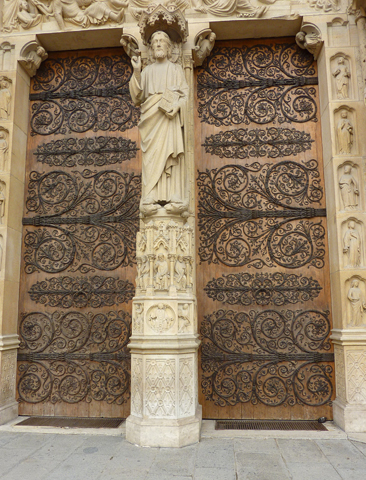
The huge entry doors
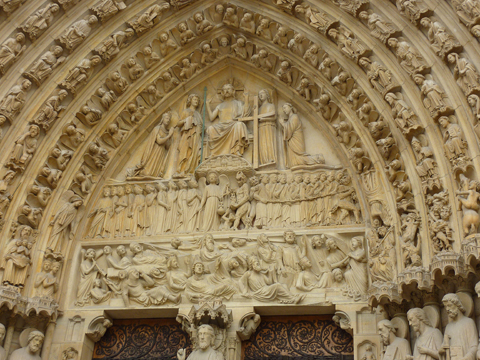
There are 3 doorways into the main entrance of the church. This is the center one. It depicts Christ as Judge at the end of the world, holding up both of His hands. Below Him an angel and a devil weigh souls in the balance. The devil cheats by pressing down. The good people stand on the left looking up to heaven and the wicked people on the left are chained up and looking down into hell.
Along the side of the church you will notice flying buttresses and gargoyles. These are 50 foot long stone beams that stick out of the church and make complex Gothic architecture possible. The pointed arches inside cause the weight of the roof to push outward instead of downward. The “flying buttresses” support the roof by pushing back inward. Gothic architects were masters at playing these forces against each other to make larger and larger churches, with more room for stained glass windows. Of course, then they had to decorate the extensions, called flying buttresses, with gargoyles
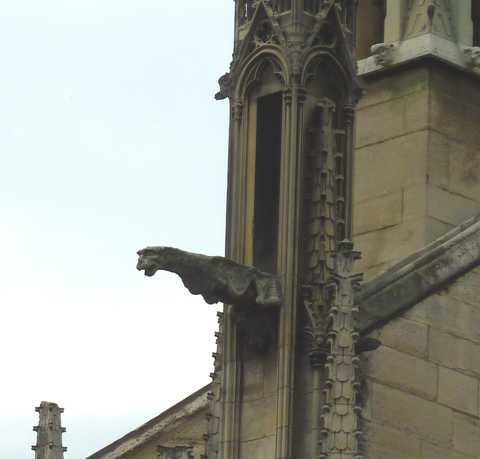
Flying buttresses
Let’s take a walk completely around Notre Dame. On our way we will admire the gardens and the architecture.
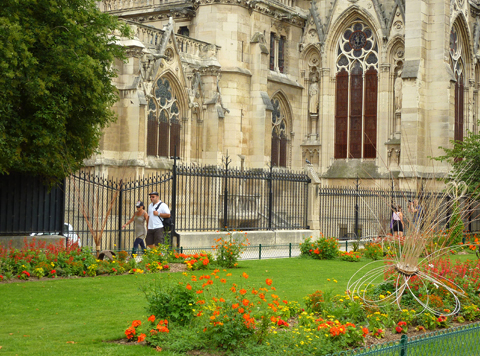
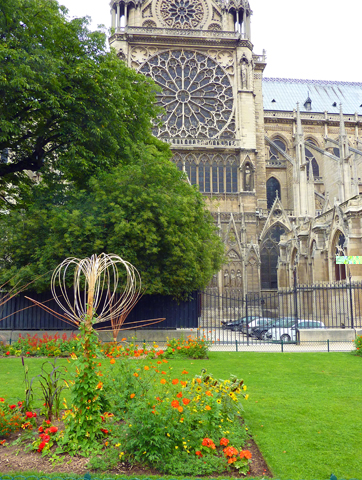
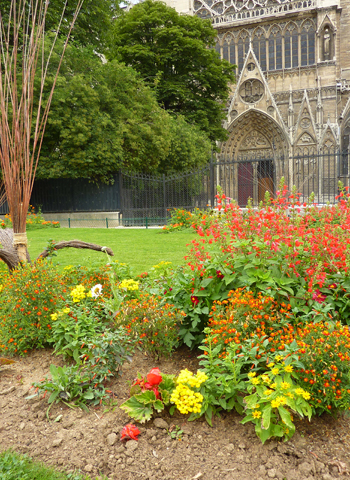
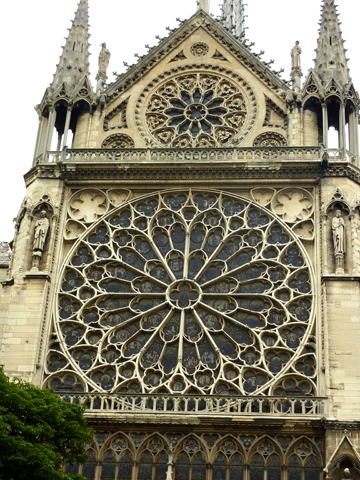
At the back of the church is another round “rose” window, but without the statues of the Blessed Mother and Baby Jesus.
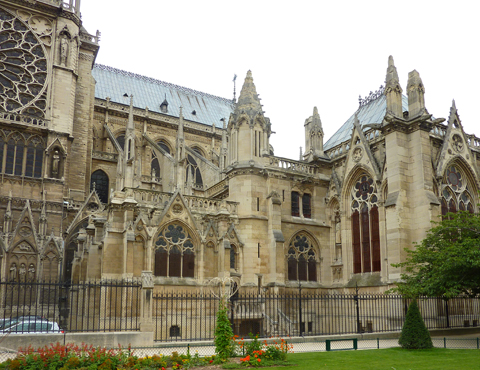
The side of the cathedral is beautiful also.

This side of Notre Dame faces the street, and across this street are many shops selling all sorts of souvenirs, and things to eat.
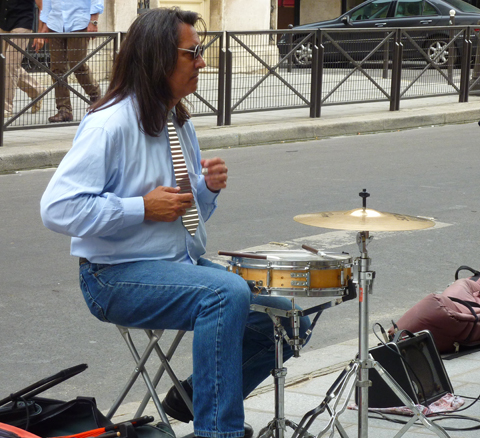
This musician was playing drums and keeping rhythm by strumming on the bars of his necktie. He did it so well that it was necessary to look closely to realize that it was his necktie that he was strumming.

These apartments across from Notre Dame are among the most expensive in Paris.
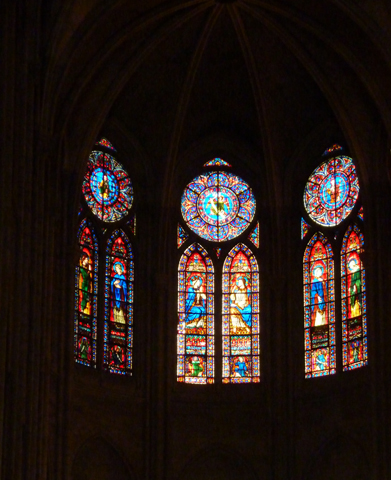
Stained glass window.
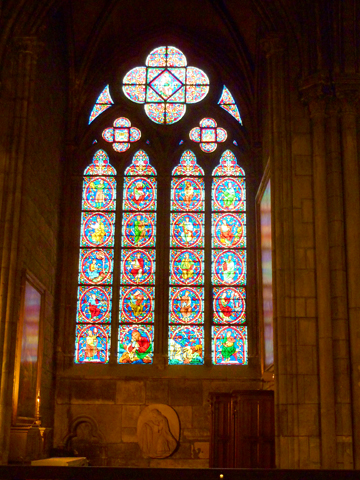
Stained glass window behind main altar
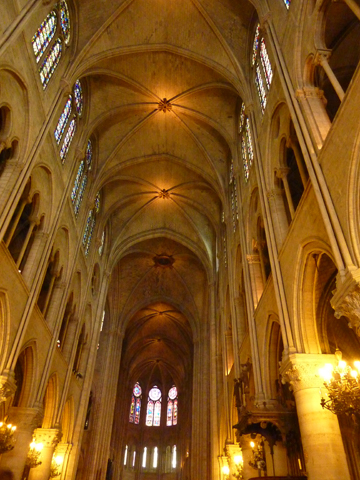
Inside Notre Dame cathedral
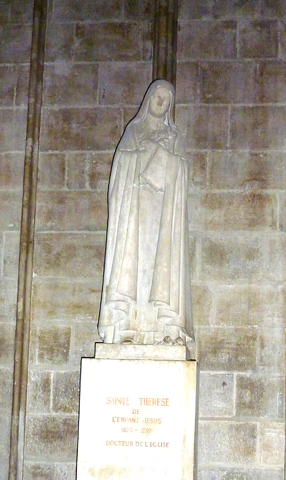
St. Therese of the Child Jesus
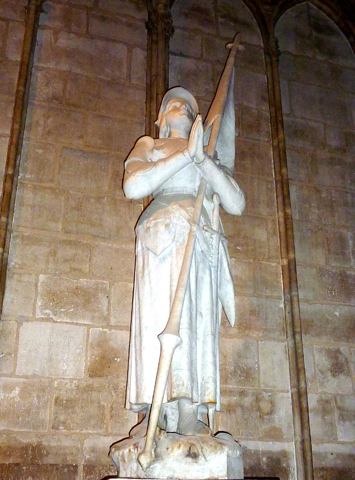
St. Joan of Art 1412-1431
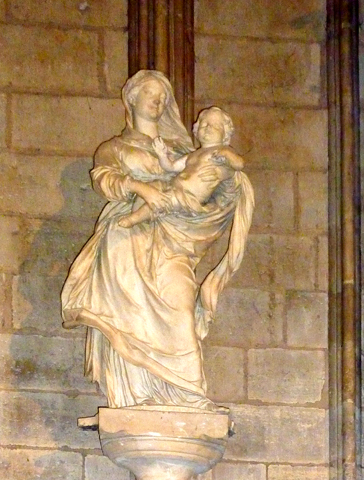
Blessed Virgin with Child Jesus
Arc de Triomphe
Monday, July 12
|
The Arc d’Triumph is an outstanding feature of Paris, and so we wanted to see it up close. We did walk through the tunnel under the street, and found ourselves in the circle which surrounds it. It was a very windy day, and although Melanie, Art and Lillian climbed up to the top; I stayed behind in the shelter of the massive stone. |
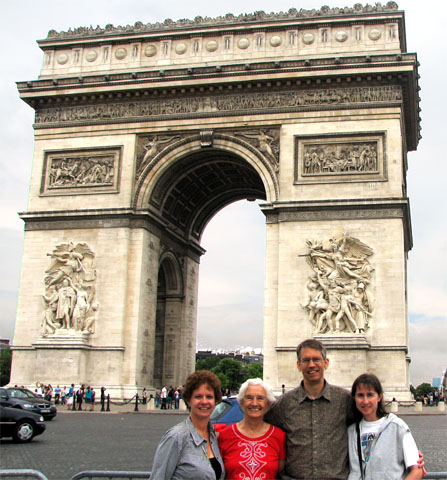
We posed for a group photo in front of the Arc
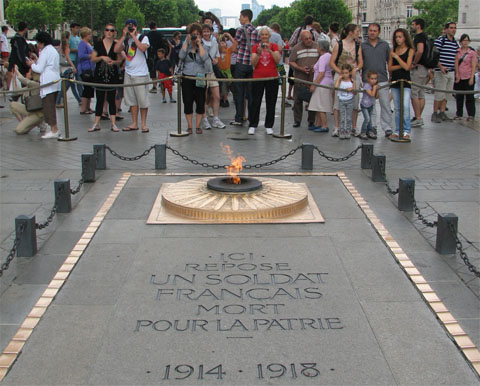
Beneath the arc lies a tomb for the Unknown Soldier of World War I

This street entertainer, dressed as an Egyptian pharaoh sat on a park bench, which rather spoiled the mood. Others I have seen,stood on a box. All were silent
Sainte-Chapelle
Sacre-Coeur
 |
Sacre-Coeur Basilica stands on the highest point in Paris (420'), and stands out with its white exterior, containing gypsum which whitens with age. It took 44 years to build, and was finally completed in 1919. |
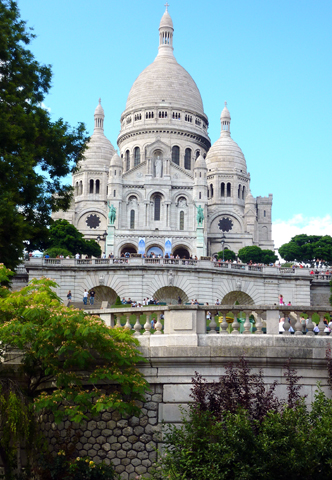
Sacre-Coeur, The Basilica of the Sacred Heart of Jesus of Paris
It has the amazing distinction of having at least one person continually in the church praying for Christ to be understanding of the world’s sins, 24 hours a day, 7 days a week ever since the church was completed! All through two World Wars, they have carried on. I find this amazing!
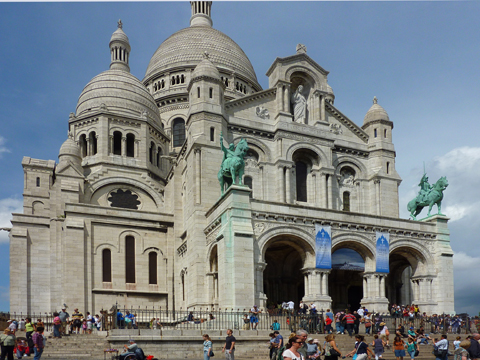
Close-up of the front of Sacre-Cœur Basilica
There is a plaque on the pillar where the 13 bombs of WW II that hit Paris – all in a line, all near the church – killing no one. Needless to say, devotion to the Sacred Heart was increased.
All of the church’s windows were broken by the concussions of WWII bombs, so all the glass that we see now is new from 1945.
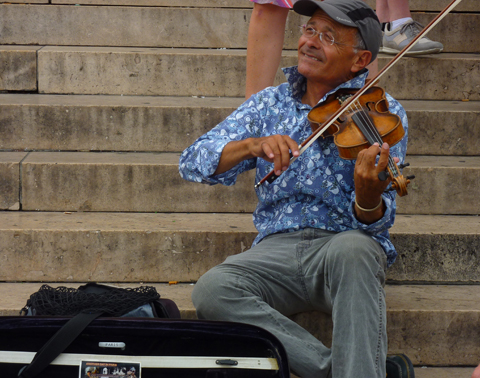
As we approached, I noticed a violinist on the steps, playing very well. He invited me to sit next to him, and so I did. He seemed so friendly, and his music was nice.


An equestrian statue of Joan of Arc stands in front of the basilica

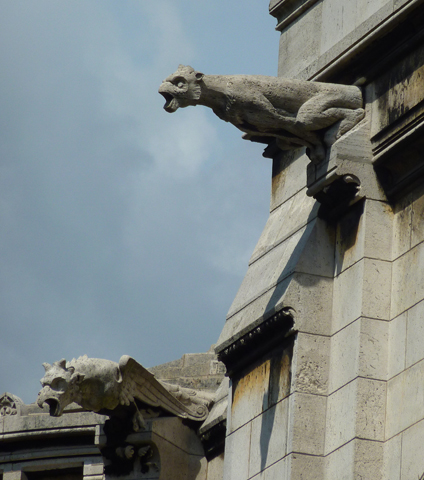
Flying buttresses and gargoyles were popular in church building at this time.

I wondered why this door and only this door was painted red.

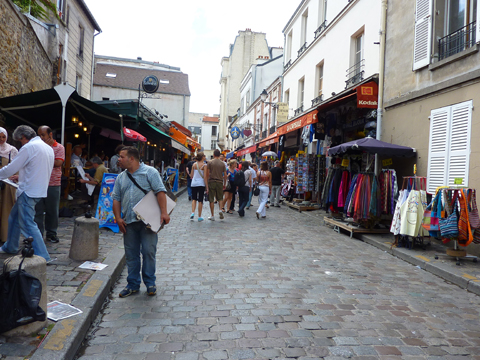
This village seemed to me how a small French village should. The cobblestones, the small shops with their wares spilling out into the street, and even some horse-drawn carriages spoke of a small French town. There was a great deal of art work for sale here at amazing prices.

Saint Michel slays the dragon

Another violinist had set up, but I preferred the music of the first man.
Boat Ride on the Seine
Tuesday, July 13
 |
ll of us wanted to take a boat ride on the River Seine, and since this was our last day in Paris, time was running short. To reach the Seine from our apartment, we had to walk beneath the Eiffel Tower once again. |
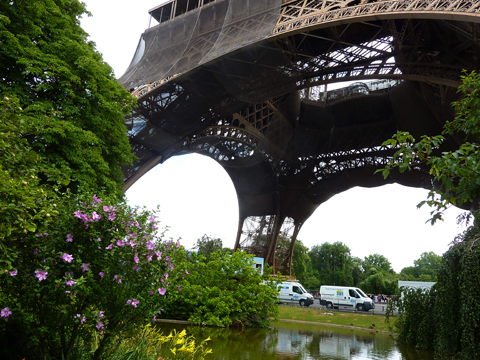
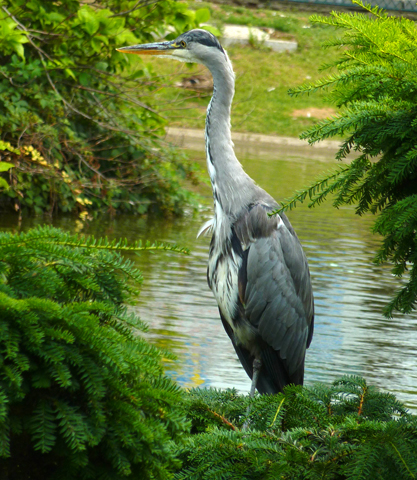
I was amazed to find the small park (very small) almost under the great tower, and there, despite the noisy large crowds, was a heron standing at the edge of a pond
As we walked down the trail to the dock we passed some French soldiers, well armed complete with rifles. I didn’t dare take a picture of them. There were people everywhere, with excitement growing, in preparation for Bastille Day, July 14th. Since that was the day we were scheduled to fly home we decided to get an extra early start, to make sure to get on crowded trains and through the crowded DeGaule airport, which is difficult on ordinary days.
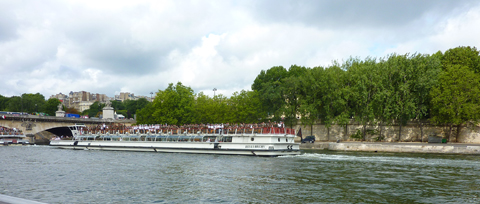
Another much larger boat loaded with 3 bands in full uniform, passed us. They were here for Bastille Day also. They cheered and waved at them and we waved back, but I don’t think we spoke, which would betray ourselves as foreigners.
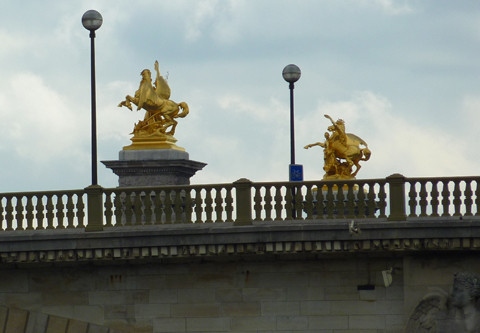
There are many bridges over the Seine. This bridge had Gilded statues standing at each end of the Pont Alexandre III (Alexander III Bridge)

Statue depicting one of the Fames restraining Pegasus, the winged horse

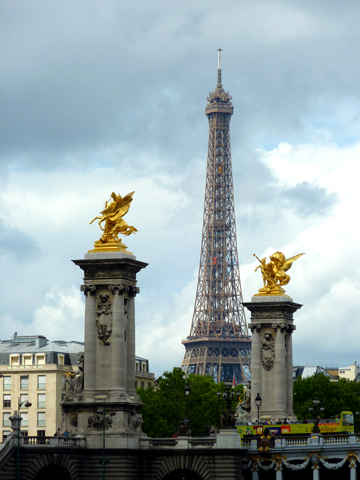
Eiffel Tower in the distance, framed by the statues of the Pont Alexandre
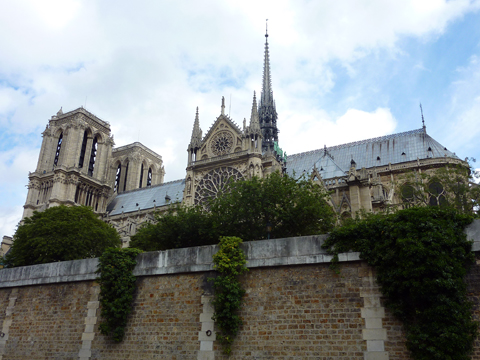
Notre Dame cathedral seen from boat deck as we floated past

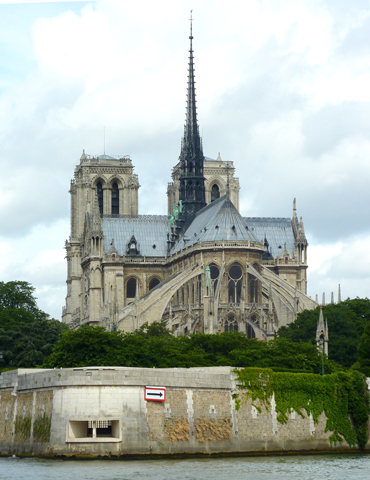
The back of Notre Dame cathedral
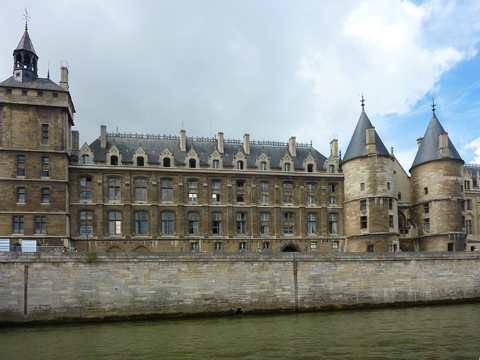
The Palais de Justice (Palace of Justice), built on the site of the former royal palace of Saint Louis, of which the Sainte Chapelle remains.
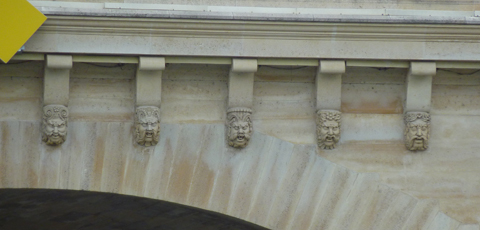
Decorations on the Pont Saint Michel, the most famous bridge in Paris
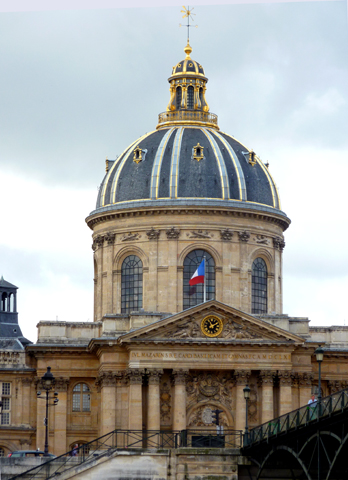
The Institut de France (The French Institute)
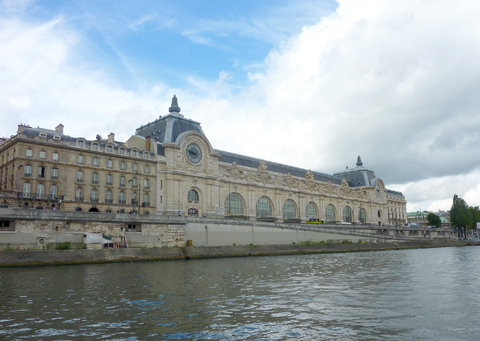
Musée d'Orsay, an old train station that has been converted into a wonderful Museum of Impressionist Art
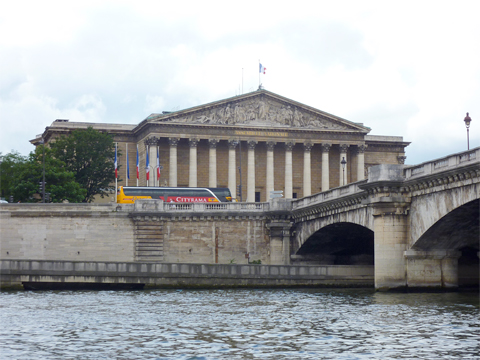
Assemblée nationale (National Assembly), the lower house of French government
Saint Sulpice Church
|
he first thing one notices about this church is that it is not finished. It does, however, have a remarkable organ, which offers Sunday morning concerts |
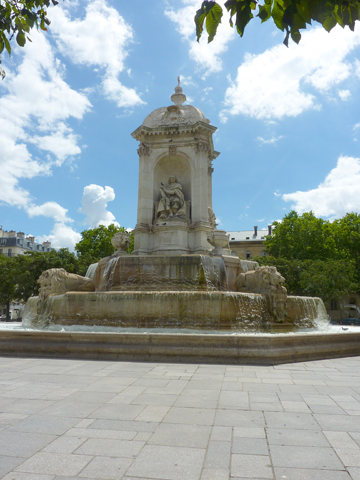
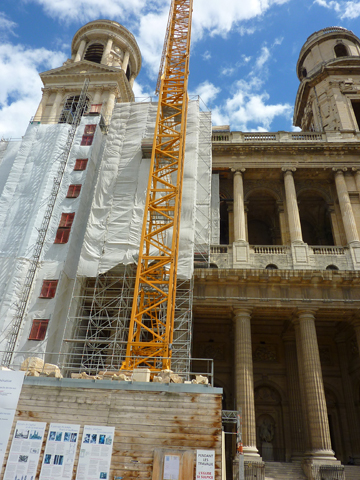
St. Sulpice is modeled after St. Paul’s Church in London, and is well on its way to being a great attraction in its own right.
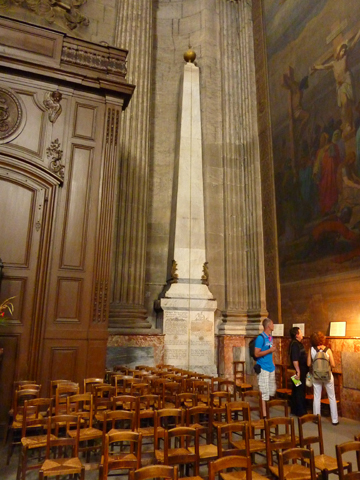
This obelisk marks the winter solstice. On Dec. 24, the sun shines through a tiny hole in the opposite window to a mark on the obelisk showing the winter solstice. Each day the sun moves down the obelisk and across the floor until at midsummer it lights up the altar.
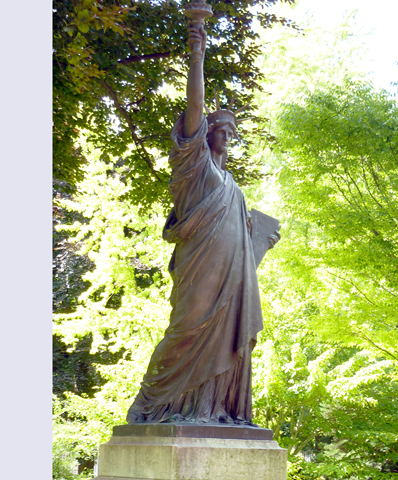
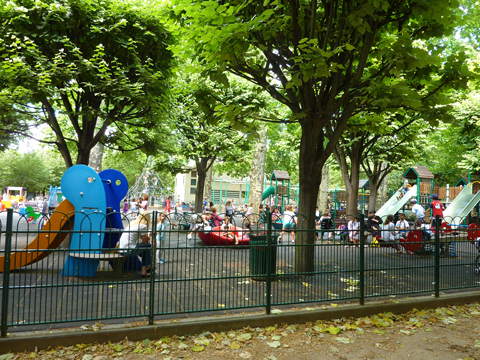
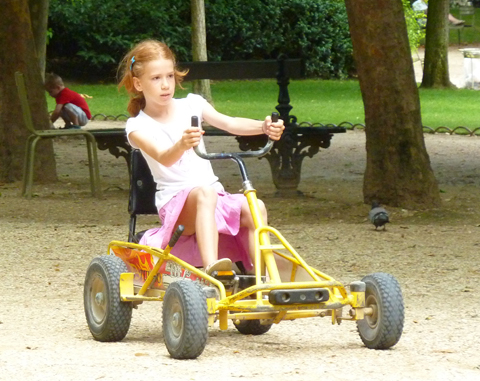
There is a extensive children’s playground in the area, with all sorts of toys for their amusement
Luxembourgh Gardens
|
hese gardens are known as the most beautiful in Paris, and a great place to watch Parisians at rest and at play. These 60 acres are the private gardens of the French Senate, which meets here in the Luxembourg Palace. Luxembourg Palace was begun in 1615 for Marie de Médici. Recently widowed by the death of Henry IV, and homesick for her native Florence, she built the palace as a re-creation of her girlhood home, the Petti Palace. |

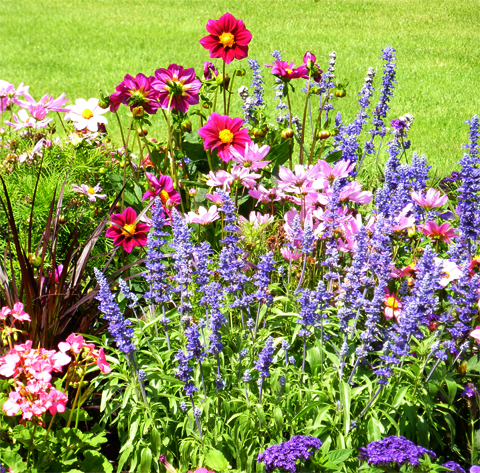
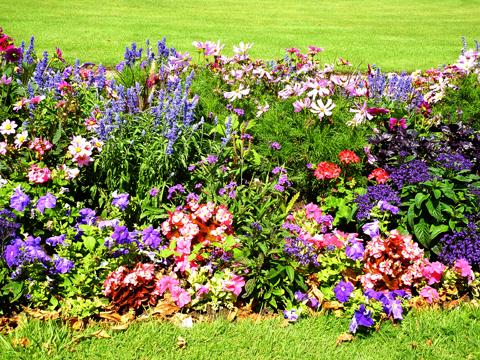
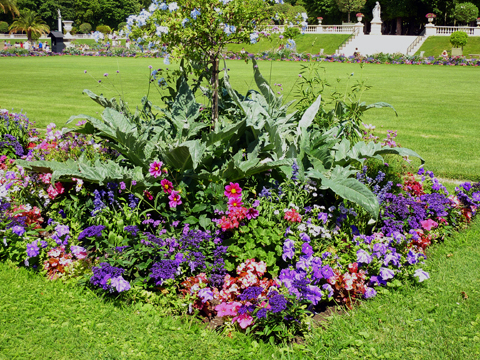
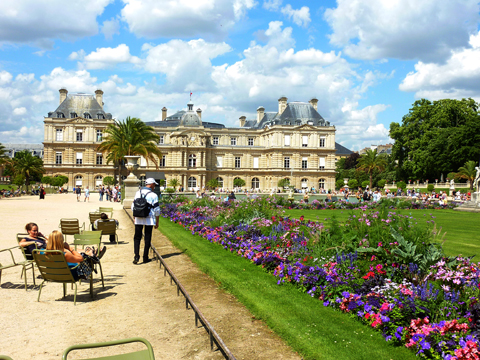
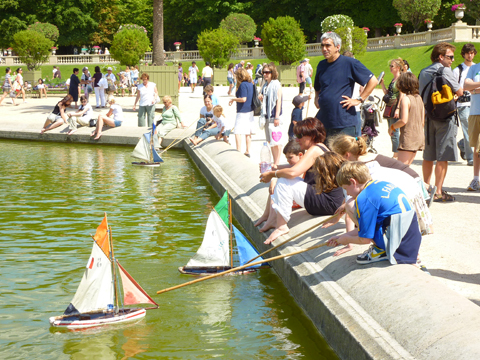
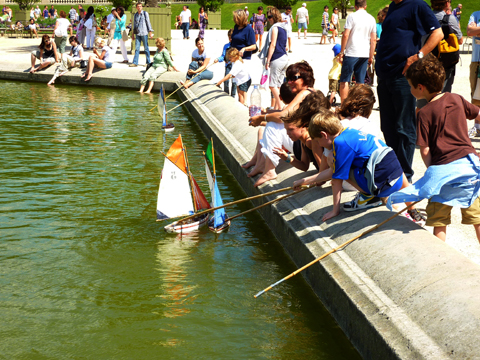
On this very hot summer day, children had gathered around the pond, playing with rented toy sailboats. There were playgrounds for them to play on swings, slides, and many other childrens’ amusements
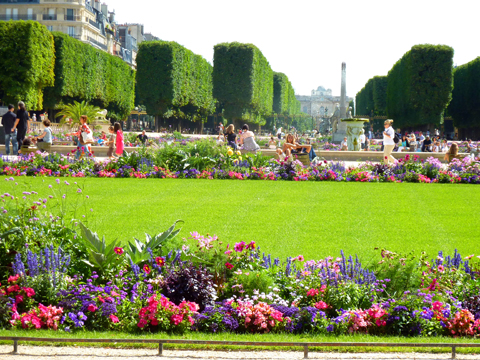
Manicured trees formed hallways to walk through
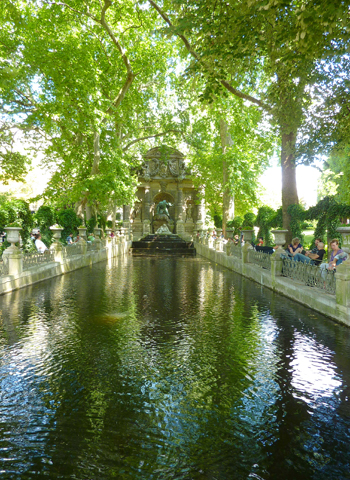
Further on was an area for adults to relax at a lovely reflecting pool
Wednesday, July 14
|
oday was our day to start HOMEWARD BOUND! Our wonderful adventure was now over and we needed to go our separate ways. In accord with instructions I had crammed my belongings into my one carry-on suitcase, and a tote bag. I was astonished when Art and Melanie agreed to accompany us to the airport, since their flight did not leave until 3 hours after ours. We expected delays because this was the big French holiday, Bastille Day, and all sorts of celebrations would be taking place, much as we do on July 4th. We found the trains crowded, but not much more so than usual. The problem came at DeGaulle airport. France’s population was deserting the homeland! It seemed that everyone was there. The airport is one of the most confusing in the world in good times and this was anything but good. We were pushed and shoved in every direction, the directions were written in French only, there were no attendants from whom to ask directions, and literally hundreds of other people were doing the same thing at the same time. It was a colossal mess. I would still be wandering that airport were it not for Art’s heroic gesture of carrying my bag in addition to his own two. He was tall enough that I could track him in the mobs, but it was still difficult. I am eternally grateful to him for that kindness. He did actually find the proper flight for us, and put us in the correct line, said our good-byes; and then started off to repeat the same thing with Iceland Airways. |
Eventually Lillian and I were able to board our enormous 777 and find our seats. This would be a daytime flight to Toronto. It was raining as we boarded the plane, which not a good sign. Things got worse with lightning and thunder added. We sat on the flight line for what seemed a long time, but perhaps ½ hour. Eventually the huge engines roared their full power, and we climbed through and above the clouds. I remember trying to sleep with little success.
Arriving once again in Toronto, we were dismayed to discover that once again, our bags were missing, along with those of about 15 other people. Nobody seemed to be in charge, and people were just milling around wondering what to do. It was fortunate that we had a long layover time, because we used almost all of it trying to straighten out the mess. Eventually a woman, who appeared to be a manager, took 7 of us past all the security guards, found our bags, retagged them as required, and got us through it all. I don’t think I’ll be flying through Toronto any time soon.
Meanwhile Art and Melanie also were delayed by the storm, but by the time they were ready to depart it had gotten worse, and they waited for 2 hours on the ground. When at last they reached Iceland, their plane to Seattle had already left, and there were no more flights to the US that day. The airline put them up for the night, and gave them dinner, and put them on a flight to New York and eventually Seattle the next day. Art had missed a day of work, and was charged an extra day of vacation, even though there was nothing they could have done about the flights.
Pete met us at the airport and took us to their home, where they were celebrating Roseann’s birthday. We all went out to dinner at the Olive Garden together. Patrick came the next day to pick up Lillian and take her back home, by way of Cedar Point.
Looking Back
|
lthough it might read like a frantic race; our trip was actually a wonderful opportunity to enjoy London and Paris, and especially each other. Being together as a family made everything more fun, and everyone contributed to it. Most of the time we traveled around together, although we sometimes went separate ways; and this added to the joy of the trip. |
Each of us had done considerable studying in advance, and knew the significance of what we wanted to see. I remember being amazed at seeing the real original Magna Carta, the score for the “Wedding March,” the actual Rosetta Stone and such treasures. I had never even wondered where these things might be, just assuming they had been lost to history. It was wonderful to be able to actually stand at 0°, 0 minutes and 0 seconds of latitude and realize that all places on this planet are measured from this very point – precisely from this very point.
We did a lot of laughing too, and of course, that added to the fun. I am grateful to my family for “conjuring” up this trip and including me in it. Thank you Lillian Lothamer, Melanie and Art Enyedy.