
Monday, September 18
 |
oday we were up at 4:45 AM for a 5:30 breakfast, which would get us on the road by 6:15 AM. The sunrise was poor for photography. We spent some time in the Maasai Mara Reserve and found some new (to us) animals. The first one was the waterbuck. |

Waterbuck Kobus ellipsiprymnus
I’m not totally certain about this identification, but the shape of the horns, and the white ears with black tips are sound clues
Our wide-awake driver/guide stopped at a tree, where at first we saw nothing unusual. Then he pointed out to us a Verreaux’s Eagle-owl, barely awake in its nest in the early morning light.

Verreaux’s Eagle-owl, Buba lacteus
Once again we made a try at catching the Little Bee Eater before it could fly away. It meant a quick trigger finger on the cable release.


Little Bee Eaters, caught showing their front and back views at the same time.
Along a road we found some Helmeted Guinea Fowl. I was almost surprised that we were still seeing things that were new to us.

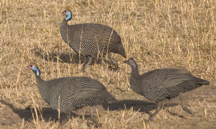
Helmeted Guinea Fowl, Numida meleagris
Some of these birds had names that sounded strange to us.

Kori Bustard, Ardeotis kori struthionculus
Others were familiar.
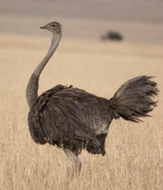
Ostrich Struthio camelus massaicus
These handsome 1-1/2 year old cheetahs were about to set off on a hunt. They were most likely brothers who stayed together after their mother left the cubs when they were old enough to fend for themselves. Cheetahs are usually solitary hunters except when they are young, or a small group of bachelors.
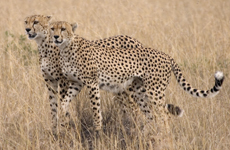

These cheetahs are setting out on a hunt.
They had selected a Cape Buffalo as their target. A lone cheetah could never hope to bring down such a large animal, but with advantage of surprise and two cheetahs, they might have a had chance.

One of the cheetahs madw a fairly close approach.
The Cape Buffalo spotted the cheetah, and they formed a wall of defense. With no chance of surprise, the cheetah no hope of bringing down a single animal.

An impenetrable living wall.
The cheetahs had been defeated. They would try another time, another place.

The cheetah goes hungry.
Serengeti National Park
|
oday was our day to visit the Serengeti National Park. It was quite a long drive from the Maasai Mara Reserve where we had been staying. |
Once we arrived, we found a huge open savannah – with no wildlife at all. Where had all the famous animals gone? I think they had all either migrated north, or gone to the Maasai Mara, because there was virtually nothing moving. Our driver/guide did take us along the prescribed route, and the scenery was beautiful, but barren of wildlife.
At one point we found some Red-necked Spurfowl.


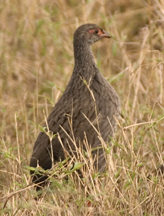
Red-necked Spurfowl, Francolinus afer
The Agamax Lizard is sometimes called the “blue-jeans lizard.”

Agamax Lizard, Agama agama
We were now in Tanzania, having crossed the border with little problem. Our drivers just went to the building, talked with the guards, and then drove on through.
Cheetahs, like many other animals, like to use termite mounds as lookout points.


Crocodiles spin while mating.


We seldom see the underside of a crocodile.
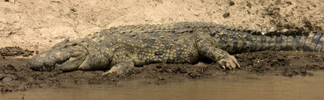
"The Crocodile On The Riverbank” is the title of a popular book.
We followed the river for some time. At one point there were many hippos.

This hippo appeared especially contented.
This bird was beautifully colored. The light-colored stripes are strands of grass in front of it.

Superb Starling, Spreo Superbus
We crossed this river on a bridge. It may have been the Mara River upstream from our campsite.

Elephant at the riverbank
We had our box lunch at a parking lot near a bend in this river not far from this viewpoint. A great many hippos were in the river there.
We turned around and headed back to Kenya, but spent quite a while at the border while our driver/guides went into the guardhouse and talked with the guards. I began to be thankful that I was carrying my passport, but eventually they came back out and got into the Land Rovers and drove off. It must be more difficult to enter Kenya than Tanzania. We were careful not to photograph the border station, lest we create trouble.
Afternoon in the Mara Reserve
 |
ack once again in the Mara we found a Leopard Tortoise just off the side of the road. My Audubon Field Guide stated that they are frequently found along roadsides, and so it was. |
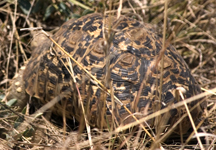
Leopard Tortoise Geochelone perdalis
Lo and behold! We found another Lilac-breasted Roller on a branch! This one was also a juvenile. They must not be as rare as I had imagined.

Lilac-breasted Roller
We discovered yet another new bird – the Martial Eagle, which was busy consuming a Guinea Fowl up in a tree.

Martial Eagle, Polemaetus bellocosus
Some birds make some unusual nests. These round balls were nests built by the weaver bird family.

Weaver bird nests
This lioness was resting quietly.


At last she stirred enough to yawn.

We found another pair of spotted hyenas, and were able to approach them more closely.


A beautiful wattled plover appeared along the side of our truck.

African Wattled Plover,
It began to rain again, so we returned to camp. There were no sunset pictures.
 Click to return to Main Menu
 Click here for the story of the previous day
 Click here for the story of the following day
Click here to send Zoe an email.