
Friday, September 15
A Visit To A Maasai Village
 |
oday was a special day. For the first time, a visit to a nearby Maasai Village outside the Mara Reserve was planned. It had been announced in the pre-trip literature, and people could sign up for it if they wished. Joe VanOs talked a lot about it, and some of the tribesmen came in full paint and costume to perform their tribal dances for us at suppertime. |
The Maasai are the native people of this part of Africa whose ancestors migrated up the Nile River around the 15th century and settled in this area. They do not grow crops, and seldom hunt wildlife, but live off their cattle, which provide all their needs. They move in search of water and good grass for the cattle as needed.
The Maasai have a long history of being ferocious fighters; so much so that when the slavers came to capture victims for their slave trade, they avoided the Maasai territory.As a result, the Massai were not decimated or wiped out as were some of the other African tribes, and remain strong to this day.
The Maasai are a dark, slender people, said to be among the tallest in the world.They certainly did appear that way to us, at least. What surprised me was how friendly they were to us. Perhaps it was because the money we paid to visit them represented probably more than their entire annual income for just one morning of welcoming us. Or perhaps they are just naturally friendly – we posed no threat to them.
We were up at 5:15 to finish breakfast by 6:00 and be on the road by 6:15. The village we were going to was a real working village where the people lived on a regular basis – not some sort of model or replica. The men came out in a procession singing a monotone chant. They all stepped in time to their own music. They formed a semi-circle facing us and began their dance, in which some men jump very high in the air.
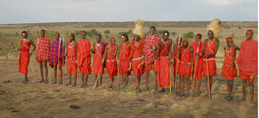
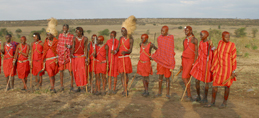
The Maasai are famous for these dances and for their ability to jump, apparently without effort. It is the result of much practice from a young age, and is considerably admired by both men and women of their culture. The jumpers appear not to bend their knees or use their arms at all, though on close inspection they do so, slightly.
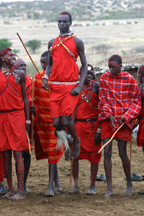

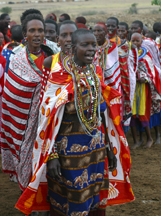
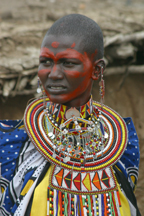
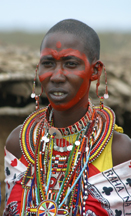
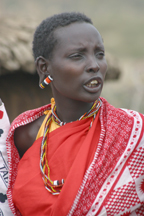
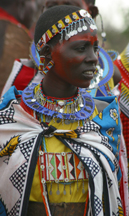
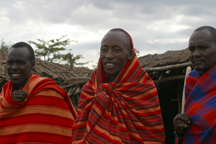
All of the Maasai men wore bright red, the color of blood; and many of the women wore red also. The women wore other colors too, and were decked out in their finest beadwork, some of which was really beautiful. Both men and women wore make-up, mostly red paint.
The women came out of the village chanting in unison, and like the men, one of them would sing out a phrase in Swahili to which the others would reply. I think I would have liked to know what they sang, but perhaps it was better that I did not.



Their village consisted of a circular wall made of brush and branches with thorns and held up with sturdy sticks for the purpose of keeping lions out at night. It also served to contain the cattle, on which they depended for survival.

The people had known for some time that we were coming, and apparently had been preparing carefully for us.

The elders sat along the wall of one of the huts watching.


After the men danced and the women sang, they opened the gate to the village and welcomed us in. They seemed eager to show us how they lived, and so began the day, by demonstrating how they milk a cow. I suspect a great many of us know how that is done, and probably a fair number of us had milked a cow ourselves, but everyone watched attentively. I noticed that the woman holding the head of the cow with one hand, was holding her baby with the other hand.
Next they demonstrated how they collect blood from the cow for drinking, by puncturing a vein in the cow’s neck, and collecting the blood in a gourd. Thankfully nobody fainted. Because there were so many of us, (approximately 40 people) they did it twice so that everyone would have a chance to see it closely.
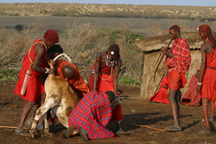
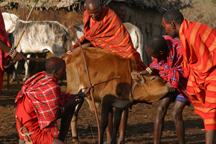
Two women sat on the ground, and stirred the blood until it coagulated. After throwing away the portion that had coagulated, the blood now flowed freely and would be mixed with the milk and drunk.


Cow’s blood being collected in gourd.

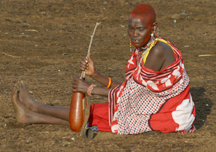
Cow’s blood being stirred to coagulate it.
The women stooped or sat on the ground in three long rows (there were more women than men), while the elders took some of the milk in their mouth and blew it out over the women in blessing (from my body to your body). The women who were thus honored appeared very pleased, but I was silently grateful not to be so blessed.


The cattle had been contained inside the compound since the previous evening; they were eager to be released, so the men ceremoniously opened a gate and let them out. Young boys were the caretakers, and separated the calves from the cows, which were taken to grazing places.


The women paraded around the village again, chanting. I noticed how well they kept in step. They must have been rehearsing this for some time, or perhaps it was part of their daily rituals.

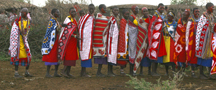
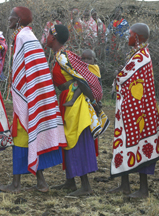
Again the men performed their dances with the high jumps. It must have been especially important when 2 men jumped in unison. They really did their best to entertain us. The elders watched all this, along with us.


Notice that this man’s hips are about the height of the other men’s shoulders. The men average well over 6 feet tall.
The next item was a re-enactment of a Maasai wedding. They were careful to let us know that it was not a real wedding, but rather what would happen if it were a real wedding. We were informed of this several times, so it must have been important to them.
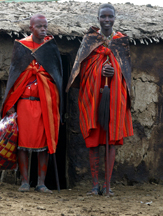
The groom emerged from his parents' home with his attendant.

Joe VanOs had clearly directed that no hint of western influence was to be seen. People carefully took off their sandals and piled them all together.
The groom and his attendant walked across the yard to the home of the bride’s family, where they were welcomed, and received a gift – a blanket in a plastic bag.
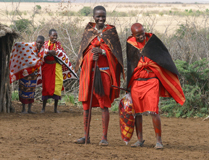
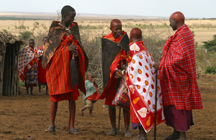

The bride’s family greeted the men. Notice the very small child in the background who pulls up his cloth wrap showing his western shorts. Who could be angry at such an innocent child?

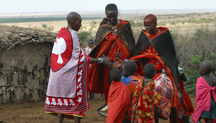
The village waits for the bride to emerge from her home.

Here’s the beautiful bride in all her finery! She walks slowly out one gate of the village, around the outside, and in through another gate. A man follows her blowing on the gourd.

The groom and his attendant await her at the other gate.

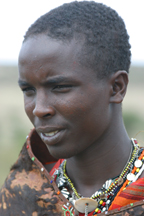
The bride’s walk around the outside of the village symbolized her leaving her own home for her husband’s home.
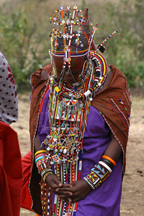

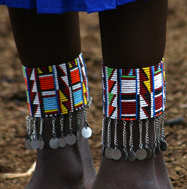
The bride’s jewelry really was beautiful, and had this been a real wedding, I’m certain she would have made it herself. She even had bracelets on her ankles!

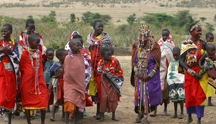
All of the children, and many of the adults, as well as members of our party followed her around the village compound.
The huts they lived in were built by the women, and were made of a circle of sticks stuck into the ground on end, side by side, and coated with a plaster made of mud and cow dung. In time, of course, it needed repair; so two of the women who must have been the most skilled home-builders demonstrated how to repair a home. They seemed to do a good job to my inexperienced eyes. (I know nothing about how to make a house out of mud and cow-dung).


Of course, the presentation would not have been complete without the marketplace. The women offered for sale their home-made jewelry, some carvings, and small trinkets as well as some larger items. I was glad to help support these hard-working people.

A SPECIAL PRESENTATION
 |
s we progressed through the morning, I saw so many interesting people whom I wanted to share with you. All of these people had agreed in advance to have their pictures taken, and had no qualms about it. Because of the language barrier, I could not ask their permission to photograph them, but I am certain they were well aware of what I was doing and willingly cooperated. Therefore all of these are “grab shots.” May they increase the mutual friendship between us all. |
The Maasai Women





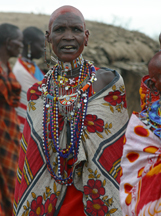


The Maasai Men




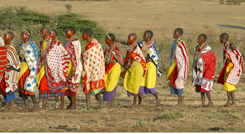
The Maasai Children and some women


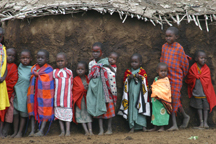

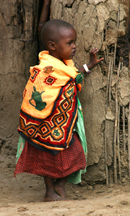


The two things that most impressed me about our visit was how cheerful all the people were, even living in what we would consider the depths of poverty and deprivation. Women have no rights at all, and are valued about the same as cattle, if even that, yet they smiled even with their eyes in a universal language. If they were acting, no one could have faked that many people for so long a time, so they must have meant it.
The second thing that impressed me was the darling little children, just like ours, only with a different color skin. They smiled, toddled and acted just like children everywhere. It was my special joy to photograph them, and share some of their pictures with you.
Although I had not originally planned to make this visit, I’m glad I went. It was a brief glimpse of a lifestyle so very different from my own, and I shall always remember it. I hope that our visit and contribution will help to improve the lives of our hosts and hostesses.
 Click to return to Main Menu
 Click here for the story of the previous day
 Click here for the story of the following day
Click here to send Zoe an email.